
The Urgent Generational Shift in Metalcasting and Forging
“I think we’ve buried more pattern makers than we’ve created,” remarked Will Shambley, a veteran foundry leader at Yankee Casting in Enfield, Connecticut.
Shambley starkly outlined the demographic cliff facing the industry today. When the retention of institutional knowledge cannot keep pace with the rapid rate of retirements, the industry requires immediate intervention.
The American manufacturing sector is undergoing a major demographic shift. Across the nation, veteran pattern makers, metallurgists, and seasoned plant engineers are reaching retirement age. These departures also mean the loss of the nuanced expertise that keeps shop floors operating safely and efficiently, known as tribal knowledge.
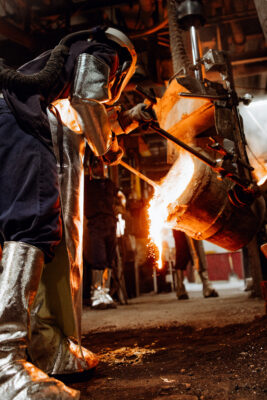
A number of Yankee Casting interns have gone through METAL Bootcamps and on-line training.
As decades of specialized experience exits the workforce, commercial foundries are left scrambling to backfill highly technical positions. The reality of this shifting landscape is already being felt.
“I’m not joking when I say the engineering team is going to have an average age of 22 or 25 in a couple of years,” he explained.
Bridging the Gap Between Classroom Theory and Shop Floor Reality
This is precisely where the Metallurgical Engineering Trades Apprenticeships & Learning (METAL) program provides value to the industry. METAL, led by IACMI – The Composites Institute®, and funded by the Department of War’s Office of Industrial Base Policy, was built to revitalize American manufacturing through hands-on training in casting and forging.
Supported by industry leaders and academic institutions, METAL offers K-12 outreach programming and university bootcamps, METAL introduces students and career seekers to modern metalcasting and forging careers. Participants can complete METAL’s before attending immersive, in-person bootcamps led by professional metallurgists and manufacturing experts who can share their knowledge and expertise.
Justin Pavlov, a materials science student at the University of Connecticut who currently interns at Yankee Casting, used the free METAL online training to reinforce his university coursework. Reflecting on the Level 1 modules, Pavlov highlighted the immense value of having the lessons available on demand.
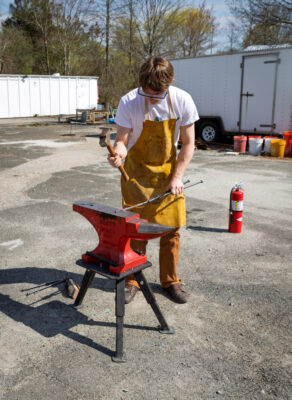
Justin Pavlov is an intern at Yankee Casting and President of the Metalworking Club at the University of Connecticut,
“For somebody going into this industry, it’s crucial information,” said Pavlov.
By providing a credentialed, structured curriculum, the METAL program ensures that young engineers step onto the shop floor equipped with the technical vocabulary and firm grasp of essential casting principles required to succeed in today’s manufacturing environment.
High-Impact Training
For commercial foundry operators, the logistical challenge of onboarding this new talent has always been present. In a live manufacturing environment, training cannot completely halt active production.
“With interns and new hires, you give them projects, but then they get downtime while they’re waiting for something,” Shambley explained. “It was really helpful for me as an employer to have content that was validated that they could read while they were in downtime, especially in their early training days,” he continued, referring to his interns that had gone through the METAL program.
METAL solves this operational friction by providing easily accessible digital modules and real-world, hands-on training. Shambley points to this flexibility as a massive operational advantage for employers managing young teams. Instead of leaving young technicians to learn solely through ad hoc observation, foundries can seamlessly integrate METAL’s curriculum into their daily workflows, maximizing the value of every shift.
Eliminating the Financial Barriers to Workforce Expansion
Traditional external technical training and commercial industry seminars are notoriously expensive. When facilities attempt to upskill an expanding roster of technicians, the cumulative cost can quickly become prohibitive, forcing management to limit training opportunities.
METAL training goes a long way toward bringing down in-house training costs. Shambley emphasized just how critical this cost-saving aspect is for a business striving to remain competitive. “METAL is really great if you’re trying to staff up and grow… 20 people times 20 classes times a hundred bucks starts to become a lot of money,” he said regarding the cost of traditional workforce training routes.
Precision Training
The effectiveness of the METAL program also lies in the highly targeted nature of its university-designed curriculum. Rather than offering broad engineering overviews, the modules dive deeply into the science and processes found in foundries every day.
For technicians actively managing complex alloys, this straight-to-the-point instruction is invaluable. Pavlov experienced this immediate relevance while working through specialized modules during his internship. 
“Magnesium was probably the most informative out of the ones I’ve taken, because it was straight to the point, a buttload of information per lecture, like especially the naming nomenclature,” Pavlov recalls. “It was all like very good background information.”
This direct alignment between the digital curriculum and the physical tasks performed on the melt deck accelerates the time it takes for a new hire to become a fully competent contributor.
Save the Foundry!
An issue close to the hearts of both Shambley and Pavlov was the University of Connecticut’s shutdown of its active student foundry.
“Up until January, UConn had a really good student foundry that got warehoused,” said Shambley, who is working to raise money to relocate the foundry equipment to a new facility. “The administration isn’t anti-foundry,” he added, noting the space was used for another department that was expanding. Shambley had recently worked to get the foundry at UConn certified by the Foundry Educational Foundation.
The Foundry closing hit Pavlov particularly hard. He credited his time at the foundry as part of the school’s Metalworking Club for his interest in working in the metal industry.
“It stunk, because a lot of the people’s junior and senior design projects were more foundry-related,” Pavlov explained. “But now, if you go into my department, it’s all plastics and PLAs and polymer work, because we don’t have access to something like a foundry.”
Pavlov is now the president of the metalworking club.

A cast human face created from a sand mold as part of a demonstration at the UConn foundry.
When students lose physical access to molten metal, the entire industry loses a vital recruitment pipeline.
Grassroots Recruiting
Shambley sees the METAL approach as the most exciting aspect of the initiative.
“What I’m excited about with METAL is you guys are building the infrastructure so that it’s easy between you and the FEF (Foundry Educational Foundation) to reach out and touch the high school teachers,” he said, “and the local kind of associate-level school professors… and give them content to help recruit.”
Ultimately, METAL is about securing the future of the American industrial base through equipping a new generation of metalworkers. To fill the rapidly emptying ranks of the manufacturing sector, industry leaders must reach intohigh schools and vocational programs to demystify the trade. The METAL program is actively building the connections required to facilitate this outreach.
As the landscape of American manufacturing continues to evolve, the demand for highly skilled, technically adept foundry workers will only grow. By capturing essential metallurgical knowledge, eliminating the financial barriers to high-quality training, and providing a structured pathway to the shop floor, METAL is ensuring that the foundational art of metal casting will actively thrive well into the future.