
Sparks flew as students from Tennessee School for the Deaf turned a university foundry into their classroom. Through METAL’s hands-on workshop, eight high school students pounded sand molds, poured molten metal and discovered their potential in metal manufacturing.
METAL, led by IACMI – The Composites Institute®, with funding from the Department of War’s IBAS Program, introduces students, career seekers and communities to the possibilities of metalcasting and forging. Through hands-on K-12 workshops, metallurgical bootcamps and apprenticeships, METAL is training a workforce that’s prepared to forge America’s future.
Advisor and TSD Transition Coordinator Daniel Jerrolds believes there’s a bright future for students who are interested in metalcasting, forging and other trade careers.
“I’ve started calling trade programs the modern day ‘Gold Rush,’” Jerrolds said. “There are jobs. The demand is there. If you look at a lot of technical programs, the job force is aging out and we’re not keeping up.”
He’s right — the need for trained metal workers is urgent. By 2033, almost 4 million manufacturing jobs could be available in the U.S. without the workforce to fill half of them.
Jerrolds, who began his career at TSD nearly 20 years ago as the construction teacher, says he has a heart for connecting students with hands-on skills. One of his first jobs was welding. Jerrolds learned on-the-job with his dad, who was a contractor for railroads in Tennessee. Today, Jerrolds shows students how to build their futures. Starting in sixth grade, TSD’s students receive aptitude testing, career counseling and vocational rehabilitation guidance to find the best path after school. In 2025, every graduating student had a plan, from employment to technical programs and college enrollment – breaking the school’s record in post-grad placement rates.
“I saw a need for what we’re doing with this program,” Jerrolds added. “The sooner we can get students in the right programs, whether it’s welding, forging and casting or plumbing or HVAC, and expose them to these skills, the better.”
Thanks to METAL, Jerrolds has one more tool in his career-planning belt. Through the program’s free, hands-on metallurgical training for K-12 schools, he’s introducing students like Tyarius (Ty) Howard to fulfilling, stable careers in metal — before they graduate.
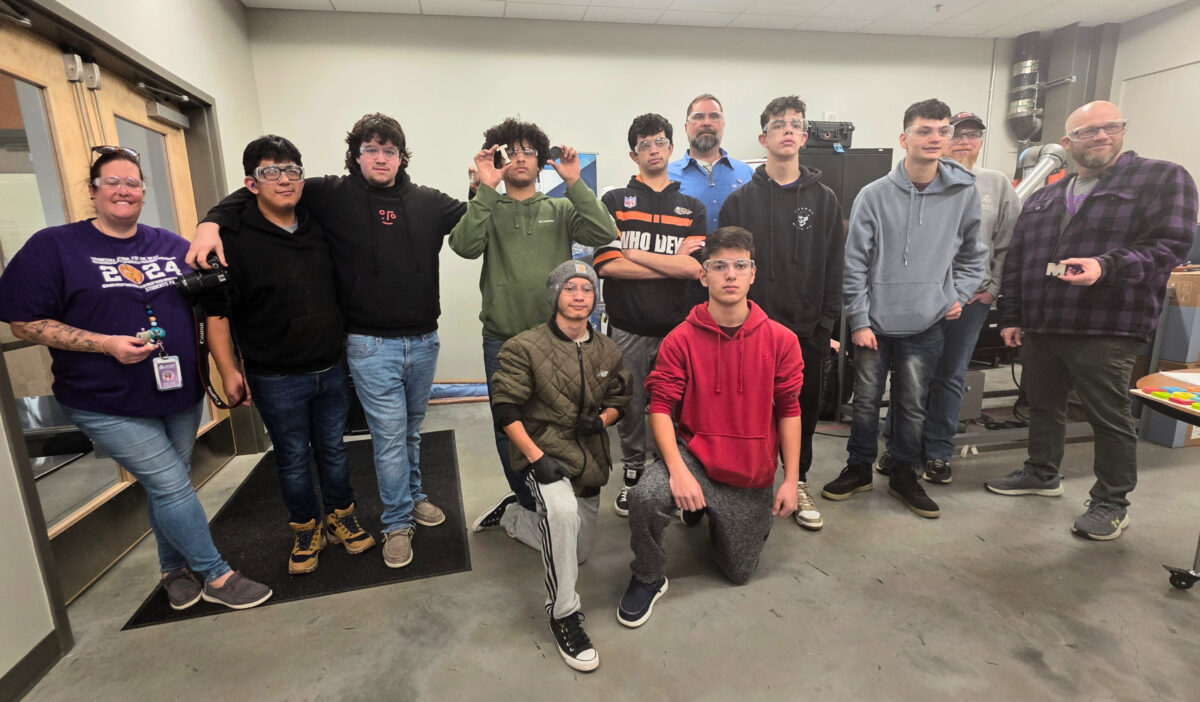
Eight students from Tennessee School for the Deaf joined metallurgists at the University of Tennessee, Knoxville to learn how to mold, cast and polish a finished casting — expanding their hands-on skills and career potential.
A Day In the Foundry
Ty Howard, 17, thought he wanted to become a welder. METAL’s workshop made up his mind.
Like Jerrolds, Howard’s dad taught him how to weld. Growing up, when the father and son retreated to the garage to work on the family car, Howard watched his father’s torch throw bright electric arcs.
“I was always interested in the sparks,” Howard said through a sign language interpreter. “It looked fun, so I started to learn and see how to make different shapes and lines. That was fascinating to me. Then I started wanting to become a welder with cars.”
As metal manufacturing returns to the U.S., the nation will need 320,000 skilled welding professionals in the next three years. The field includes boilermakers, sheet metal workers, iron and steel workers, metal fabricators, welders, machine operators and more. Welders earn an average salary of $55,600, with strong opportunities for advancement.
During the half-day workshop at the University of Tennessee, Knoxville, Howard explored new ways to spark his curiosity through metalcasting and forging. Howard and his classmates learned sand casting firsthand, using wooden letters as patterns to pack sand into a hollow mold. After melting aluminum to about 1,300°F, they poured the melted metal into the mold to create their first castings.
Howard cast a solid aluminum “T,” for Ty, small enough to fit in the palm of his mother’s hand.
“Mom was like, ‘Oh, I love it. I see you did a great job and it’s a really nice shape,’” Howard recalled her reaction after the workshop. “I showed her what I did to clean up the metal,” he added, filing down the rough edges by hand.
Isaac Murray, 17, said his favorite part of the workshop was forging: heating metal to a fire-red before hammering it into a desired shape. The finishing touch? Stamping it with a METAL logo.
“I was shocked we were going to get experience with molds and casting and learn in-depth information about different kinds of metals,” Murry said through the interpreter. “It would be a great opportunity for anybody.”
For Thomas Drye, a UT research associate who led the workshop with METAL, the goal is introducing students to careers in metal manufacturing they might not know about.
“When I was in high school, there weren’t a lot of experiences like this,” Drye said. In one study, almost 60% of Gen Z said they might have been interested in manufacturing careers if they’d been exposed to related opportunities in school.
“Now the kids know, ‘I’ve done casting. I know a little bit about what this is,’” Drye said. “They have familiarity if they go into a foundry and apply for a job. There are plenty of workarounds to support them on the job today. All you need is ambition and drive.”
Introducing deaf students to metal manufacturing also means addressing a key concern for employers: workplace accessibility.
Making Manufacturing Accessible
“How do we make it safe?” is the first question manufacturers ask Dr. Linda Bryant and James Mallory at the National Technical Institute for the Deaf’s Center for Workforce Development when hiring deaf and hard of hearing employees.
Established in 2025, the center connects deaf and hard of hearing people with in-demand technical jobs through training, job placement and transition support. It also helps employers and training programs like METAL create safe, inclusive manufacturing environments.
“My mantra has always been that the deaf and hard of hearing population is an untapped resource for companies and industries with vacancies or high demand,” said Bryant, the center’s director. “Should people open their minds and accept them into positions, employers find they’re very capable and valuable to the company and the economy.”
In the U.S., about 54% of deaf people are employed, compared to 70% of hearing people, according to the National Deaf Center on Postsecondary Outcomes. The employment gap widens further for deaf people from minority racial and ethnic backgrounds.
However, accessibility in manufacturing is often possible through simple changes. Mallory, a professor and technical workforce development specialist, encourages trainers to use clear language, visual demonstrations and technology for communication when interpreters aren’t present. On the shop or foundry floor, blinking lights and mirrors can help enhance safety. In facilities built with industry best practices in mind, changes may not be needed for deaf and hard of hearing employees.
“There is no typical deaf person. It’s not one size fits all,” Mallory said. “Modifications are based on the employer and the worker. A lot of times the changes are small — and if they’re good for deaf and hard of hearing people, they’re good for everybody.”
Jerrolds noted that onboarding deaf employees can feel daunting for manufacturers, which is why industry relationships and education are important.
“It’s new territory for them and they see it as a big question mark,” Jerrolds said. “That’s one reason I try to get students into work-based learning experiences and job shadowing. It’s as much for the employers as it is for the student.”
A Limitless Future in Metal
With the right tools, resources and support, the Deaf community can excel in manufacturing careers. Nathan Montoya, a career and technical education teacher at TSD, said he felt at home in METAL’s workshop alongside his students. Montoya, who is deaf, has a background in mechanical engineering.
“It’s all about exposure,” he said through the interpreter. “Let the students get their hands dirty. I want to see more of that. The industry is doing this for the students, showing them how they can have a career in this field.”
Howard has another year until graduation, but he’s already revved up to pursue a career in automotive manufacturing. He hopes to use his skills in welding, mechanics and metalcasting to build everything from cars and trucks to motorcycles and roll cages. Through METAL, Howard gained the momentum to shift his future into gear.
“I felt really great there. I never experienced anything that was a fun lab I could learn in, and I learned quite a bit,” Howard said about the workshop. “I just want the opportunity to learn and to have experience so when I go and work, I’ve learned what I need.”
Ready to cast America’s future? If you’re a teacher, school administrator, or parent interested in bringing METAL’s K-12 initiatives to your school or community, fill out our contact form.
Ignite your future in metal today: Start METAL’s free online training and visit our events page to attend the next METAL bootcamp or workshop near you.
If you are deaf or hard of hearing and interested in new career opportunities — or you’re an employer looking to hire talented, motivated workers — the NTID Center for Workforce Development can help you get started. Visit the NCWD website or email NCWD@rit.edu to learn more.