
The first time Marisa Holding heard about Cast in Steel, an upperclassman walked into the University of Wisconsin–Madison holding what looked like a spear. Not a prop. Not a replica — a real spear. He pulled an African spearhead from his backpack and explained it was for the Cast in Steel competition.
“I was lost for words,” Holding said. “What competition has students make weapons on campus that are meant to be functionally tested? I decided then that I was going to join the competition the following year.”
What is Cast in Steel?
Subscribe to Cast in Steel to see sparks fly on the Season 1 premiere, “George Washington’s Sword,” July 9 at 8:00 p.m. ET on YouTube.
Holding kept that promise, participating in 2025 and 2026 Cast in Steel – a national competition where college students test their engineering expertise by designing and casting metal tools like Thor’s hammer and George Washington’s sword from scratch. This year, 62 teams from universities across the United States came together to cast their own horseman’s axe. But the competition isn’t only about teaching tomorrow’s engineers how to make performance-ready products. For many, Cast in Steel is their first introduction to the craft and community behind modern American manufacturing.
“The primary goal of this competition is to touch the hearts of young people who’ve never realized that going into manufacturing and making castings or forgings could be thrilling, worthwhile, purposeful and meaningful,” said Raymond Monroe, executive vice president of the Steel Founders’ Society of America, the organization that hosts Cast in Steel.
Today, more than half of Generation Z, people ages 14 to 29, remain neutral or disinterested in manufacturing careers. In one survey, almost 60% of Gen Z respondents said they might have pursued manufacturing if they had access to related programs in school.
Programs like Cast in Steel and METAL, both supported through funding by the Department of War’s (DoW) Office of Industrial Base Policy, which manages investments made pursuant to the Industrial Base Fund (10 U.S.C §4817), are working to change these odds for future generations with hands-on training and real-world metalcasting experiences.
That mission comes at a critical moment for the industry. By 2033, nearly 4 million manufacturing jobs could be available in the U.S. with only enough workers to fill half the roles. When America’s manufacturing foundation is weak, its defense, energy and other critical infrastructures are left vulnerable to supply chain shortages.
“Our job is to deter a conflict from ever happening,” said Matthew Draper, the technical director for the U.S. Department of War. “To make sure that everyone in the world who is potentially our adversary knows and understands that America is ready to respond, we need people. We need a lot of people in manufacturing.”
This year, student teams from 10 of METAL’s university partners participated in Cast in Steel, including grand prize winner the University of Wisconsin–Madison.
An Axe to Grind – How to Make a Horseman’s Axe
For six months, 300 college students dedicated their time in between classes mastering the art and science of casting a horseman’s axe. They pulled all-nighters, drove hours to work with industry partners, and some like Teagan Strecker learned how to form and reshape metal for the very first time.
Strecker, a UW–Madison material sciences major, had no interest in metalcasting. In fact, no one on her Cast in Steel team, The Mad Badger Metalcasters, had attempted casting or forging before. But with mentorship from experienced Cast in Steel competitors, including Holding and Laney Zuelsdorff, Strecker joined in.
“I didn’t really know what Cast and Steel was, but they promised me it would be fun, so I decided to give it a shot,” she said.
Before firing up the foundries, university teams realized they’d need to win the battle of historical research.
A horseman’s axe isn’t exactly like an axe used for chopping wood. Rulers like Robert the Bruce, King of Scotland, were believed to use this type of axe in man-to-man combat, wielding the weapon with one hand during combat from horseback. Horseman’s axes were often outfitted with leather wrist straps for utility, langets — or narrow strips of metal — for strength, and spikes for protection. The students’ axes, meant to resemble historical accuracy, could not weigh more than 3.3 lbs or be longer than 31.5 inches.
“The most important thing a lot of teams miss is the research and narrowing down what makes a horseman’s axe, a horseman’s axe,” said Devyn Fidel, a Cal Poly Pomona manufacturing engineering major who competed in Cast in Steel for the second time this year. “It can’t be too front heavy, otherwise it’s really hard to swing.”
Turning ideas into battle-ready weapons was tough — demanding teams of mechanical engineering, materials science and manufacturing engineering technology students, plus the expertise of industry leaders.
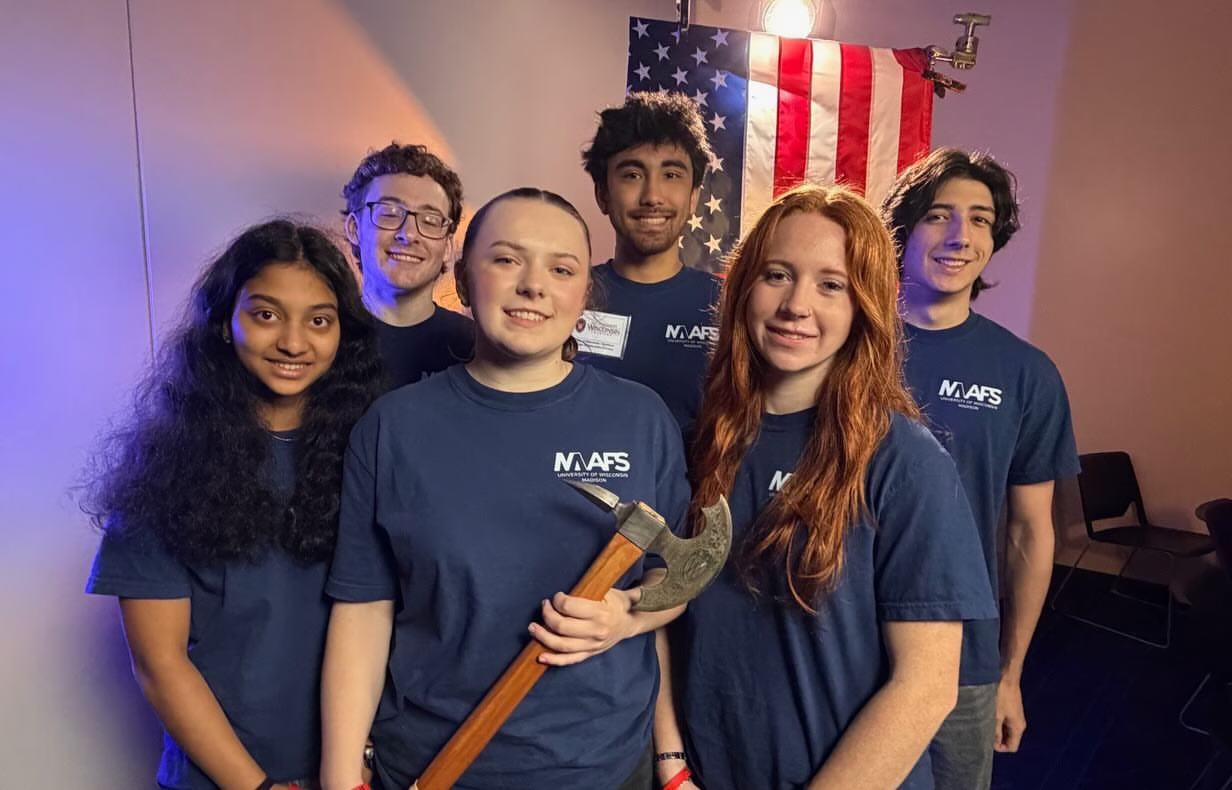
Cast in Steel 2026 Grand Prize Winners, The Mad Badger Metalcasters, from the University of Wisconsin–Madison included Malini Datta-Nemana, Evelyn Dwyer, Chase Edwardson, Mathias Gitterle, Ana Lesmeister, Simon Niemcek and Teagan Strecker. Photo courtesy of UW–Madison’s College of Engineering.
The Messy Middle
In addition to design, students had creative liberty to choose the materials they cast their axes from. Ryson Haag, a mechanical engineering student at Georgia Southern University, said his team’s axe wasn’t pretty, but they were determined to cast a tool that wouldn’t break. They decided to use a modified 8630 steel with extra chromium and experimented with heat treatments to avoid brittleness.
“Our first axe was a sledgehammer,” Haag said, forming a broad triangle with his hands. “With a 40 degree tip, it’s not cutting anything.”
To overcome design challenges, Haag learned how to use CAD simulation software like SOLIDCast to optimize mold designs and solve metal velocity problems during a pour. Practicing simulations taught him how to make effective molds for investment and sand castings, applying the engineering principles he learned in class to a real-life project.
“It saved me a lot of time because it taught me here’s what the theoretical says and here’s what better and worse ideas look like,” Haag said. “That is one of the best things I could have gotten out of Cast and Steel.”
Cast in Steel competitors are under a time crunch to complete alloy selection, mold design, casting simulations, heat treatment processes, post-processing finishing, and product testing — often for the first time. The students who participate in METAL’s bootcamps have an advantage. Through METAL’s nationwide training programs, students gain hands-on foundry experience and foundational casting and forging skills before stepping into competitions like Cast in Steel.
Steven Fedell, a 2026 mechanical engineering graduate from Penn State, Behrend, said his experience with the university’s METAL bootcamp helped prepare him to lead his team to second place in Best Sand Casting.
“I went into the competition thinking, ‘You have to consider people’s lack of experience and you only have so much time,’” Fedell said. “You could be the smartest person in the world, but if you can’t communicate your ideas to others, does it really matter?”
However, limited experience doesn’t deter students’ motivation or imagination. Daniel Branagan’s team from Michigan Technological University made the unconventional choice to cast a heart-shaped axe head from cast iron steel. The durable, heat-resistant nature of cast iron is perfect for products like skillets and wood-burning stoves, but using it to cast a functional axe was complex.
“To make cast iron strong enough, you have to go through a specific heat treating process, which is impossible to do on your own,” explained Branagan, a material sciences PhD candidate at Michigan Tech. “You need molten salt baths and carbonizing atmospheres.”
Branagan’s team worked with Aalberts Surface Technologies, a leading surface technology service provider that specializes in metal coating and heat treating for the automotive, mechanical engineering and medical technology industries. Industry partners are an essential resource during the competition, providing students guidance and facilities they may not have access to. Aalberts provided chemistry recommendations and heat treated the team’s axe in addition to funding Michigan Tech’s costs for the project.
Working with an industry partner showed Branagan how the skills and techniques he used for Cast in Steel are relevant to industrial metal manufacturing.
“This could very well turn into a job someday,” he said.
At Miller Castings, engineer Eric Cramer partnered with Cal Poly Pomona’s students. Miller Castings, a lost wax investment casting manufacturer that serves aerospace, military and commercial customers, financially supported the project, provided foundry tours, and mentored the students throughout the investment casting process.
“I don’t think they realized how much time and effort goes into every step. They learned a lot from the explanations on why their design should be tweaked to get it through the foundry,” explained Cramer, a Cal Poly Pomona alumnus who’s just as invested in the outcome of Cast in Steel as the students he works with. “I really wanted them to win.”
This year, with Cramer’s help, Cal Poly’s License to Steel team won second place for Best Investment Casting.
“What prepares people the most is being face-to-face with the industry,” said Ethan Beltran De Anda, a mechanical engineering major at Cal Poly. “You actually meet with them and talk to them. Then people in the other groups are your future peers and coworkers. It’s just a really good experience.”
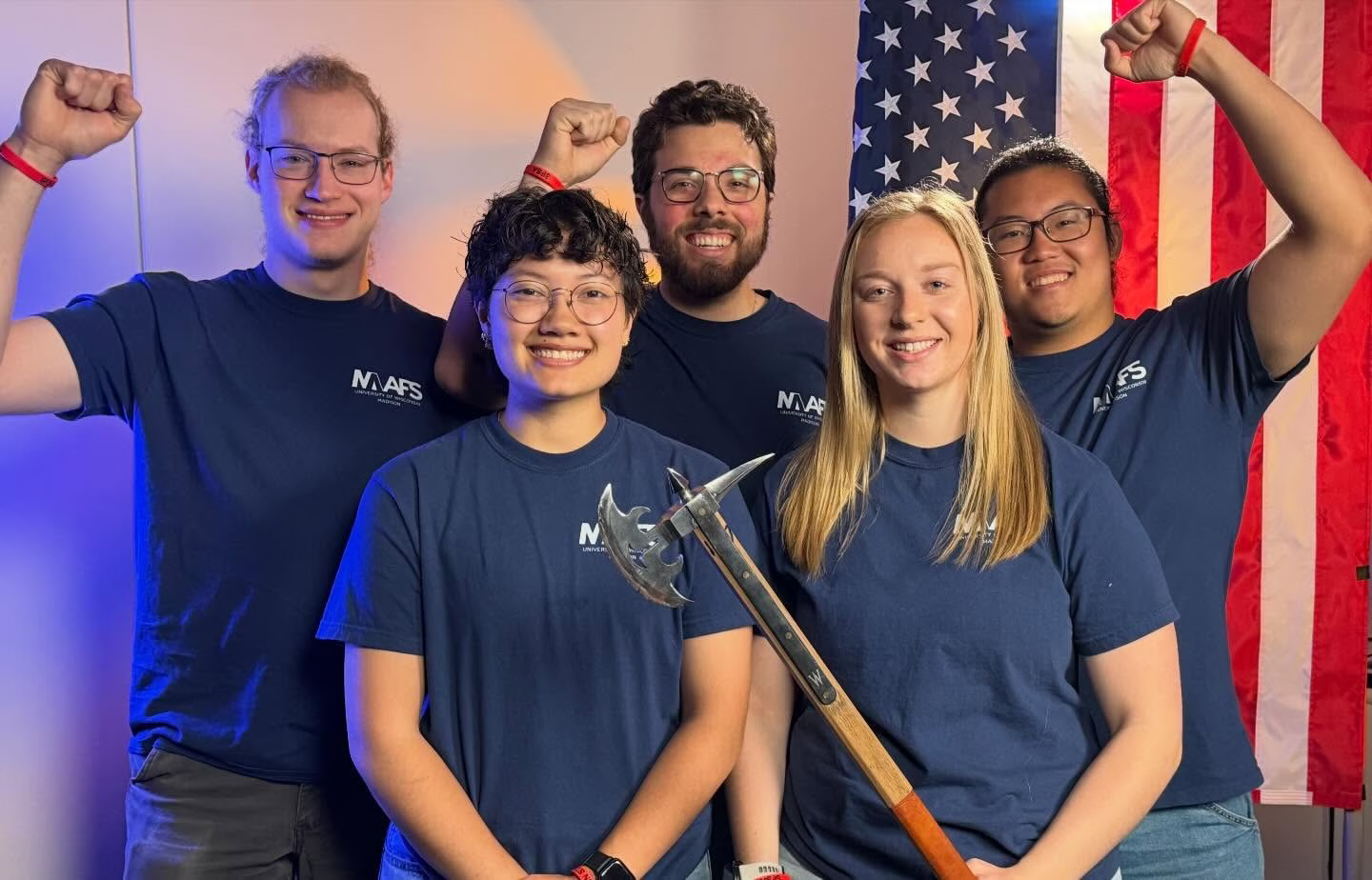
Cast in Steel runner-ups, The Mad-Town Axemen, included University of Wisconsin–Madison seniors Ivan Cermak, Dominic Chione, Marisa Holding, Wen-Yo Yen and Laney Zuelsdorff. Photo courtesy of UW–Madison’s College of Engineering.
Chopping Down the Competition
What matters most after six months of production is having a functional tool to test. For three days in April, every university team meets in Grand Rapids, Michigan for a live, high-energy showdown where industry experts judge the cast creations in a series of performance challenges.
Dr. Frank Pfefferkorn, a professor of mechanical engineering at UW–Madison, said Cast in Steel is as close to a real-world engineering project as students can get.
“From the very beginning, they have a product they have to deliver,” Pfefferkorn explained. “It’s like you’re a contract manufacturer and you have to make every decision along the way.”
“It builds their confidence that they can do this,” he added.
Before the event, teams test their weapons at home, slicing into everything from logs and Roombas to playing real-life Fruit Ninja. Then, if the axe survives, it’s ready for the Cast in Steel stage – a moment heightened by TV crews filming the competition.
“We were really nervous that the ax was going to break,” admitted Breannyn Black, a mechanical engineering major at Michigan Tech. Her team had ideas for optimization, but simply ran out of time. Ready or not, she stepped onto the testing stage and threw their axe into a knight’s suit of chainmail.
“I could not believe it took that first hit. I was so happy,” Black said. “When I hit it again, I was like, ‘Wow, I made something that does its function. It does what it’s supposed to do and it’s impressive.’ I felt pretty empowered by that.”
Performance tests included piercing a two-by-four plank of wood with its spike and cutting into a steel sheet suspended from the ceiling. The teams were not only under the scrutiny of the judges, but their peers from other universities, too.
“It was cool to see how everyone performed,” said Zachary Platt, a mechanical and manufacturing engineering technology student at the University of Northern Iowa. The spike on his team’s axe wobbled during its performance, knocking them out of the competition. “You can’t win them all, and I’m happy with how ours turned out.”
Not all the axes made it through in one piece.
“I can’t lie,” Fedell laughed, “watching some of the axes shatter spectacularly on stage was pretty neat.”
Beyond axe performance, students were judged on technical reports, casting creativity, and videos documenting their process. Longtime Cast in Steel judges Patrick Nowak and Forged in Fire’s David Baker say the competition never fails to deliver impressive ingenuity.
“I like seeing the students’ approaches to the problems they’re given and how they use whatever resources they have to try to meet the contest criteria,” Nowak said.
“The point of the competition isn’t to win or lose,” Baker added. “Don’t get me wrong, everybody’s excited to win, but it’s really about designing and manipulating material to create a tool. It’s an exciting thing to watch and it’s fun to be part of it.”
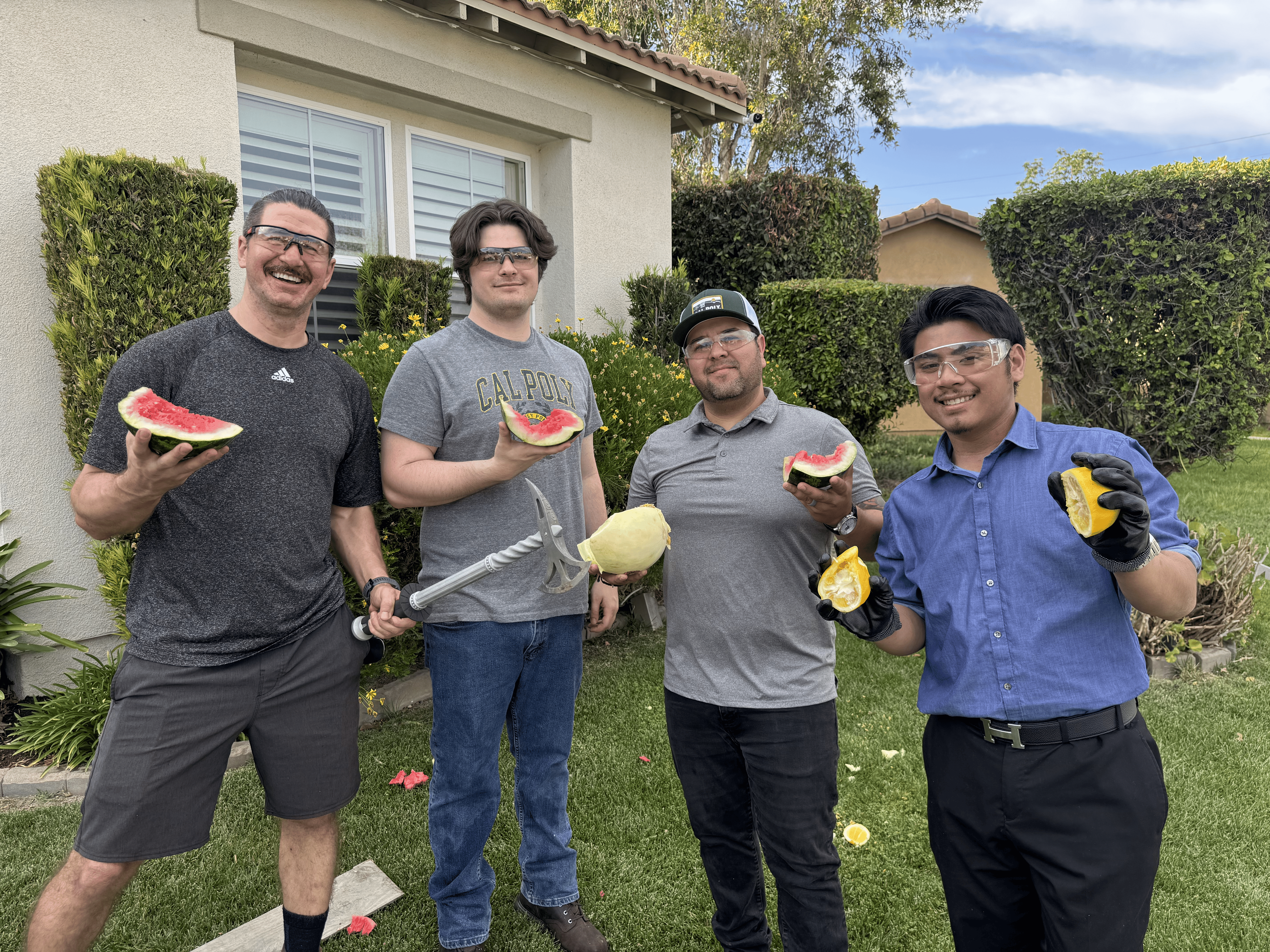
Cal Poly Pomona team “License to Steel” tests their axe out at home with real-life Fruit Ninja.
The Winning Moment
If there’s one moment Holding, Strecker and Zuelsdorff will never forget, it’s winning Cast in Steel. After three days of brutal product testing, the remaining teams stood on stage, waiting for the final results. One by one the judges named the teams who, unfortunately, did not cast the winning horseman’s axe.
“Finally, there were two teams left on stage and it was Wisconsin and Wisconsin,” remembered Zuelsdorff. “We had matching shirts, so it looked like one team up there, and we looked at each other and said, ‘We won no matter what. We’re giving it back to our university’s club.’ It was an all-around amazing moment.”
That’s exactly what the grand prize winners, The Mad Badger Metalcasters, chose to do. The team donated the entire $25,000 prize to UW–Madison’s Material Advantage and Foundry Society student chapter. Holding and Zuelsdorff’s team, The Mad-Town Axemen, earned second place — and took pride in mentoring The Mad Badger Metalcasters on an award-winning axe.
Strecker walked off the stage with more than prize money and bragging rights. She had discovered an entirely new career path.
“I was not really interested in metallurgy at all before I did Cast in Steel, and now I’m doing it in my job,” said Strecker, who’s an intern at GE Healthcare’s refractory process innovations plant. “Seeing that you can do metallurgy, especially as a woman, inspires you and shows you that metallurgy is still an exciting field to be in.”
For SFSA Executive Vice President Raymond Monroe, the students’ enthusiasm is all that matters.
“These students are the future of our industry and American manufacturing,” said Monroe. “I’m thrilled we have so many young people who are excited to be involved in our competition, and I look forward to their leadership in the future.”
Ready to cast your future in metal manufacturing? Explore METAL’s free online training and hands-on bootcamps to discover careers in metalcasting and forging. Visit our events page to find a bootcamp near you.
Watch the Season 1 premiere of Cast in Steel, “George Washington’s Sword,” July 9 at 8 p.m. ET on YouTube.