The Skills Gap Threatening America’s Foundries: How Keystone Development Partnership Plans to Fix It

Keystone Development Partnership (KDP) launched 20 years ago after a massive skills gap derailed Pennsylvania’s transportation industry. Now, America’s metal industry faces a similar situation. An unprecedented labor gap has emerged, and KDP, Jobs for the Future (JFF) and METAL are working fast to repair it. 

For the first time since WWII, America needs more metal workers. 

By 2033, there could be nearly 4 million manufacturing jobs available across the country. But without stronger training pipelines, almost half those jobs could go unfilled, threatening national defense and U.S. supply chains. 

An aging workforce and reindustrialization have lit a fire under metal manufacturers — and the nation. 

“American prosperity and security depend on the development and promotion of competence,” President Donald Trump wrote in the 2025 National Security Strategy. “Cultivating American industrial strength must become the highest priority of national economic policy.”

But the most experienced metal workers are tired of keeping the irons hot. 

Millions of Baby Boomers are retiring, or trying to. Debra Killmeyer, a KDP project consultant and former dean of workforce at the Community College of Allegheny County, says labor shortages keep metal manufacturers and their employees under strain. 

“I talk to companies with people who’ve been there 44 and 46 years about how they can’t retire because they don’t have their replacement,” Killmeyer said. 

Since 2000, workers 55 and older have been the fastest-growing age group in the workforce, according to the United States Census Bureau. In manufacturing, the shift has been more pronounced. In 2022, 40% of employers had workforces made up of at least one-quarter older workers, nearly triple the rate of two decades earlier. States with older populations, including Maine, Pennsylvania, New York and Illinois, rely more on workers who are 55 and older.

Source: https://www.census.gov/library/stories/2025/12/older-workers.html 

“That is where apprenticeships help,” Killmeyer said.

In partnership with METAL, a program led by IACMI – The Composites Institute®, with funding from the Department of War’s IBAS Program, and Jobs for the Future, KDP is forging Pennsylvania’s next generation of metal workers through registered apprenticeships. 

History Repeats Itself

This is not the first time KDP Executive Director John Tkach has watched an essential industry fall behind.

In the 1990s, Tkach worked for the Public Transit Agency in Pittsburgh as Pennsylvania’s buses underwent a technological transformation. The old General Motors “fishbowl” buses were being replaced with higher-tech Neoplan models. Before long, more than 1,000 Neoplan buses were on the roads.

“One day, buses became computers on wheels,” Tkach said. For years, the buses stayed under warranty and went back to the manufacturer for repairs. When the warranties expired, transit mechanics were suddenly responsible for maintaining machines they had never been trained to understand. 

“When they went out of warranty, these vehicles had between 500,000 and a million miles on them,” Tkach explained. “Then it was the transit worker who had to take care of it, and they didn’t have the experience or knowledge.”

Today’s metal industry faces the same challenge.

Automation is creating safer, more accessible foundries — and deepening the industry’s skills gap. More training is required to operate the robotic arms, automated pouring systems, and autonomous cranes that now do the heavy lifting. 

“It’ll always be a process with people,” said Dr. Robert Voigt, a professor of industrial and manufacturing engineering at Penn State University. “But the demands on the workforce have gone up in terms of the application of knowledge at all levels.”

In 2000, Tkach conducted a skills gap analysis for the Public Transit Agency, learning what skills the mechanics and technicians needed to repair modern buses and developed a training curriculum. Soon, Pennsylvania’s Department of Labor and Industry wanted in-depth labor research conducted for other industries. Five years later, the Pennsylvania AFL-CIO, a statewide federation of labor unions, launched the Keystone Development Partnership. 

“My passion is to ensure businesses have the skilled workers they need and workers have the opportunities,” Tkach said.

Today, KDP is the driving force behind Pennsylvania’s manufacturing ecosystem, connecting employers and workers to the training resources they need to thrive. 

Forging the Future Together

KDP has partnered with Jobs for the Future, a nonprofit transforming education and workforce systems, to strengthen manufacturing apprenticeships for nearly a decade. They’ve expanded industrial manufacturing technician programs across the state, supporting almost 900 workers in everything from metal fabrication to food processing to bio-medical production. In total, KDP has managed program administration for 3,600 apprentices. 

Brian Paterniti, the director of workforce development of The Manufacturers’ Association, said one benefit to working with KDP is its extensive community network, including union and non-union companies, local workforce development boards, job centers, training providers, and community organizations. 

KDP also offers the Registered Apprenticeship Navigator program, a registered apprenticeship program that prepares people to assist employers and other organizations in developing and registering apprenticeships across Pennsylvania. So far, KDP has trained 150 people through the program.

“Apprenticeships are not easy. It’s difficult. It’s a lot for the apprentices and the employer,” Paterniti said. “KDP, JFF and METAL make it easy. John and Deb are right there, holding the manufacturers’ hands.

METAL’s partnership with JFF and KDP is helping manufacturers do more than fill open jobs. It’s offsetting training costs and revitalizing a metal workforce that’s built to last. Training an apprentice without experience can cost nearly $9,000, according to one Department of Labor study. That doesn’t include the price of an apprentice’s travel, salary and equipment. 

Through METAL and JFF, casting, forging and plate rolling companies across the country can receive assistance in developing an apprenticeship or other work-based learning programs. This funding is also eligible for training equipment and instructor costs, curriculum development, program design and implementation, and support services for apprentices. 

“We’re seeing a growing gap in the workforce. Experienced, highly skilled workers are retiring, and too few younger workers have the training needed to step into those roles,” Tkach explained. “Employers are looking for quick fixes, but the real solution is a long‑term strategy. That’s what registered apprenticeships provide — a reliable pipeline to develop your own skilled workers.”

More than 65% of manufacturers say attracting and retaining talent is their top business challenge. Apprenticeships are solving this problem — and introducing younger generations to career options that don’t require college. According to the Department of Labor, 94% of people who complete a registered apprenticeship stay employed with average salaries of $84,000 a year. 

“Apprenticeships reduce the risk for the employer with a tried and true system,” Killmeyer said. “With METAL’s funds, I’m able to sit down with casting and forging companies and take the time to listen to each of their challenges and help them find solutions.” 

More than anything, foundries need people who are ready to be hands-on in casting America’s future.

Your Apprenticeship Starts Here

Tkach and Killmeyer have spent decades navigating workforce challenges for one reason: apprenticeships create careers — and change lives. 

KDP’s network reaches veterans, immigrants and refugees, women in trades, formerly incarcerated individuals, and people in addiction recovery through community partners and apprenticeship sponsors. With decades of experience, Tkach’s team is connecting underrepresented communities to meaningful work in metalcasting and forging.

“It’s been really nice helping populations that may not otherwise know or have been exposed to these types of careers,” Killmeyer said. “Being able to do that makes a difference.”

Tkach will never forget one apprentice he met through Pennsylvania’s Office of Vocational Rehabilitation, which helps people with disabilities enter the workforce. The apprentice, a young man, was eager to pursue a career in metal manufacturing, but needed additional support in the classroom.

“He said, ‘I’m not stupid. I learn differently. This apprenticeship program was exactly what I needed,’” Tkach remembered. 

The apprentice told Tkach he never imagined he would have a career — or a house and a family of his own. Today, he has all three. His employer is even considering him for a supervisor role.

“All because of an apprenticeship,” Tkach said. “That’s what it’s all about.”

Ready to forge a stronger workforce? Learn how JFF can help your company implement an apprenticeship or other work-based learning programs here.

Cast your career in metal. Register for our free online training, then visit our events page to attend the next METAL bootcamp near you. 

If I Can Cast, You Can Too: A First-Timer’s Experience in the Foundry

Nothing could have prepared me for my first time in a foundry.

Yet there I was at Erie Bronze and Aluminum Co., mesmerized by the sound of grinding machines, the sharp smell of metallic dust, and the giddy energy of everyone around me — all waiting in line to pour their first casting.

One metal worker, both hands wrapped around the heavy castings he cleaned, smiled warmly at the line of newcomers. “I’ve been there,” his eyes, filled with knowing anticipation, seemed to say.

Staring inside the massive ceramic crucible glowing red like a dragon’s mouth, I tried not to think about what I was about to do.  

“I’m nervous,” I said to Russell Winter, a third-generation tool and die maker still dressed in his silver protective gear, raising my voice over the foundry’s symphonic churn. 

“My arms shook the whole time,” he admitted, “mostly from nerves.” Great, I thought, staring up at the well-over-six-foot-tall man. I flexed my biceps — reminding myself they existed — attached to my spindly 5-foot-6 frame. Would I even be able to hold the ladle? Let alone manage a ladle filled with molten aluminum?

I heard the voice of Crystal Bentley from IACMI – The Composites Institute, in the back of my mind. On the flight to Pennsylvania she said, “In every class I’ve been to, someone has spilled the metal.”

Not me, not today, I prayed. Before fear held me back, someone piled a fire-resistant coat, gloves, leg and foot covers, and a massive face shield into my arms. “Your turn.” 

I stood there like a toddler as student teachers from Penn State Behrend quickly and efficiently strapped everything onto me, tucking the protective gear over exposed clothing and tugging to make sure it all fit right. The oversized stuffed gloves turned my hands into teddy bear paws. 

“How do you grip anything in these?” I said. A voice beyond my face shield responded, “Tightly.” 

My Journey to the Foundry

Getting to Erie Bronze and Aluminum Co. took two flights from Knoxville and Charlotte and a 15-minute car ride. Finding my way to metalcasting took more than a year, and that journey began with METAL.

My trade is writing. The most gratifying part of my job is listening to the stories people share with me. For a moment, I see the world through their eyes, gain an understanding of their experiences, and find the words to pass it on. Then, I find the next story.

But writing about the metal industry felt different — I haven’t been ready to move on. I’ve spent the past year writing blogs for METAL, a program funded by the Department of War’s IBAS Program to revitalize metalcasting and forging in America through hands-on K-12 workshops, metallurgical bootcamps and apprenticeships

I’ve seen the enthusiastic glow of students learning the trade; been inspired by the earnest dedication of the metallurgists reviving it; and felt the passion of recruiters who’d do anything – even babysit – to make sure apprentices succeed. 

Here’s what I’ve learned along the way: Metalcasting is doing more than offering people careers — it’s changing lives.

For example, Georgia Southern University student Robert Myers became a welder and machinist after high school. But when a car accident put his career on hold, he decided to return to school, where he discovered GSU’s metalcasting program and hands-on internships.  

“I’m so glad I found metalcasting when I did,” Myers said. “This industry is one of the blocks the world is built on. We need people who are willing to keep it alive.” 

Then there are service members like Airman Savana Ohlenburger, learning the skills needed to support U.S. aircraft and weapons production; and Barron Industries’ Michael Price, a quality coordinator who stepped into the metal industry for the first time during COVID in search of a better way to support his family. 

Again and again, I’ve heard these stories – often holding back my own tears during interviews, moved and stunned by the opportunities manufacturing jobs are offering Americans once again.

Why didn’t anyone tell me? I’ve thought. People should know these jobs exist. 

“Have you tried it before,” interviewees would ask, “pour metal?” Sheepishly, I’d shake my head no.

“You should,” they’d say. Maybe. 

America’s Blue Collar Comeback

There’s no denying the future of American manufacturing is strong. By 2033, the country could need nearly 4 million manufacturing workers to support its defense and supply chains. However, half of those jobs could go unfilled if manufacturers can’t train new employees fast, Deloitte reported

At the same time, “white collar” office jobs across tech, government and other industries continue to get slashed. In 2025, the information sector lost 5,000 jobs on average per month, according to the U.S. Bureau of Labor Statistics. These included jobs at software, publishing, broadcasting, telecommunications, data processing and web companies. Tech giants like Amazon and Meta laid off thousands in 2025 and early 2026, with more cuts likely to come. Federal employment continues to slide, down 11% since October 2024.

Some days, scrolling on LinkedIn is downright depressing. Layoff victims are now competing with artificial intelligence, corporate offshoring and a ruthlessly competitive job pool. Professionals across marketing, human resources, administrative roles and sales are begging for interviews. But the jobs just aren’t there. 

As someone in the “information” industry, diversifying my skills started to seem like a wise idea.

Breaking Metal – And Barriers

More than 20 blogs and dozens of interviews later, I decided it was my turn to experience the foundry. Doubts I’ve carried my entire life lingered: I’m not good at math. I couldn’t make more than a C in chemistry class. I have no hand-eye coordination, and I’m clumsy. When I told my family I planned to attend a casting and forging bootcamp, my sister laughed. “Can I come watch?” she said.

I share that to say, if you feel like an unlikely candidate for metal manufacturing, you’re not alone.

Thankfully, the encouragement from everyone I’d met in the industry overpowered preconceptions about myself and today’s manufacturing environments. Sure, people said it was dirty and the hours could be long. But they also said it was innovative, fulfilling and often thrilling – watching electric arcs illuminate the inside of a furnace, or flames flash up from sand molds during a pour. 

More than anything, the sparks – and camaraderie – around metalcasting and forging sounded fun. So, I took METAL’s free online training, laced up my leather boots and prepared for the experience of a lifetime.  

For two days, I joined real metal workers, manufacturing owners and industry leaders in Erie, Pennsylvania to learn new skills for the nation’s most urgent jobs. We learned how to use SolidCast and FlowCast software to simulate the time, metal quantities, and cooling patterns of pouring a casting. 

We tested the strength of iron, aluminum and other metal materials using tensile and hardness testing machines. All metals and metal manufactured-parts undergo rigorous quality testing. After all, lives depend on it. 

“Would this be the type of test they’d use on steel beams before building a bridge?” I asked, watching the Tensile machine stretch a thin strip of metal to its breaking point. A quiet anticipation filled the room. 

“Absolutely,” a student teacher responded. A minute later, the metal split with a loud “pop,” like uncorking a champagne bottle. Everyone jumped, some exclaimed, and we all laughed at ourselves.  

The group also dabbled in mold design. We used Autodesk Fusion, a software for 2D and 3D CAD modeling, to turn simple lines and dots into drawings of real machined parts. Man, I thought, customizing my creations on the screen, I could have enjoyed this. If only I had known it was an option.      

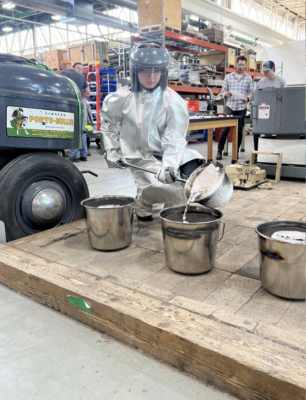
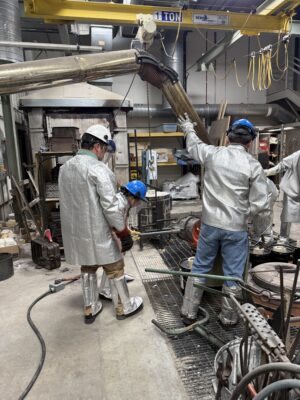
Then on a March morning, dressed in my shiny, silver suit, it was finally time to pour molten metal.

The Final Pour

“This one is going to be more complicated,” said Dr. Paul C. Lynch, an associate professor of industrial engineering, as I stepped up, death-gripping my empty ladle. I’d watched in patient awe as everyone in my group meticulously poured the lava-like aluminum into stein molds. No one had spilled a drop, and I was the last one up.  

Dr. Lynch leaned in and shouted over the machines, “We are going to need the metal to cool in your ladle before it is poured. After your ladle is filled, we’re going to put a metal cooling block in it to try to bring the temperature down before you pour.” 

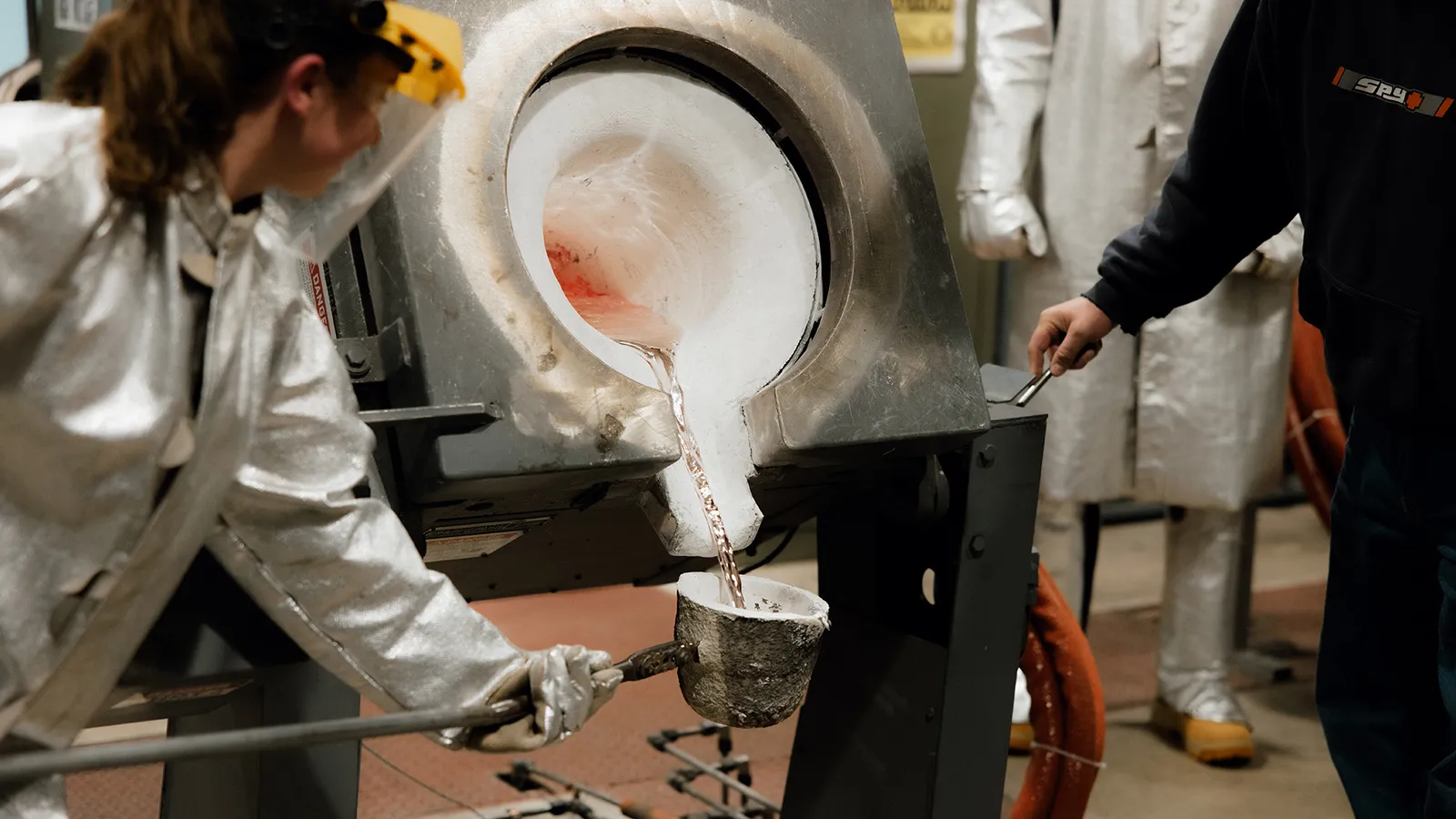
I nodded, wordlessly, and turned to the metal worker who manned the crucible in protective wear that reminded me of the X-Files. He scooped molten aluminum into his ladle and gently transferred it into mine. I turned back to Dr. Lynch, slicing the air with the ladle’s heat. 

“Swish it!” He said, and my arms attempted small, careful circles. His student came over with the cold stone and I went stock-still. He dunked it in the metal once, read the thermometer and shook his head. Again. Dunk, still not cool enough. I pinched my elbows into my abdomen and activated my core. I could not let go.  

As I began to wonder how much longer I could hold, Dr. Lynch released me, “It’s cool enough! We can pour!”

I found the molds on the floor behind me. I was pouring spiral castings instead of steins, which explained the temperature difference. Cautiously, I overturned the liquid metal into the mold’s teacup-size hole. Dr. Lynch guided me. “Faster,” he encouraged. Seconds later, I finished pouring metal into three molds and returned my leftover aluminum to the crucible. 

It was over – and the metal didn’t spill! My fears of tripping and setting the foundry on fire slipped away.

I returned to my group like a champion. Exhilaration and a sense of accomplishment clung to the warm air. We had all faced our fears. We overcame stigmas, passed down from parents and grandparents, about manufacturing work. We looked beyond gender, age and education to learn something new. We got our hands dirty. We took part in a process that civilizations are built on

And, much like any rat pack, we were sorry to see the moment end. 

Nothing could have prepared me for my first time in a foundry — or for my next question:

When can I do that again? 

Ready to explore a future in metal? Start METAL’s free online training and visit our events page to attend the next METAL bootcamp or workshop near you.

By: Amanda Freuler

Georgia Southern University partners with METAL to advance workforce training in metalworking and manufacturing

STATESBORO, Georgia (February 11, 2026) – The Metallurgical Engineering Trades Apprenticeship & Learning (METAL) program, led by IACMI – The Composites Institute®, is proud to announce a new partnership with Georgia Southern University to enhance and scale up industry-driven training opportunities for current and prospective metalworking and manufacturing professionals. Funded by the Department of War’s Industrial Base Analysis and Sustainment Program, METAL strengthens and diversifies the U.S. metal manufacturing workforce, focusing on casting, forging and plate rolling.

Georgia Southern’s Foundry Educational Foundation (FEF) program will implement METAL’s nationally recognized curriculum in its program, beginning with a combination of online training and immersive in-person bootcamps held at a manufacturing lab, equipped for metal melting, heat treatment and machining capabilities.

In addition to adult training, these programs will lead outreach efforts for K–12 students by offering workshops and partnering with high schools and other local and regional schools to spark early interest in metallurgical careers.

“The hands-on training students and job seekers will experience through METAL’s partnership with Georgia Southern will teach them industry-ready skills they can apply immediately,” said Lucinda Curry, METAL National Workforce Manager at IACMI. “These are high-demand, high-impact careers and exposing students to modern metalworking helps build a pipeline of talent ready to support American manufacturing and innovation.”

Upon completing online and in-person bootcamp training, participants may enter a stacked curriculum offering a menu of specialized training opportunities within METAL, allowing participants to tailor their learning experience, including an enhanced focus on automation in the casting and forging industry. 

“We are excited to partner with METAL to provide hands-on and computational learning experiences using our exceptional manufacturing facilities,” said Mingzhi Xu, Ph.D., FEF Key Professor at Georgia Southern. “By opening our foundry and laboratories to the broader community, we are proud to support METAL’s mission and help prepare the public for high-impact careers in modern metal manufacturing.”

Georgia Southern University’s partnership with METAL includes:

  • Online training, progressing to hands-on, in-person bootcamps conducted within a manufacturing lab, equipped with metal melting, heat treatment and machining capabilities
  • Execute a minimum of 12 in-person bootcamps for at least 150 participants throughout the course of its tenure
  • Host at least six open foundry nights for a minimum of 200 K-12 students
  • Foster collaborations with local high schools and community colleges. This strategic partnership will focus on integrating METAL training into their educational curriculum, enriching opportunities for students interested in metalworking and manufacturing. 
  • Participate in a comprehensive Train the Trainer initiative, which aims to equip future METAL program partner schools and training centers with the knowledge and capability to host bootcamps
  • Establish academic credit for secondary and post-secondary students and non-credit pathways including courses that can be applied to micro credentials, industry certifications, apprenticeships and degree tracks. The effort ensures alignment with industry standards while providing students with recognized certifications and future educational opportunities in metallurgy.

Georgia Southern’s addition to the METAL network strengthens a growing national network of METAL hubs, including the University of Alabama at Birmingham, The Ohio State University, Pennsylvania State University, the University of Tennessee, Knoxville, Tennessee Tech, Michigan Technological University, California State Polytechnic University, Pomona, NC State and Purdue University. Together, these institutions are revitalizing American manufacturing by delivering responsive, scalable and sustainable workforce development programs.

For more information about METAL at Georgia Southern, please contact:

Sarah Pope
Email: Sarah@piper-communications.com
Phone: 865-329-0553 

About METAL
Metallurgical Engineering Trades Apprenticeship & Learning (METAL), led by IACMI, is an industry-driven initiative aimed at providing high-quality, hands-on training in the metalworking and manufacturing sectors. The program is designed to address workforce development needs by offering comprehensive curricula in casting, forging and metallurgy, with an emphasis on automation and modern manufacturing technologies.

About IACMI
IACMI – The Composites Institute® is a national public-private partnership focused on advancing composite materials and process technologies. Supported by the U.S. Department of Energy and the Department of War, IACMI brings together over 170 members from industry, academia, and government to drive manufacturing innovation and workforce development.

About Georgia Southern University Foundry Educational Foundation Program
The Georgia Southern University Foundry Educational Foundation (FEF) Program provides hands-on education and workforce training in metalcasting. FEF Certified in 2021, the program integrates experiential learning, modern foundry practices, and industry-aligned curriculum to prepare students and professionals for careers in metal manufacturing. Through access to state-of-the-art foundry and manufacturing facilities, the program supports education, outreach, and industry engagement while contributing to the development of a skilled, industry-ready workforce.

About Georgia Southern University

Georgia Southern University, a public Carnegie Doctoral/R2 with a Carnegie Community Engagement classification, offers approximately 149 different degree programs serving nearly 31,600 students through 11 colleges on four campuses in Savannah, Hinesville, Statesboro, Swainsboro and online instruction. Founded in 1906, Georgia Southern is a leader in higher education in southeast Georgia with expert faculty and a focus on public impact research and engaging learning opportunities through knowledge and know-how that prepare our students to soar beyond and take ownership of their lives, careers and communities. Visit GeorgiaSouthern.edu.


###

METAL Is for Everyone: Finding Your Place in Metals Manufacturing

Dr. Alexandra (Allie) Glover remembers her grandfather, Douglas Glover, by his quirky inventions, from a mechanical cherry pitter to a peanut butter stirrer, and his passion for metallurgy. He was a specialist in powder metallurgy and ball bearing manufacturing, dedicating his career to improving movement in engines, industrial equipment and power tools. 

He also illuminated the pathway for his granddaughter’s career.

Douglas Glover

Today, Allie Glover is a professional metallurgist and assistant professor in materials science and engineering at her alma mater, Michigan Technological University, where her grandfather also earned his metallurgy degree.

“Metallurgy isn’t something you find out about by accident,” Glover said. “Normally, someone has a connection — a family member or friend, or they live in a community that has a forging house or metal casting foundry.”

Dr. Allie Glover

However, the connection between metals manufacturing and American communities slowly faded. When Glover’s grandfather began his career in the 1950s, the U.S. had three times more foundries, and more than 16 million Americans made a living from manufacturing. Today, metal stamping and forging businesses are declining 2.3% per year on average. By 2033, almost 4 million manufacturing jobs could be available in the U.S. without the trained workers to fill them. 

“We gave our know-how and our facilities away,” said Dr. Paul Lynch, an associate professor of industrial engineering at Penn State Behrend, referring to offshoring efforts. “We need to train people and get the know-how back.”

What was once seen as a dangerous job for manual laborers is now a high-tech, innovative field with competitive salaries for skilled engineers, technicians and foundry workers. In 2024, U.S. manufacturing workers earned more than $106,000 on average, while production workers and non-supervisors made about $61,000 and saw 4.2% annual wage growth.

“I think people still have misconceptions that the field is dirty or antiquated,” Glover said. “But it’s a very fun field to work in. I’ve found metallurgy to be incredibly welcoming and rewarding.”

Motivated to inspire the next generation of metalcasters and inventors, Glover joined METAL and professional metallurgists across the country in rebuilding America’s metal industry — one person at a time.

Metal Is for Everyone

METAL, led by IACMI – The Composites Institute®, with funding from the Department of War’s IBAS Program, is preparing a resilient, adaptable metal workforce that the nation can depend on. Through hands-on K-12 workshops, metallurgical bootcamps and apprenticeships, METAL ignites student curiosity about manufacturing while helping employers improve training practices.

“There isn’t a lot of structured training in the foundry,” explained Michelle Szymik, vice president of human resources at Wisconsin Aluminum Foundry. “You have to rely on your tenured employees to train new people who may have never even walked into a manufacturing environment before.”

From NFL pros to key players in national defense to tomorrow’s engineers, METAL makes metalcasting and forging accessible to everyone. Career seekers and industry professionals can get started with METAL’s free, self-paced online training. After learning the basics of casting design, additive manufacturing and melting processes, they’re ready for hands-on training with professional metallurgists — 3D-printing molds, pouring red-hot, molten metal and finishing their own castings. METAL also offers advanced bootcamps focused on digital casting technologies and sand science.

“The hands-on participation was amazing,” said retired NFL linebacker and entrepreneur Tim Johnson, who attended METAL’s Ohio State University bootcamp while developing his life-saving helmet technology, H.I.P. MD’s Brain Crown. “I used a ladle to pour aluminum into a mold, finished what I made, and earned a certificate in metal. If you’re looking for a metalcasting opportunity, this is the place to go.”

Bootcamp participants spend nearly a week in a foundry learning design and simulation software, discovering the chemistry of aluminum, brass and steel, and safely pouring liquid metal into molds — casting souvenirs like a stein, coins and a design of their choice.  

“There really is something for everyone,” Glover said. “If you find something that you excelled at or enjoyed, pay attention to those moments. You don’t have to be good at everything to succeed.”

Yash Babar, the youngest person to ever attend a bootcamp, decided to try the experience at Ohio State University during his summer break. Not only did he leave with an aluminum Nike sneaker he designed and cast, but with the confidence to consider a career in engineering. 

“I’m still trying to find out what I want to do in the future, and I ended up loving it,” Babar said about metalcasting. “The instructors were easy to approach and spent time explaining things. When you’re new to something, you might be shy. They make you feel like you belong here.”

Forging New Pathways Into Metal

After years of hearing her grandfather’s stories of sparks and fire, Glover tried metallurgy for the first time in a high school jewelry class. Torch in hand, she learned how to melt and bond metals, print custom designs with a rolling mill, and experimented with titanium anodizing, a process used in aerospace and defense to color-code parts. 

“I think many women are more attracted to arts or crafting spaces,” Glover said. “A lot of casting and forging programs are focused on blacksmithing, and that works for some students. But we try to have avenues for someone who might be interested from a creative arts background, too.” 

Hands-on experiences like these, Glover said, are what turn curiosity into career direction.    

“That’s how you get to see the industry,” she said. “There are so many possibilities.”

Through a partnership with the Foundry Educational Foundation (FEF), METAL supports universities nationwide with hands-on curriculum and paid internships for students pursuing metallurgy. FEF scholar Victoria Rambo was a sophomore at Virginia Tech when she began to discover how many doors foundry experience could open. Her enthusiasm led her to create replica missile fins for the National Museum of the Marine Corps, present at the American Foundry Society national conference and be featured in the book Women in Steel Volume II.

“The experience helped me with professional development and technical knowledge when I applied for the job I have now,” said Rambo, who’s an associate metallurgist at Carpenter Technology Corporation. “If you fall in love with metalcasting, give it your all because the opportunities will be there. The connections you make will be your biggest support along the way.” 

James Votava, a CNC operator engineer at C&H Precision Weapons, isn’t sure where his career would be without his hands-on internships and scholarships.

“I didn’t have the money for college,” Votava said. “I took out a couple of loans and I worked at McDonald’s, but FEF helped me get industry experience and financial support. Without these programs, metalcasting will be lost.”

The Future of Metal Is Built by Everyone

There’s never been a better time to consider a career in metals. In 2020, almost 29 million Baby Boomers retired, leaving unmanned machines and significant skills gaps across U.S. foundries. As Gen X, Millennials and Gen Z step into leadership roles, the American workforce is rapidly changing, and manufacturing is too. 

Manufacturing Works, a partner of METAL and Jobs for the Future, connects manufacturers with talent and resources to keep pace with industry trends and high-quality production. Tiffany Rashada, director of strategic marketing, said creating welcoming spaces where younger people can thrive is critical to manufacturing’s future.

“There are a ton of students coming out of high school who are not interested in the college path,” Rashada said. In 2024, more than 17 million Americans between the ages of 16 and 24 were not enrolled in school. “They want jobs where they can do hands-on learning and have a career.”

From builders and problem solvers to artists, engineers, career changers and lifelong learners, METAL Program Manager Mike Kubacki said the metal industry is for anyone who wants to make a difference in their lives — and move the nation forward. 

“Metals manufacturing needs more than one type of person, and that’s exactly its strength,” Kubacki said. “Whether someone is discovering metal for the first time, returning to the workforce, or bringing decades of experience, there is a place for them here. METAL is proving that the future of metals is built by and for everyone.”

For Glover, the metal industry has always been a place where she could be herself. With a visual mind and love for hands-on learning, metallurgy gives her a creative outlet to bring new ideas to life.

“I think it’s the same reason people craft or cook — both things I enjoy,” Glover said. “Metallurgy gives you ownership of a project and helps you build skills that apply to a lot of other careers.”

Her advice for anyone curious about metalcasting or forging is simple: try it.

“If you learn something about yourself, like what you enjoy or what you’re good at, you’ll broaden your horizons,” Glover said. “Just be open to those opportunities.”

Ready to find your place in manufacturing? Start METAL’s free online training and visit our events page to attend the next METAL bootcamp or workshop near you.

Purdue University programs partner with METAL to advance workforce training in metalworking and manufacturing

WEST LAFAYETTE, Indiana (February 3, 2026) – The Metallurgical Engineering Trades Apprenticeship & Learning (METAL) program, led by IACMI – The Composites Institute®, is proud to announce a new partnership with Purdue University engineering programs to enhance and scale up industry-driven training opportunities for current and prospective metalworking and manufacturing professionals. Funded by the Department of War’s Industrial Base Analysis and Sustainment Program, METAL strengthens and diversifies the U.S. metal manufacturing workforce, focusing on casting, forging and plate rolling.

Purdue’s School of Materials Engineering within the College of Engineering and Engineering Technology Program within the Polytechnic Institute will implement METAL’s nationally recognized curriculum in its program, beginning with a combination of online training and immersive in-person bootcamps held at a manufacturing lab, equipped for metal melting, heat treatment and machining capabilities.

In addition to adult training, these Purdue programs will lead outreach efforts for K–12 students by offering workshops and partnering with high schools and other local and regional schools to spark early interest in metallurgical careers. Purdue has been a core innovation partner with IACMI since the institute was founded in 2015, providing leadership for Design, Modeling & Simulation Technology for composites manufacturing and performance. This expanded partnership builds on that cross-collaboration of research and workforce development.

“Purdue is an exciting addition to the METAL program,” said Lucinda Curry, METAL National Workforce Manager at IACMI. “Many students and job seekers are unfamiliar with the advanced technologies and career opportunities available in metal casting and forging. We are partnering with educational institutions to showcase the dynamic, rewarding careers that these industries offer.”

“We are thrilled to partner with IACMI and the METAL program to leverage decades of Purdue investment in metal casting, heat treating and characterization across campus,” said Michael Titus, associate professor of materials engineering. “The METAL program will expand and update our capabilities across investment casting and automated foundries to bring unique training opportunities to students, job seekers and industrial partners alike.”

Ragu Athinarayanan, professor of smart manufacturing and industrial informatics, added, “The METAL program will leverage Purdue’s uniquely integrated Smart Foundry, embedding Industry 4.0 capabilities such as digital twins, advanced sensing, data analytics, robotics, and AI directly into the foundry environment. This positions Purdue as a living laboratory where metalcasting expertise and next-generation digital manufacturing technologies come together to advance productivity, sustainability, and workforce readiness.”

Upon completing online and in-person bootcamp training, participants may enter a stacked curriculum offering a menu of specialized training opportunities within METAL, allowing participants to tailor their learning experience, including an enhanced focus on automation in the casting and forging industry. 

Purdue’s Engineering and Polytechnic partnership with METAL includes plans to:

  • Develop an investment casting module with both online and in-person components, as well as an in-person smart foundry bootcamp.
  • Execute a minimum of 15 in-person bootcamps for at least 225 participants throughout the course of its tenure.
  • Hold at least 25 outreach events for a minimum of 750 K-12 students.
  • Foster collaborations with local high schools and community colleges. This strategic partnership will focus on integrating METAL training into their educational curriculum, enriching opportunities for students interested in metalworking and manufacturing. 
  • Participate in a comprehensive Train the Trainer initiative, which aims to equip future METAL program partner schools and training centers with the knowledge and capability to host bootcamps.
  • Establish academic credit for secondary and post-secondary students and non-credit pathways including courses that can be applied to micro credentials, industry certifications, apprenticeships and degree tracks. The effort ensures alignment with industry standards while providing students with recognized certifications and future educational opportunities in metallurgy.

Purdue’s addition to the METAL network strengthens a growing national network of METAL hubs, including the University of Alabama at Birmingham, The Ohio State University, Pennsylvania State University, the University of Tennessee, Knoxville, Tennessee Tech, Michigan Technological University, California State Polytechnic University, Pomona and NC State. Together, these institutions are revitalizing American manufacturing by delivering responsive, scalable and sustainable workforce development programs.

For more information about METAL at Purdue, please contact:

Sarah Pope
Email: Sarah@piper-communications.com
Phone: 865-329-0553 

About METAL
Metallurgical Engineering Trades Apprenticeship & Learning (METAL), led by IACMI, is an industry-driven initiative aimed at providing high-quality, hands-on training in the metalworking and manufacturing sectors. The program is designed to address workforce development needs by offering comprehensive curricula in casting, forging and metallurgy, with an emphasis on automation and modern manufacturing technologies.

About IACMI
IACMI – The Composites Institute® is a national public-private partnership focused on advancing composite materials and process technologies. Supported by the U.S. Department of Energy and the Department of War, IACMI brings together over 170 members from industry, academia, and government to drive manufacturing innovation and workforce development.

About Purdue School of Materials Engineering
The School of Materials Engineering (MSE) at Purdue University is a nationally recognized program offering BS, MS, and PhD degrees focused on the structure, properties, and design of materials used across industries from aerospace to biotechnology. Purdue’s MSE undergraduate program is ranked in the top 10 nationally by U.S. News & World Report, while its graduate program consistently holds a #12 national ranking, reflecting excellence in research and education. Currently, MSE is home to over 250 undergraduate students, 170 graduate students and postdoctoral researchers, and 40 core faculty members, with research and teaching spanning metals, polymers, ceramics, composites, electronic materials, and sustainable materials.

About Purdue School of Engineering Technology
The School of Engineering Technology (SOET) at the Purdue University Polytechnic Institute provides industry-ready education and high-impact research programs and offers BS, MS, and PhD degrees focused on areas such as computer engineering technology, electrical engineering technology, mechatronics and robotics engineering technology, and smart manufacturing. Purdue’s SOET talent pipeline produces graduates with engineering knowledge and practical skills who are recruited by Fortune 500 companies and startups worldwide. SOET is home to more than 1,400 undergraduate students, 170 graduate students and postdoctoral researchers, and 80 core faculty members, with research and teaching spanning manufacturing technologies, autonomous and intelligent systems, health sciences and technologies, energy, materials and sustainability, and a senior capstone course that produces new intellectual property and companies each year. 

NC State awarded Department of War-funded METAL hub to advance U.S. metals workforce

RALEIGH, North Carolina (January 14, 2026) — North Carolina State University is proud to announce a new partnership with the Metallurgical Engineering Trades Apprenticeship & Learning (METAL) to enhance and scale up industry-driven training opportunities for current and prospective metalworking and manufacturing professionals. Led by IACMI – The Composites Institute® with funding from the Department of War’s Industrial Base Analysis and Sustainment Program, METAL strengthens and diversifies the U.S. metal manufacturing workforce, focusing on casting, forging and plate rolling.

The METAL (Metallurgical Engineering Trades Apprenticeships & Learning) program is a national network of universities offering immersive bootcamps, workshops, and training modules in casting, forging, and related processes. NC State’s hub will fill a critical gap by adding powder metallurgy and powder-enabled forging to the curriculum — technologies now central to aerospace, defense, and high-performance manufacturing. 

“Integrating NC State into the METAL program amplifies our workforce development initiatives throughout the region,” said Lucinda Curry, METAL National Workforce Manager at IACMI. “Many students and job seekers don’t realize the innovation, technology, and career potential in metal casting and forging. By collaborating with educational institutions, we’re opening the door to exciting, high-impact careers in these vital industries.”

At NC State, the hub will be Co-led by Dr. Tim Horn, Associate Professor in Mechanical and Aerospace Engineering, Director of Research at the Center for Additive Manufacturing and Logistics (CAMAL), and Director of the Powder Materials Manufacturing Facility; and Dr. Gracious Ngaile, Professor in Mechanical and Aerospace Engineering and Director of the Advanced Metal Forming and Tribology Lab (AMT_Lab). Together, they bring internationally recognized expertise in powder production, additive manufacturing, and advanced forming processes.

The NC State METAL Hub will be open to the public, offering Bootcamps and Workshops — immersive training in powder metallurgy, additive manufacturing, and forging, reaching K-12, students, apprentices, and working professionals. The program will also feature the Manufacturing Road Show — a novel, weeklong immersive manufacturing statewide engagement model in which participants visit and actively work with multiple North Carolina manufacturers to experience real-world scale industrial practices.

“By leveraging NC State’s world-class facilities and expertise, we will prepare participants to meet the workforce needs of the aerospace and defense industries while ensuring North Carolina remains at the forefront of advanced manufacturing,” said Horn.

Ngaile added, “Our hub will deliver hands-on training in the science and practice of metal forming and powder metallurgy, equipping engineers and technicians with the skills to drive innovation and competitiveness.”

With this award, NC State joins leading institutions including Penn State, The Ohio State University, Michigan Tech, the University of Alabama at Birmingham, and the University of Tennessee, Knoxville as part of the METAL network. The hub underscores NC State’s commitment to advancing U.S. manufacturing competitiveness, strengthening supply chains, and training a resilient workforce.

About METAL

Metallurgical Engineering Trades Apprenticeship & Learning (METAL), led by IACMI, is an industry-driven initiative aimed at providing high-quality, hands-on training in the metalworking and manufacturing sectors. The program is designed to address workforce development needs by offering comprehensive curricula in casting, forging and metallurgy, with an emphasis on automation and modern manufacturing technologies.

About IACMI

IACMI – The Composites Institute® is a national public-private partnership focused on advancing composite materials and process technologies. Supported by the U.S. Department of Energy and the Department of War, IACMI brings together over 170 members from industry, academia, and government to drive manufacturing innovation and workforce development.

Small But Mighty: TOSOH SMD Powers Semiconductor Innovation with METAL Bootcamp

Cyler McClure has spent his career studying the ins and outs of semiconductors—microscopic metal switches that power today’s world. Now, as product engineering manager at TOSOH SMD, McClure empowers the engineers and technicians driving America’s semiconductor industry forward.

When he learned about METAL’s metallurgy bootcamp at Ohio State University from his director, Eduardo del Rio, McClure knew this was a training opportunity the team couldn’t miss.

“We thought the bootcamp would help grow the knowledge of our workforce,” said del Rio, who serves as the director of research and development at TOSOH SMD, a leading supplier of semiconductor materials in Ohio.

Built from billions of transistors, minuscule stacks of silicon and metal, semiconductors operate everything from smartphones and laptops to robotics, medical devices and GPS systems. You’d never know semiconductors exist—except for their massive impact. Semiconductors underpin more than 300 industries, including automotive, manufacturing, healthcare and U.S. defense. The technology is so far-reaching that one semiconductor job generates more than five new jobs across America’s economy.  

“Semiconductors are used in everything,” del Rio explained. “You see it in your everyday life—smart factories, smart cities, facial recognition, voice recognition, artificial intelligence. As we get into a more electronically-automated life, semiconductors need to continue progressing.” 

But semiconductor production, much like other metal products, is at risk in the U.S. 

By 2033, almost 4 million manufacturing jobs could be available nationwide, without the skilled labor to fill them. The semiconductor industry alone faces a shortage of 67,000 technicians, computer scientists and engineers—a gap that threatens America’s supply chain resilience and security.

TOSOH SMD is working to meet this demand, relying on strong materials, an innovative team and industry-wide collaboration. “We truly believe in partnering with universities and other industries to foster collaboration and growth of materials science in the U.S., especially for the semiconductor industry where TOSOH SMD is a critical supplier,” del Rio said. 

Del Rio shared METAL’s bootcamp with TOSOH SMD’s casting technicians, PhD materials engineers and managers. For McClure, it felt like the perfect opportunity to refresh his team on metal manufacturing basics and learn cutting-edge techniques for incredibly fine metalcasting. 

“I’ve always had a strong interest in materials, especially metals, so I was excited for the opportunity to revisit core concepts,” McClure said. “My goal was to gain practical insights I could bring back to support smarter design choices.”

Plus, McClure admitted, he was eager for a week spent transforming metal in the foundry. 

Back to the Basics

Led by IACMI – The Composites Institute®, with funding from the Department of Defense’s IBAS Program, METAL introduces students, career seekers and industry professionals to the possibilities of metalcasting. Through free online training and hands-on casting and forging experiences at universities nationwide, participants explore the metal industry—and pour molten metal into creations of their own. 

METAL also upskills America’s manufacturing workforce through advanced bootcamps for metallurgists and metal workers. Industry professionals start with self-paced, online modules, building their foundation in materials science. Then, with the basics covered, they’re ready to spark their curiosity in the foundry with topics like the science of sand and digital technologies for casting.

Ohio State University researcher and bootcamp lead Dr. Jason Walker said he wants people to understand how complex and diverse the world of metal manufacturing is. 

“Metalcasting is not just pouring liquid metal in a foundry,” Walker explained. “Behind every pour is an entire industry: people engineering binders and coatings, developing next-gen refractories, building high-temperature furnaces and controls, running multiphysics simulations, integrating automation and robotics, advancing additive manufacturing, inspecting parts, handling post-processing—the list goes on. The foundry floor is just one node in a much larger ecosystem that has many different needs.”

When it comes to tech manufacturing, McClure knows exactly what it takes to build a powerful semiconductor. The Ohio State alum has developed new casting techniques for metals used in transistors and refined the chemistry of aluminum for enhanced semiconductor performance. Today, his team designs metal alloys to fuel tomorrow’s groundbreaking technology.

“I love working with people. I was really excited to get into a management position so I could better support others and help train everyone to be the best version of themselves,” McClure said. 

Together McClure’s team returned to the foundations of metallurgy at The Ohio State University. Technicians and engineers each cast an aluminum stein, a brass medallion and their own lost foam casting—McClure made a candle holder for his wife. But their work wasn’t over when the metal cooled. Then the team learned the art of finishing a casting with heat treatment, CNC machining, grinding and polishing. 

“I was surprised by how much hands-on experience was offered. My favorite activity was the opportunity to pour, by hand, molten aluminum and brass, not just once, but several times each day,” McClure said. “We got to take home some really cool trinkets, which was exciting and added a sense of ownership to the experience.”

The team also learned simulation software to prevent defects in semiconductors before production even begins. Using MAGMASOFT®, bootcamp participants studied the theoretical temperature of metal as it solidifies. If the metal doesn’t solidify correctly, the casting can end up with defects like air bubble holes, resembling the inside of baked bread.     

Avoiding defects in semiconductor production is essential, McClure said. Even the smallest imperfection can lead to excessive production delays, device failure and millions in lost revenue. High-quality is a fingerprint of TOSOH SMD’s semiconductor materials, imprinted in the team’s DNA.

McClure and his colleagues took quality testing beyond simulations, too. They performed fluidity spiral tests to determine how well molten metal flows through a mold, indicating its ideal pouring temperature, and tensile tests helped measure how much stress a casting can take before it breaks. In-person testing showed the team how to bring new quality control processes back to the lab—fine-tuning metal structures to meet the demands of advanced semiconductor development.     

“This experience helped all of us step back from our daily routines and see manufacturing challenges from a broader perspective,” McClure said. “It bridged gaps between roles and encouraged a shared understanding that will strengthen our teamwork and problem-solving going forward.” 

Powering a Smarter Tomorrow 

Thanks to METAL’s bootcamp, everyone from TOSOH SMD returned home with new and refreshed skills to sharpen the company’s competitive edge. Technicians gained engineering insight to strengthen product quality; material engineers bridged theory with hands-on practice; and managers deepened collaboration—molding a manufacturing team built for the future.

Would McClure recommend the bootcamp to other managers? Absolutely. 

“Investing in this kind of training benefits not just the company, but the industry as a whole—promoting smarter manufacturing, better process control and a more unified approach to solving casting and manufacturing challenges,” he said.

As McClure motivates his team in the lab, his director, del Rio, keeps his eyes on the future of semiconductor innovation—looking for opportunities to grow TOSOH SMD’s research and people. 

“The semiconductor industry has a great future,” Del Rio said. “We just need to continue building the workforce and ecosystem to push it to its full potential.”

Ready to power the future of American manufacturing? Register for our free online training, then visit our events page to attend the next METAL bootcamp near you.

A Family Trade: David Muzzy Joins Buck Company’s Next Generation of Metal Innovators

David Muzzy still remembers his first time visiting a foundry. While his dad, Glenn Muzzy Sr., gave him a tour of Walker Machine and Foundry Corp. where he worked, Muzzy felt the heat radiating from massive induction furnaces and watched as fire-hot metal lost its form—turning into liquid, ready to become something new. 

That was the moment Muzzy imagined his future in metal. 

Muzzy, 22, followed his father’s footsteps into college, attending Glenn’s alma mater Penn State and majoring in industrial engineering. But it wasn’t until Muzzy held a ladle and poured ductile iron during his first internship that he felt his passion for metalcasting ignite.  

“I remember being able to see it all up close—looking at the molten metal flowing, the way you move it around, pouring it. It looks like you are looking into the sun,” Muzzy explained. “You get that really bright light, the flare that comes out of the ladle, and the whole reaction is really cool.” 

Every summer after his freshman year, Muzzy interned at Buck Company, a leading manufacturer of ferrous and non-ferrous castings in Lancaster, Pennsylvania. From making sand cores for molds to melting and pouring iron and aluminum to processing finished parts, Muzzy touched every phase of the casting process—or so he thought.

“I went through the entire foundry,” Muzzy said. “I did all the hard manual labor, and that experience is really rewarding. You have long days, but you finish and you feel accomplished.”

College only sparked Muzzy’s curiosity about metallurgy more. He served as vice president and president of Penn State’s American Foundry Society student chapter and received scholarships from the Non-Ferrous Founders’ Society and the Foundry Educational Foundation

By his senior year, the undergrad went from learning in the foundry to leading innovation. Muzzy knew how demanding the job could be—especially the task of manually lifting and pouring 30 pounds of metal hundreds of times a day. He could see the strain on workers and the risks that came with it. So he set out to build a safer, smarter way.

The solution? Muzzy designed a six-foot robotic arm that reaches into the furnace, retrieves the exact amount of metal for each cast, and pours it in the same spot every time. It reads project-specific codes and automates a job that once required intense physical effort.

“It has increased our production, but the real benefit is we’ve seen a massive increase in employee retention in that department,” Muzzy said. “It’s a hot, brutal environment to work in for 10 hours.”

After seeing the impact he could make, Muzzy returned to Penn State his senior year ready for a new challenge—and he found it at METAL’s metallurgy bootcamp

Preparing Tomorrow’s Workforce

At universities across the country, students, industry professionals and career seekers get a rare chance to fully immerse themselves in metalcasting. Through METAL—led by IACMI – The Composites Institute®, with funding from the Department of War’s IBAS Program—industry professionals deliver a hands-on casting and forging experience for anyone eager to explore metal manufacturing.

The free bootcamps start with a self-paced online training that introduces participants to the metal industry and its career possibilities. Advanced bootcamps for industry professionals cover topics such as the science of green sand and virtual reality, helping manufacturers optimize production.

Dr. Robert Voigt, a professor of industrial and manufacturing engineering who leads Penn State’s bootcamps, has spent more than 35 years teaching metallurgy—and witnessing generations of innovation. Automation, he said, has changed everything.  

Robots are now doing manufacturing jobs—cutting molds, pouring metal and sanding casts—that at one time required teams of people in dangerous or harsh conditions. As the industry’s capabilities have evolved, so have customer expectations. Metal workers and engineers must sharpen their skills to keep up, Voigt said. 

“Behind all that automation is strong scientific and engineering knowledge. It’ll always be a process with people, but we have to improve our practices and refine our knowledge to be able to deliver the quality that the industry needs,” he added.

For Muzzy, METAL’s bootcamp was an opportunity to learn metallurgical skills that would mold his career. He’d poured metal, but now he had a chance to finish a cast to completion. Using a CNC machine, Muzzy shaved down and perfected a small medallion he made entirely on his own. 

Muzzy also learned how to run solidification simulations, which are critical for a foundry’s quality control. Software like MAGMASOFT® help manufacturers predict how molten metal will cool, solidify and form inside a mold. Foundries use it to prevent defects, optimize designs, reduce scrap and accelerate production before they ever pour real metal. 

Both machining and simulations were concepts Muzzy never encountered in his college courses or internships. Thanks to METAL’s bootcamp, Muzzy discovered new skills and pathways in metallurgical engineering he’d never considered—or knew existed.

“Before the bootcamp, my head was just at, ‘I’m going to work in the foundry in production, molding and pouring and that’s it,’” Muzzy said. “But being able to see the other side of things and experience different aspects of the foundry made me want to go into a role where I help in different departments, offer input and have influence. It helped me see the bigger picture.”

The Next Generation of Metal

Today, Muzzy is a full-time manufacturing engineer in Buck Company’s iron foundry. He supports machine automation, ensures the right tools and heat codes are in place for production, trains colleagues across departments—and occasionally returns to the robotic pouring arm he built.

“I don’t have a boring day at work,” Muzzy said. “Every day is exciting, every day is interesting, and I really love what I do.”

His father, who’s now Buck Company’s executive vice president, couldn’t be prouder.

“David is part of a great young team we have at Buck, who all have an opportunity to be the next generation of leaders in metalcasting,” said Glenn Muzzy Sr. “I have spent my entire career in the foundry, and it’s rewarding to be a mentor for him and the team.” 

Voigt, who taught both father and son, called David Muzzy an industry success story.

“When David hit the ground after he graduated, he was ready to go—he understands the science, he understands the new technology and he understands the people,” Voigt said. 

METAL’s Penn State bootcamp reinforced Muzzy’s passion for the foundry, revealing career opportunities he never knew were there. He recommends the experience to anyone open to trying something new—and who wants to make a difference.

“Take the opportunity to hold the metal in your hands and pour it yourself,” and, he added, “don’t place yourself above anything. There are a lot of opportunities to grow if you’re willing to learn.”

Ready to shape the future of American manufacturing? Register for our free online training then visit our events page to attend the next METAL bootcamp near you.


Great Question Podcast: Forming Metal Heads: How To Address the Metals Casting and Forging Skills Gap

Check out this episode of Great Question: A Manufacturing Podcast featuring METAL Program Manager Mike Kubacki.

Manufacturers understand the skills gap: every day they recognize that do not have enough people or enough of the right people to execute the difficult and sometimes dirty, often dangerous tasks like pouring and forming molten materials, grinding or machining parts, treating and handling those parts, welding and finishing components and systems, etc. It’s more than a practical problem. It’s an economic and institutional crisis.

The Metallurgical Engineering Trades Apprenticeship and Learning program (METAL) established by the Dept. of Defense in 2024 is moving fast to resolve it, setting up and coordinating practical training in critical disciplines for metal casting and metal forging processes at seven universities, and drawing in fresh minds who ensure that knowledge and practical understanding continue to be available to engineers and investors in the decades ahead of us.

Mike Kubacki, program manager for METAL describes the program and its progress.


Anderson County Students Experience Forging Firsthand at UT Knoxville

Original source: WBIR

Students from Anderson County, Tennessee, recently visited our partners at the University of Tennessee, Knoxville (UTK) for an immersive, hands-on forging workshop. During the session, students explored the properties of metal through a series of interactive activities that connected classroom concepts with real-world applications in metallurgy and materials science.

Their first activity was clay forging, which introduced them to the behavior of metal under heat by using modeling clay to simulate how metal behaves during the forging process. Students practiced drawing out and upsetting the clay, then pressed images into their finished pieces before setting them to cure.

Next came sand casting, where students used their 3D-printed designs from school to create molds and pour molten tin, transforming their digital models into tangible cast shapes. Meanwhile, small groups took turns participating in induction forging, heating metal “lollipops” until they were red hot, then hammering their initials into them. 

Watch the full coverage here

Pouring Metal and Powering National Defense: DoD Contractors Join METAL Bootcamp

Melissa Walston and Rachel Reed have spent their careers traveling the world, learning languages and guiding U.S. diplomats across foreign nations and cultures. But when it came to navigating a foundry for the first time, they felt lost. 

In their new roles as Department of Defense contractors with Vision Point Systems, Walston and Reed support metal manufacturing projects for the Navy’s Carderock Naval Surface Warfare Center. Carderock is the Navy’s premier center for engineering, modeling and testing ships and ship systems. Its mission spans ship design, naval architecture and the strength of the structures that keep sailors safe at sea. At its core, both Carderock’s success and the future of U.S. defense rely on one critical capability: consistent, high-quality metal production.

“Metal is in everything,” said Reed, who’s a program analyst. “The Naval Service Warfare Center and other government agencies require a strong base of manufacturers who can provide the materials we need at the scale and to the specification we need—and that’s not easy.” 

Reed joined Vision Point Systems in February after 15 years managing international exchange programs and delegation visits. Her superpower? Connecting the right people and organizations, no matter where they’re from. Now Reed coordinates contracts between metal manufacturers and the Navy. But to lead this collaboration, she needed to understand the world of metallurgy.  

“When I first did an audit visit at a foundry, it was awesome, but it was also confusing,” said Reed. “The terminology was so unfamiliar to me, it was like a different language.”

Reed, who is fluent in Japanese, knew she had to approach her new job like she was preparing for a trip—immersing herself in casting, forging and manufacturing culture. Her colleague, Walston, recommended METAL’s week-long metallurgy bootcamp at Penn State University to Reed.

“I immediately started telling my coworkers, ‘you guys have to take this course.’ It will help so much because none of us came from this world,” Walston said, referring to manufacturing.  

Walston, who’s a program coordinator at Vision Point Systems, has led American ambassadors around the world, tracked missions in the U.S. Air Force, and served as an executive assistant at the White House. Her career, nothing short of a Disney World ride (she worked there, too), is now focused on reigniting the nation’s defense manufacturing capabilities.  

“I’ve spent most of my life, in one way or another, supporting my country,” Walston said. “It means a lot to me to be doing something that is directly helping our military. I know what it feels like to be one of them, waiting for a part to be fixed or made.”

Off to Bootcamp

Walston decided to try Penn State’s METAL bootcamp after her Vision Point Systems orientation, when she realized she had no idea what a Charpy was. 

“I sat in this meeting and almost every briefer brought up the term ‘Charpy.’ I kept laughing to myself saying, ‘I know they’re not talking about the pen in my purse,’” she said—they weren’t. In metalcasting, a Charpy, pronounced like “Sharpie,” is a type of test used to measure the material’s toughness when struck with sudden impact. 

Walston quickly learned “Charpy” wasn’t the only term she’d need under her belt to support the defense industry’s metal pipeline. “I thought my head was going to explode. I didn’t understand most of what I heard,” she admitted. 

An introduction to metallurgy terminology and science—from casting and heat treatment to nonferrous metals and alloys—is exactly where METAL’s online training starts. Led by IACMI – The Composites Institute®, with funding from the Department of Defense’s IBAS Program, METAL is building a highly-skilled, adaptable manufacturing workforce with K-12 workshops and hands-on bootcamps for career seekers.

As more metal workers retire, the U.S. faces a critical knowledge gap. By 2033, manufacturers could need more than 2 million additional workers to keep up with supply chain and national security needs. 

“Right this moment, we cannot entirely build a U.S. naval ship in the United States,” Walston said. “You don’t know what the future’s going to hold, and we need to be self-sufficient. If there’s a surge, we need to be able to meet that demand.” 

Through partnerships with Penn State and universities across the country, METAL bootcamps are forging the next generation of industry leaders and innovators. Walston signed up without hesitation when she learned she could support her country by melting, casting and forging metal.

For one week, Walston and Reed suited up in safety glasses and fire-resistant gear to bring the science of metalcasting to life. From designing 3D molds to melting aluminum and bronze to machining a finished part, they experienced exactly what it takes to create a casting with their own hands.

Reed said the highlight of the bootcamp was firing up the foundry furnace for her first pour. After aluminum is heated to about 1,300 degrees Fahrenheit and liquifies, participants get the rare chance to carry the ladle and pour metal into the mold themselves.

“It was so cool. I’m never going to have that opportunity again,” Reed said. “It gave me a real respect for the work that our manufacturing partners do and how complicated it can be.” 

Walston said she might have had a different career if she’d known what was possible in metal manufacturing sooner. 

“If I had been introduced to the foundry when I was in high school, that would’ve been where I wanted to be—working with my hands, getting dirty, playing with fire, and getting paid for it,” Walston said. “I was on cloud nine.” 

Both Walston and Reed returned home with their own creations—a bronze medallion and an aluminum stein—and a deeper understanding of what the Navy needs from metal manufacturers.   

The Secret Weapon to Career Success

Since graduating from METAL’s bootcamp, the contractors feel like they’re finally speaking the same language as their metallurgy and manufacturing partners. Reed said she’s not only better equipped to have technical conversations, but she knows what a foundry needs to be successful. 

“Every place is a culture, and METAL was my cultural introduction to working with manufacturers,” Reed said. “There’s a lot of time dedicated to keep a foundry running. I learned more about how they operate and the costs associated with producing a part.”

She strongly encourages anyone who supports the metal industry—or is curious about a fulfilling, well-paid career—to experience the bootcamp for themselves. 

“We need more people interested in manufacturing,” Reed said. “Programs like METAL are essential because a lot of people are afraid of what they don’t understand. If you can get hands-on experience and realize the opportunities that exist, that is the real strength of this program.”

What Walston found in the foundry was confidence. Now she asks the right questions, keeps pace in meetings, and uses her growing expertise to help safeguard America’s metal production—and its future.

“I owe so much of my progress to this course,” she said.  

Ready to cast a stronger career and a stronger America? Register for our free online training then visit our events page to attend the next METAL bootcamp near you.

Penn State Industrial and Manufacturing Engineering Professor Robert Voigt, Melissa Walston, Professor Paul Lynch and Ralph Workman celebrate Walston’s graduation from Penn State’s METAL bootcamp.

Rachel Reed graduates from METAL’s week-long, hands-on bootcamp experience with students and fellow industry professionals who expanded their skills in metallurgy.

Changing Lives: Manufacturing Works Fuels Ohio’s Metal Industry with Registered Apprenticeships

Manufacturing Works has been the right hand of Northeast Ohio’s manufacturing community for nearly 40 years. Through life-changing apprenticeships and strategic funding, the organization helps manufacturers grow their talent and produce high-quality parts faster. Now, at a pivotal time for our nation, Manufacturing Works is forging a skilled workforce for the metal industry.

Foundries today need one thing: people. More than 65% of manufacturers said attracting and retaining talent is their top business challenge, according to a 2024 National Association of Manufacturers survey. By 2033, almost 4 million manufacturing jobs will be available in the U.S., but half could go unfilled due to an unprecedented skills gap in the workforce. 

Beth Dawson, director of apprenticeship programs at Manufacturing Works, explained that the COVID-19 pandemic catalyzed the nation’s labor shortage. Before the end of 2020, almost 29 million Baby Boomers in the U.S. retired—200% more than in 2019.

“When you look at the skilled workforce in manufacturing, most of them are planning to retire,” Dawson said. “The need for new talent and knowledge transfer is critical.”

Casting Solutions to the Talent Crisis

When metal workers are in short supply, America’s strength is, too. Metalcasting, forging and rolling are vital for producing fighter jets, naval ships, weapons, and components in transportation, medical and agricultural industries.

In April, the White House issued an executive order to ensure national security and economic resilience related to critical minerals like metal and its manufactured products. 

“A strong national defense depends on a robust economy and price stability, a resilient manufacturing and defense industrial base, and secure domestic supply chains,” President Trump wrote.

Together with METAL and Jobs for the Future (JFF), group sponsors like Manufacturing Works are part of the solution. Manufacturers, who are often short on time and budget, can partner with group sponsors to manage apprenticeships and workforce development programs for them, JFF’s Director of Solutions Design and Delivery Mark Genua explained.    

“It’s an easy lift for small to mid-sized employers. They could have an apprentice the next day,” Genua said. “Instead of taking the time to develop a program, employers can do what they do best—train.”

METAL, led by IACMI – the Composites Institute and supported by the Department of Defense’s IBAS program, and JFF work with community colleges and nonprofit organizations across the country to administer apprenticeship programs for metal manufacturers. Through this partnership, casting, forging, and plate rolling companies can access up to $24,000 per year for in-person or online learning programs. The funding can cover training equipment and trainer costs, curriculum development, program design and implementation, and support services for apprentices. Manufacturing Works was awarded incentive funding from JFF through METAL earlier this year.

So far, JFF and Manufacturing Works have sponsored and supported seven forging apprentices. But this is only the beginning. Since Dawson joined Manufacturing Works in 2020, the organization’s apprenticeship programs have grown 400%—making it clear, manufacturers need help.

“I met a company with machines that can produce 30,000 parts a day,” Dawson said. “But because they don’t have the talent to run the machines, they’re only producing 14,000 parts. Think about what that does to their production.” 

Dawson works closely with her teammates Angilique Cole, workforce program and data coordinator, and Tiffany Rashada, director of strategic marketing, to connect manufacturers with apprentices—and transform metal workers’ lives.

Training Metal Workers—And Changing Lives

In Northeast Ohio, the road to a manufacturing career can feel out of reach. Many residents face hurdles that extend far beyond the foundry—from reading and transportation to the high cost of childcare. In East Cleveland, where household incomes are around $37,500—less than half the national average—families must overcome steep economic challenges.

Most apprenticeship programs take about four years to complete. But when metal workers graduate, they have the skills to support a fulfilling, in-demand career, with salaries starting at $57,500 a year, according to Manufacturing Works’ data.

That’s exactly what Manufacturing Works’ apprentice Alexandra Wagoner was looking for.

“I wanted to go into a career path that wouldn’t require a long academic education,” Wagoner said. “This is the only option for me that provides a stable career without needing a bunch of college.”


When Manufacturing Works visits high schools, Dawson said their goal is to help students and parents see the potential and career opportunities the metal industry offers.

“Their earning potential coming out of college is likely going to be lower than a journey-level person completing their apprenticeship, and with an apprenticeship, they won’t have college debt,” Dawson said. 

Cleveland is also one of the most diverse cities in Ohio. To help apprentices and metal workers find success, manufacturers need to build welcoming environments with a strong learning culture, Rashada said. 

“Most manufacturers care about employee engagement and retention,” Rashada explained. “But to even engage people that are non-traditional in manufacturing, your culture matters.”

With a deep passion for their communities, the Manufacturing Works team is dedicated to helping Ohio’s manufacturers overcome workforce challenges. Through mentorship, supervisor training, high school outreach and math- and literacy-focused pre-apprenticeships, Manufacturing Works is forging an industry where metal workers thrive.

Thanks to Cole, manufacturers can trust that their apprentices are on the track to success.

“I have to fuss at them sometimes, but it is all for the good,” she joked. “I just want them to let me know if they encounter and stumble across anything, professionally and personally. We can get over this hump together.”

Cole said the most rewarding part of her job is seeing people’s humble beginnings before finding a career in manufacturing. 

“When they get to the finish line, I’m probably more emotional than they are,” she said. “They don’t realize the difference they’ve made in their lives.”  

Ready to forge a stronger workforce? Apply for JFF’s apprenticeship incentive program here. 

Cast a new career: Register for our free online training, then visit our events page to attend the next METAL bootcamp near you.