
THE OPPORTUNITY
FEF scholarship support through the Foundry Educational Foundation’s METAL Advanced Internship Program helped Olson connect with Rowan Meadows, a Purdue University mechanical engineering student with strong potential but no prior foundry experience. Olson chose to treat the internship as more than a summer assignment. The objective was to give Rowan a structured introduction to the entire operation, real technical work, and a clear path to determine whether metalcasting could become a long-term career.
The Advanced Internship Program, supported through METAL, aims to increase students’ exposure to metalcasting by providing them with hands-on industrial experience while strengthening partnerships between universities and metalcasting companies. Funding and personal contacts are used to incentivize companies to start or expand their internship program.
METAL, led by IACMI – The Composites Institute®, and funded by the Department of War’s Office of Industrial Base Policy, was built to revitalize American manufacturing through hands-on training in casting and forging.
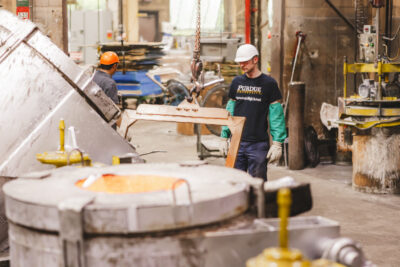
Purdue student Rowan Meadows took part in the FEF advanced internship program supported by METAL.
THE INTERNSHIP DESIGN
Rowan began with Olson’s five-day engineering internship rotation across the Core Room, Airset, Green Sand Molding, Melt and Shakeout, and Cleaning Room. The program paired floor exposure with daily observations, questions, and recap conversations so the experience connected process knowledge to engineering judgment.
Parker Schelske, Olson project engineer, served as Rowan’s sponsor. Parker created a practical development cadence: clear ownership for priorities, regular check-ins, access to technical resources, weekly reporting, and work that increased in complexity as Rowan built confidence. The arrangement gave Rowan the room to learn while maintaining accountability and ensuring school remained the priority.
THE RESULTS
Rowan’s summer moved from learning the foundry to contributing to it. He supported degasser redesign work and helped produce defect-free casting. He showed growing initiative in technical research, documentation, and problem solving, then continued that momentum by pursuing controls and automation work connected to his Purdue studies.
Olson extended Rowan a part-time project engineering role while he completes his degree. His current work includes PLC programming for the degasser project, control-cabinet planning and documentation, fabrication coordination, and research briefs. Olson’s intent is to keep building the relationship and compete for Rowan as a full-time engineer after graduation.
The development was mutual. Parker’s sponsorship became a meaningful leadership assignment, requiring him to set direction, coach a junior engineer, coordinate technical support, and create a repeatable accountability rhythm. The result was growth in both the student and the mentor.
WHY THE PARTNERSHIP MATTERS
This is the outcome Olson hopes an FEF partnership can produce: scholarship support opens a door, a deliberately designed internship turns exposure into capability, and sustained mentorship creates a real career pathway.
Rowan arrived without foundry experience. He is now contributing to Olson’s engineering work, completing a part-time role while finishing Purdue, and evaluating metalcasting as a long-term career.
Olson is grateful for the partnership and looks forward to continuing to invest in FEF students, the engineering pipeline, and mentors who help convert early potential into lasting industry talent.