Filling in the Coming Gaps: METAL and Yankee Casting

The Urgent Generational Shift in Metalcasting and Forging  

“I think we’ve buried more pattern makers than we’ve created,” remarked Will Shambley, a veteran foundry leader at Yankee Casting in Enfield, Connecticut. 

Shambley starkly outlined the demographic cliff facing the industry today. When the retention of institutional knowledge cannot keep pace with the rapid rate of retirements, the industry requires immediate intervention. 

The American manufacturing sector is undergoing a major demographic shift. Across the nation, veteran pattern makers, metallurgists, and seasoned plant engineers are reaching retirement age. These departures also mean the loss of the nuanced expertise that keeps shop floors operating safely and efficiently, known as tribal knowledge.  

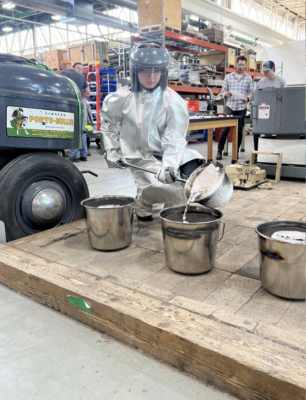
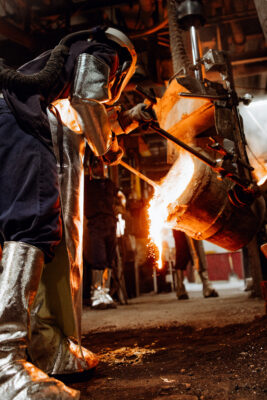
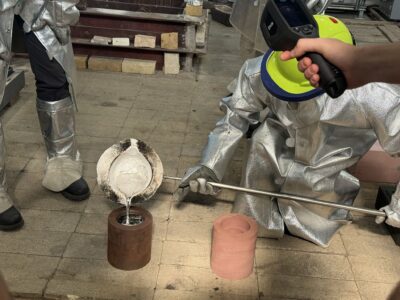
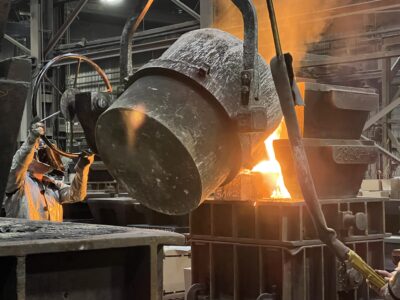
A metalworker pours molten metal from a crucible.

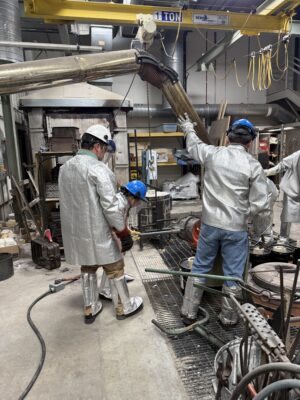
A number of Yankee Casting interns have gone through METAL Bootcamps and on-line training.

As decades of specialized experience exits the workforce, commercial foundries are left scrambling to backfill highly technical positions. The reality of this shifting landscape is already being felt.  

“I’m not joking when I say the engineering team is going to have an average age of 22 or 25 in a couple of years,” he explained.   

Bridging the Gap Between Classroom Theory and Shop Floor Reality  

This is precisely where the Metallurgical Engineering Trades Apprenticeships & Learning (METAL) program provides value to the industry. METAL, led by IACMI – The Composites Institute®, and funded by the Department of War’s Office of Industrial Base Policy, was built to revitalize American manufacturing through hands-on training in casting and forging. 

Supported by industry leaders and academic institutions, METAL offers K-12 outreach programming and university bootcamps, METAL introduces students and career seekers to modern metalcasting and forging careers. Participants can complete METAL’s before attending immersive, in-person bootcamps led by professional metallurgists and manufacturing experts who can share their knowledge and expertise. 

Justin Pavlov, a materials science student at the University of Connecticut who currently interns at Yankee Casting, used the free METAL online training to reinforce his university coursework. Reflecting on the Level 1 modules, Pavlov highlighted the immense value of having the lessons available on demand. 

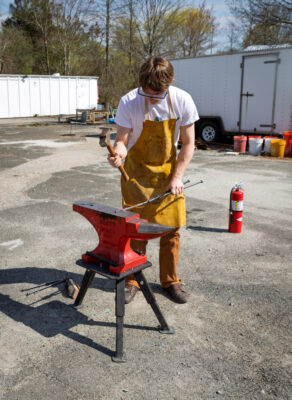
Justin Pavlov hammers a piece of metal on an anvil.

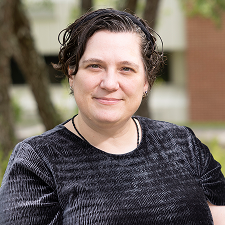
Justin Pavlov is an intern at Yankee Casting and President of the Metalworking Club at the University of Connecticut,

“For somebody going into this industry, it’s crucial information,” said Pavlov.  

By providing a credentialed, structured curriculum, the METAL program ensures that young engineers step onto the shop floor equipped with the technical vocabulary and firm grasp of essential casting principles required to succeed in today’s manufacturing environment.  

High-Impact Training  

For commercial foundry operators, the logistical challenge of onboarding this new talent has always been present. In a live manufacturing environment, training cannot completely halt active production.   

“With interns and new hires, you give them projects, but then they get downtime while they’re waiting for something,” Shambley explained. “It was really helpful for me as an employer to have content that was validated that they could read while they were in downtime, especially in their early training days,” he continued, referring to his interns that had gone through the METAL program.

METAL solves this operational friction by providing easily accessible digital modules and real-world, hands-on training. Shambley points to this flexibility as a massive operational advantage for employers managing young teams. Instead of leaving young technicians to learn solely through ad hoc observation, foundries can seamlessly integrate METAL’s curriculum into their daily workflows, maximizing the value of every shift. 

Eliminating the Financial Barriers to Workforce Expansion  

Traditional external technical training and commercial industry seminars are notoriously expensive. When facilities attempt to upskill an expanding roster of technicians, the cumulative cost can quickly become prohibitive, forcing management to limit training opportunities. 

METAL training goes a long way toward bringing down in-house training costs. Shambley emphasized just how critical this cost-saving aspect is for a business striving to remain competitive. “METAL is really great if you’re trying to staff up and grow… 20 people times 20 classes times a hundred bucks starts to become a lot of money,” he said regarding the cost of traditional workforce training routes.

Precision Training 

The effectiveness of the METAL program also lies in the highly targeted nature of its university-designed curriculum. Rather than offering broad engineering overviews, the modules dive deeply into the science and processes found in foundries every day.  

For technicians actively managing complex alloys, this straight-to-the-point instruction is invaluable. Pavlov experienced this immediate relevance while working through specialized modules during his internship.  Logo for Yankee Casting.

“Magnesium was probably the most informative out of the ones I’ve taken, because it was straight to the point, a buttload of information per lecture, like especially the naming nomenclature,” Pavlov recalls. “It was all like very good background information.”  

This direct alignment between the digital curriculum and the physical tasks performed on the melt deck accelerates the time it takes for a new hire to become a fully competent contributor. 

Save the Foundry! 

An issue close to the hearts of both Shambley and Pavlov was the University of Connecticut’s shutdown of its active student foundry.   

“Up until January, UConn had a really good student foundry that got warehoused,” said Shambley, who is working to raise money to relocate the foundry equipment to a new facility. “The administration isn’t anti-foundry,” he added, noting the space was used for another department that was expanding. Shambley had recently worked to get the foundry at UConn certified by the Foundry Educational Foundation. 

The Foundry closing hit Pavlov particularly hard. He credited his time at the foundry as part of the school’s Metalworking Club for his interest in working in the metal industry.   

“It stunk, because a lot of the people’s junior and senior design projects were more foundry-related,” Pavlov explained. “But now, if you go into my department, it’s all plastics and PLAs and polymer work, because we don’t have access to something like a foundry.”  

Pavlov is now the president of the metalworking club.

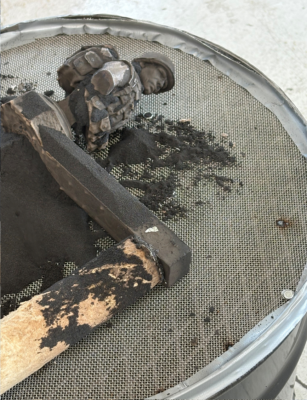
Cast image of a face.

A cast human face created from a sand mold as part of a demonstration at the UConn foundry.

When students lose physical access to molten metal, the entire industry loses a vital recruitment pipeline.  

Grassroots Recruiting 

Shambley sees the METAL approach as the most exciting aspect of the initiative.  

“What I’m excited about with METAL is you guys are building the infrastructure so that it’s easy between you and the FEF (Foundry Educational Foundation) to reach out and touch the high school teachers,” he said, and the local kind of associate-level school professors… and give them content to help recruit.” 

Ultimately, METAL is about securing the future of the American industrial base through equipping a new generation of metalworkers. To fill the rapidly emptying ranks of the manufacturing sector, industry leaders must reach intohigh schools and vocational programs to demystify the trade. The METAL program is actively building the connections required to facilitate this outreach.  

As the landscape of American manufacturing continues to evolve, the demand for highly skilled, technically adept foundry workers will only grow. By capturing essential metallurgical knowledge, eliminating the financial barriers to high-quality training, and providing a structured pathway to the shop floor, METAL is ensuring that the foundational art of metal casting will actively thrive well into the future. 


METAL on Base: Event Brings Hands-on Training to Service Members 

Directives from Secretary of War Pete Hegseth and the Secretary of the Army have emphasized the importance of expanding the defense industrial base and integrating advanced manufacturing. Failing to produce necessary components at home poses a severe risk to national defense.  The Joint Advanced Manufacturing Symposium (JAMS) was held at Fort Campbell, Kentucky in early August to address these concerns. The event brought together military and civilian leaders, experts, and industry partners to address critical needs around advanced manufacturing and defense. 

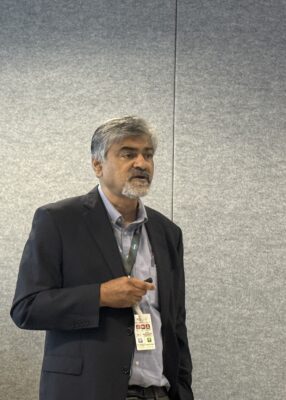
Dr. Uday Vaidya speaks to a crowd.

IACMI CTO Dr. Uday Vaidya provided an overview of IACMI’s work with composites in the defense sphere.

JAMS aimed to bridge the gap between component developers and the warfighters who use them. The symposium covered topics including accelerating innovation, enabling on-demand part production, improving operational readiness, and decreasing reliance on vulnerable, traditional supply chains.

The event featured a robust schedule of panel discussions, strategic briefings, and intensive, hands-on training workshops. Leaders from the Institute for Advanced Composites Manufacturing Innovation (IACMI) spoke about the organization and its workforce programs, including the Metallurgical Engineering Trades Apprenticeships and Learning (METAL) program. 

METAL, led byIACMI – The Composites Institute®, and funded by theDepartment War’s Office of Industrial Base Policy,was created to revitalize American manufacturing through hands-on trainingin metalcasting and forging. Members of the 101st Airborne Battalion were able to participate in a METAL Bootcamp as part of the symposium. 

Through K-12 workshops and university-led bootcamps METAL introduces students and career seekers to modern metalcasting and forging careers. Participants complete a free online training course before attending immersive, in-person bootcamps led by professional metallurgists and manufacturing experts.
 

How IACMI is Supporting the American Warfighter 

On Wednesday, August 5th, the symposium focused on advanced manufacturing training in the age of Industry 4.0. Dr. Uday Vaidya, Chief Technical Officer at IACMI, and Andrew Pokelwaldt, Director of Education and Workforce Programs, spoke about the institute and its programs. 

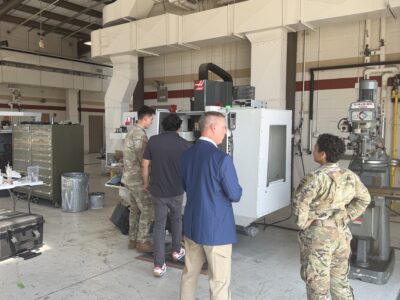
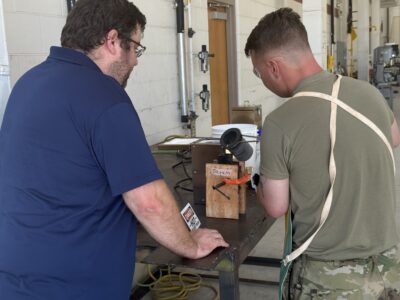
Andrew Pokelwaldt speaks with a soldier while observing the JAMS training session.

Andrew Pokelwaldt speaks with a soldier while observing the JAMS training session.

Vaidya provided an overview of the organization, originally funded by the Department of Energy, and its work on both civilian and defense projects. He spotlighted technology used to craft braided beams for construction, composite battlefield tourniquets, training rounds used for tanks, and new helmet tech. In his role at the University of Tennessee Knoxville, Vaidya also oversaw the METAL Bootcamp being offered to service members as part of JAMS. 

During his presentation, Pokelwaldt, a Marine Corps veteran, underscored a stark reality facing the domestic manufacturing base and the military alike: “Ninety percent of durable manufacturing goods and critical manufacturing equipment is supported by these roles, and most of the time if anything is critical or involves precision, it’s going to take skilled engineers, skilled technicians, and skilled workers that can operate the equipment.” 

He went on to note that even the most advanced equipment is rendered useless without a properly trained workforce. “A lot of the time it’s not the equipment, it’s the users. So if those people aren’t trained to deal with the advanced manufacturing equipment, that’s going to be a challenge, he said.”

Forging the New Workforce 

Pokelwaldt detailed the success of the IACMI’s workforce programs: 

America’s Cutting Edge (ACE) has impacted thousands over its five-year history. Combining free online courses with week-long, in-person bootcamps, ACE focuses on machining, composites, metrology, and advanced manufacturing. The goal is to get “people’s hands on that equipment,” said Pokelwaldt. 

Pokelwaldt also highlighted the importance of the METAL program. “Casting and forging has been identified as an area that the United States does not have much capability compared to what it used to,” he explained. METAL is designed to bring domestic manufacturing back and increase existing capabilities in these vital areas. METAL is rapidly expanding nationwide to meet critical demand. 
The presentation also addressed the long-term strategy for sustaining the manufacturing workforce. Pokelwaldt emphasized IACMI’s outreach efforts, recognizing that the “manufaturers of the future need early exposure to STEM concepts and basic manufacturing principles. “We start at a young age to give people basic manufacturing principles… and build all the way through,” he stated.

A surprising trend Pokelwaldt noted was that many intelligent and capable young adults entering these programs have never used basic hand tools. This lack of foundational experience makes hands-on training even more vital. “If they can’t even do that, they’ll struggle,” he said, referring to the basic mechanical adjustments often required on machinery.  

By partnering with educational institutions and industry, IACMI is working to fill this pipeline, providing internships and apprenticeships that offer real-world experience. METAL’s upcoming K-12 mobile units are designed to generate interest in manufacturing early and give young people the hands-on experience many are missing.

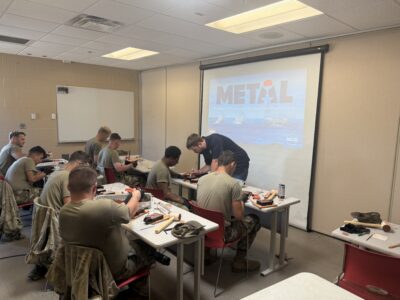
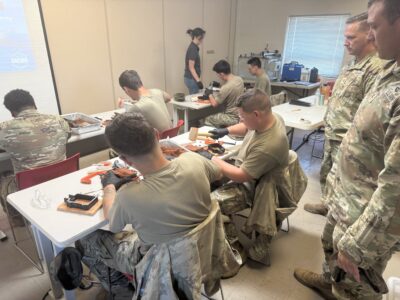
A group of soldiers prepares sand molds during a training source.

Active duty service members participated in a METAL Bootcamp from the University of Tennessee Knoxville.

The METAL Investment Casting Bootcamp 

The strategic discussions at JAMS were paired with practical application. During the symposium, service members from the 101st Airborne and visiting Marines participated in intensive workshops at the HAMMER (Hub for Advanced Manufacturing, Metalworking, Engineering, and Repair) Training Site. 

Among the offerings was a METAL Bootcamp led by Amy Wheelock and Thomas Drye from the University of Tennessee, Knoxville. The course provided trainees with a comprehensive understanding of how to move a custom design from concept to a finished metal piece. 

The workshop curriculum was rigorous and highly practical: 

A service member pours molten tin into a sand mold.

Bootcamp participants made designs using CAD, made sand molds, and poured molten metal.

  • Day 1: An introduction to the METAL program and investment casting, followed by CAD instruction and pattern modeling.
  • Day 2: A deep dive into 3D printing and injection molding. Trainees learned slicing techniques, observed injection molding demonstrations, and prepared their 3D printed patterns.  
  • Day 3: Focus shifted to sand casting and simulation, including spruce patterns, the burnout process, and a demonstration of Skuld Additive Manufacturing Evaporative Casting (AMEC). 
  • Day 4: The core activity, melting metal and performing the investment casting process, followed by retrieving and finishing the cast components. 
  • Day 5: An essential introduction to Non-Destructive Testing (NDT), where trainees performed ultrasound and dye penetrant testing on their finished parts to ensure quality and structural integrity.

The Future of Manufacturing at the Tactical Edge 

JAMS highlighted the urgent need for agile, advanced manufacturing capabilities within the defense industrial base and on the battlefield. Programs like METAL are vital to ensuring that the nation’s warfighters and thenation’sindustrial base are prepared for the challenges of the future. 

If you are interested in attending a METAL Bootcamp or want to learn more about a career in the foundry and forging industry, visit the METAL website today.

Highlights from AFS Industry 4.0 2026

“Companies need to know their destination before choosing their tech. If you don’t know where you’re going, any road will get you there,” said Jim Wetzel, co-founder of NxGen, quoting Alice in Wonderland.  

Wetzel has been a leader in manufacturing for decades, and was a keynote speaker at the most recent AFS Industry 4.0 conference.  

This strategic communication principle is the bedrock of successful Industry 4.0 adoption. Companies can’t simply plug in a new system and expect optimization without a clear blueprint of their desired business outcomes. 

Wetzel cited a report from MIT that 95% of generative AI pilots at companies are failing.  

The leading reason for these failures?  

Lack of alignment to business outcomes.  

“Know the value first,” Wetzel said, reiterating that understanding the business’ needs before making big spends on technology was key to successful implementation. 

The 2026 American Foundry Society (AFS) Foundry Industry 4.0 Conference was held in Minneapolis on July 28-30. The METAL team was there to see firsthand the future of the foundry floor. 

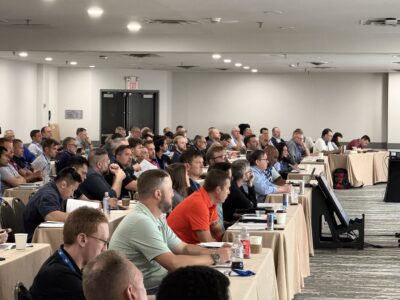
Conference attendees listen as a panel speaks on stage.

From AI integration to advanced robotics, the future of foundries is both high-tech and dependent on a skilled workforce.  

METAL, led byIACMI – The Composites Institute®, and funded by theDepartment of War’s Office of Industrial Base Policy,was created to revitalize American manufacturing through hands-on trainingin metalcasting and forging.Finding workers was a recurring point of discussion amongst attendees and during the tour of the 3M CAM facility in Saint Paul, MN. 

Through K-12 workshops and university bootcamps, METAL introduces students and career seekers to modern metalcasting and forging careers. Participants can complete METAL’s free online training course before attending immersive, in-person bootcamps led by professional metallurgists and manufacturing experts.   

1. The Stakes Are Higher Than Ever

Todd Hutcheson, Director of Advance Iowa and the Center for Business Growth and Innovation at the University of Northern Iowa, provided a sobering look at the industrial landscape.  

American metalcasting is at a crossroads.  

Ninety percent of all manufactured goods contain castings, yet the number of U.S. casting plants has declined by 72 percent since 1991.  

The path forward? Embracing technologies that bring smart manufacturing back to the U.S. while improving resiliency.  

“Value comes from change when it enables new or improved capability and from stability when it preserves or better controls existing capability,” Hutcheson said. “Industry 4.0 implementation accomplishes both.”  

Despite the decrease in facilities, Hutcherson noted the importance of casting and foundries to the economy. The industry supports nearly 800,000 jobs across the supply chain and is valued at over $50 billion. 

Hutcheson also touched on how University of Northern Iowa (UNI), a METAL partner university, is tackling industry challenges. The school’s Metal Casting Center, Foundry 4.0 Center, and Center for Business Growth and Innovation work together to “engage students and staff in research and education.” UNI will soon begin offering METAL Bootcamps as part of this mission. 

 2. The (AI) Elephant in the Room

Artificial intelligence was a hot topic among speakers and exhibitors. Mike Lakas, Senior VP for IT at the American Foundry Society touched on everything from Large Language Models (LLMs) and transformers to the influx of Chat GPT-generated content. The core takeaway was separating practical utility from marketing buzz. The highlight of Lakas’ presentation was a comparison of outputs asking generative AI to produce an image. The difference between the initial image generated years ago and the video made this year was staggering and demonstrated a point he had made earlier: “We tend to overestimate progress in the short-term and underestimate it in the long run.” 

Conor Keenan of Sinto America, who played a role in developing the new SMART Foundry at Purdue University, detailed how intelligent data tools are already making an impact. He explained that these tools are more than data collectors; they use advanced pattern recognition to drive real-time decision-making.  

“When you get your data is just as important as getting the data itself,” he stated. 

3. Who Let the Dogs Out?

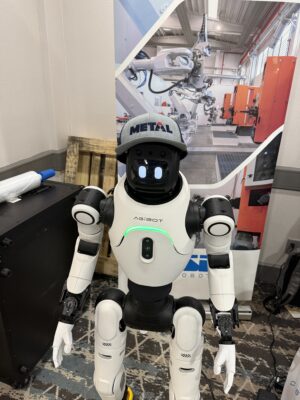
A Humanoid robot wears a METAL ball cap.

SIR Robotics, an Italian company with offices in California, showed off their robot Luciano.

Attendees were treated to case studies showing how digital tools are already yielding massive ROI on the floor:  

Spot the Robot Dog: Jacob Moreau showcased how a Boston Dynamics robot is performing over 120 autonomous inspections for a Toyota NA camshaft supplier.  

“The bot paid for itself in ROI within 10 months,” he said.  

Spot uses thermal imaging, LiDAR, and acoustic leak detection to monitor equipment across the 200,000 sq ft facility.  

Precision Pouring: Operations Data Analytics Engineer Ellyn Neubauer described how optimizing furnace controls using pyrometer data has impacted Mercury Marine, which manages an incredible 1.6 million pounds of poured steel per year. The use of the two-color pyrometer system has enabled continuous indirect temperature feedback, leading to more controlled furnace melts.  

4. At the Forefront of Cyber Security Compliance

The conversations around smart energy and cybersecurity are urgent. ECK Industries recently became the first foundry and one of the first 50 companies to achieve CMMC (Cybersecurity Maturity Model Certification) Level 2. This framework requires defense contractors to protect Controlled Unclassified Information (CUI) and applies to any company handling CUI in the DoW supply chain. This information can include drawings, specs and technical data, etc.  

Aaron Hayon, Director of Technology and Security at Eck Industries, and Jeremy Mares, who manages federal accounts at Redspin, provided an overview of the CMMC guidelines and Eck’s journey to certification.  

“Trying to be the first to do something within an industry is always challenging. It seems that every day we learn something new about how requirements should be interpreted, how the CMMC program continues to evolve, and how available tools can be leveraged more effectively,” noted Hayon of the process.  

The Takeaway 

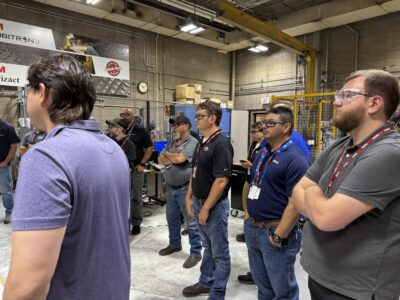
A tour group looks on as a tour guide speaks in a manufacturing lab

AFS Attendees were able to tour the 3M CAM Lab in Saint Paul, MN.

For us at METAL, the AFS Foundry Industry 4.0 Conference is a clear signal that our mission has never been more vital.  

The technological advancements showcased in Minneapolis, from autonomous robotic inspections to AI-driven process optimization, offer a definitive path forward for reversing the decline of U.S. casting and forging facilities.  

However, this digital transformation cannot succeed without a workforce capable of executing it. By continuing to offer expert-designed online and hands-on training, as well as stackable credentials, METAL is actively equipping the next generation of metalcasting pros with the digital know-how and problem-solving skills required to bring the Industry 4.0 vision to life on the foundry floor. 


The End of “Post and Pray” Hiring: The Talent Pipeline Being Forged by METAL and LaborUp

The United States manufacturing sector isn’t just facing a worker shortage; it is dealing with a systemic failure in talent acquisition.  

As an industry, we pour millions of dollars into world-class technical training, yet when it comes time for those skilled individuals to enter the workforce, we rely on the passive, outdated “post and pray” approach of general job boards. The industry passively hopes that emerging professionals will somehow stumble into the right roles. 

METAL, led byIACMI – The Composites Institute®, and funded by theDepartment of War’s Office of Industrial Base Policy,was built to revitalize American manufacturing through hands-on trainingin casting and forging. 

Through K-12 workshops and university bootcamps, METAL introduces students and career seekers to modern metalcasting and forging careers. Participants can complete METAL’s free online training before attending immersive, in-person bootcamps led by professional metallurgists and manufacturing experts. 

Earlier this year, METAL partnered with hiring platform Laborup. Through AI-powered technology, Laborup connects manufacturers with vetted, skilled workers five to ten times faster than traditional staffing agencies.

Students wearing protective gear pour molten metal into a mold.

Laborup Founder Simba Jonga attended the METAL Bootcamp at Ohio State.


Trades professionals can start by creating a free profile and speaking their job history and skills into the app. Laborup’s voice AI takes it from there, generating a resume and job profile recruiters can quickly evaluate. Once a profile is complete, the app begins matching workers with manufacturing opportunities aligned with their experience, skills and wage expectations. 

Since partnering with METAL, Laborup Founder and CEO Simba Jonga and Market Development Manager Cambrie Cook have had the chance to experience METAL bootcamps first-hand.  

“We’ve been at Ohio State and UAB [University of Alabama at Birmingham] engaging with the students, showing them the platform, showing them that these careers do exist and setting them up with interviews,” says Jonga. 

Capturing Talent on the Training Floor 

LaborUp is not just another digital job board filled with noise and unqualified spam. It is a specialized, targeted career network built exclusively for the trades and industrial sectors. The platform cuts through the clutter, serving everyone from curious high schoolers discovering metalworking to highly skilled veterans approaching retirement. 

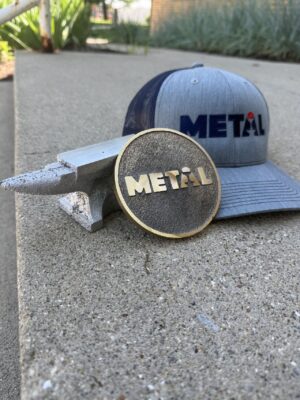
A METAL ball cap, medallion, and anvil.

METAL Bootcamp attendees create brass medallions.

The integration of Laborup into METAL bootcamps is a game-changer for the training-to-career pipeline. At the tail end of the program, students are guided through the platform, assisted in building their digital professional profiles, and educated on the diverse manufacturing career opportunities waiting for them outside the classroom.  

By engaging with METAL graduates early through LaborUp, companies have the unique opportunity to present their value propositions beyond the paycheck. Employers can highlight their company culture, career advancement pathways, and organizational mission.  

Getting in front of these students early builds brand loyalty and a deeper connection to the company’s vision, creating employees who are invested in long-term growth rather than short-term financial leaps. Thanks to the METAL Credly certification, employers know they’re getting trained and ready candidates.  

A Strategy for Every Demographic 

At the recent late-May bootcamp attended by Jonga at The Ohio State University, the participants were largely degree-track college students focused on metallurgical engineering. By capturing these individuals right as their hands-on training concluded, this partnership handed employers a direct, exclusive line to highly educated, immediate-impact talent ready to deploy. 

Conversely, at the University of Alabama at Birmingham (UAB) bootcamp attended by Cook, a much younger crowd of 15- and 16-year-olds were exploring the trades. Engaging with high schoolers might not solve a manufacturer’s immediate hiring quota for next Tuesday, but it accomplishes something far more critical: it secures the industry’s future pipeline.  

By capturing their interest now, we are showing these students that the trades offer lucrative, high-tech, and engaging career paths before they are pressured into alternative educational routes. 

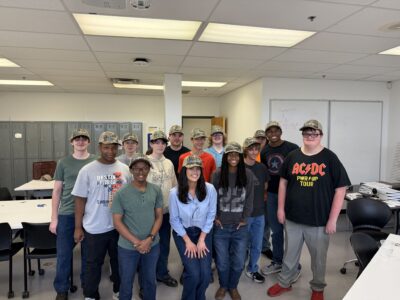
A group of students pose wearing camo Laborup ball caps.

Laborup’s Cambrie Cook attended the METAL Bootcamp at the University of Alabama at Birmingham.

Fixing a Broken Recruiting Model 

For regional and national manufacturers, the traditional hiring model is broken. When employers use general job boards, they are forced to sift through hundreds of irrelevant applications. Laborup fixes this by enabling our METAL graduates to self-report their verified bootcamp credentials directly on their profiles. Employers no longer have to guess whether a candidate has hands-on metallurgical experience; the proof is built in, giving hiring managers instant access to a screened network of verified talent. 

More importantly, this early access is the most effective weapon regional manufacturers have against massive aerospace, defense, and automotive giants. In high-density industrial corridors, independent manufacturers are competing for the exact same specialized talent pool as globally recognized corporations. If independent manufacturers wait for highly trained graduates to hit the open market, the competition devolves into a bidding war they are likely to lose. A graduate choosing a job based purely on a one-dollar-per-hour premium is a massive flight risk. 

The Future of Manufacturing Acquisition 

The momentum generated by these initial pilot bootcamps featuring Laborup is just the beginning.  

“We were able to talk about careers and expose them [campers] to what these jobs look like,” said Jonga. “They sign up for the platform and give us feedback on what they’re looking for.” 

The METAL team and Laborup are currently analyzing early data to track sign-ups, interview rates, and job placements, and are continually refining the bootcamp-to-work experience. 

The future of manufacturing relies on capturing highly skilled talent and aggressively guiding it into the workforce. Through this targeted, collaborative approach, METAL and Laborup are proving that when you actively connect the training floor to the industry floor, everybody wins. 


Forging the Future: How UTK’s Amy Wheelock is helping guide future metalcasters

The revitalization of American manufacturing relies heavily on bridging the gap between traditional metal trades and cutting-edge engineering.  

At the forefront of this movement is a concerted effort to build a highly skilled, tech-savvy industrial workforce.  

One of the chief guides of this effort at the University of Tennessee Knoxville is research coordinator and METAL workshop and bootcamp instructor Amy Wheelock. After pausing her engineering career to care for her family, she has become one of UTK METAL’s top trainers and a key part of the university’s efforts to train the next generation. 

METAL, led by IACMI – The Composites Institute®, and funded by the Department of War’s Office of Industrial Base Policy, was built to revitalize American manufacturing through hands-on training in casting and forging.  

Through K-12 workshops and university bootcamps, METAL introduces students and career seekers to modern metalcasting and forging careers. Participants can complete METAL’s  free online training before attending immersive, in-person bootcamps led by professional metallurgists and manufacturing experts like Amy across the country.  

For nearly a week, bootcamp participants gain hands-on experience in casting design and pouring processes. The trainees pound sand into molds, learn CAD software, pour molten metal, and machine-finish parts. Participants leave with their own metal creations, foundational metalcasting and forging skills, and a clearer picture of promising careers in aerospace, automotive and defense manufacturing.   

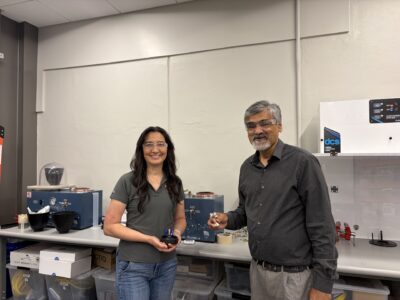
Amy Wheelock poses beside Dr. Uday Vaidya.

Wheelock works closely with IACMI Chief Technology Officer Dr. Uday Vaidya.


Building an Innovative Curriculum 

UTK’s investment casting program hasn’t been around long.  

“For us, this is the beginning of investment casting…we started this program about a year and a half ago,” said Wheelock.   

The program’s origins began when university faculty, specifically IACMI Chief Technology Officer Dr. Uday Vaidya, identified the need for a specialized casting program that previously did not exist. Wheelock, a mechanical engineer who was auditing a class, was invited to help get the project off the ground.  

“By the end of the semester, he’s [Vaidya] like, ‘You know, we’ve got some projects, I need to start up an investment casting program, would you like to come work for us?'” 

Stepping into the role of research coordinator, Wheelock became a key part of the team. The program strategically grew from its initial, small-scale concepts, like jewelry, to processing high-temperature industrial metals. Today, the curriculum involves working with Nordic Gold at 2,000°F and castable 356 aluminum alloys to produce precision-engineering components such as miniature turbine blades. 

“Investment casting is everywhere. It’s in aerospace. It’s in automotive. It’s in defense,” Wheelock said of the prominence of cast parts. 

METAL is a key aspect of the UTK investment casting program. 

“METAL [the program] is a fundamental part of the investment casting program. We teach both sand and investment casting and machining,” said Wheelock. Teaching the importance of casting is part of developing the next generation of people that can go into the workforce. We’re having diminishing numbers of people that have any knowledge of metalwork.”


The Technical Precision of Investment Casting 

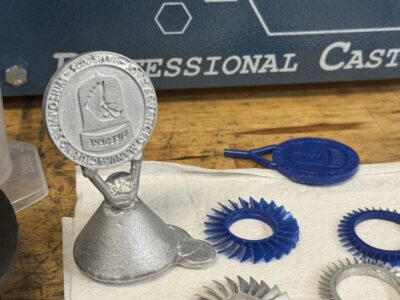
A major focal point of the curriculum is mastering the investment casting process itself. Historically referred to as “lost-wax casting,” this method has evolved significantly in modern foundries. Instead of carving beeswax by hand, students and technicians in the program frequently utilize 3D-printed PLA filaments or wax-based resins to create highly detailed patterns. 

These patterns are assembled onto a central sprue, encased in a ceramic slurry, and baked in a burnout oven at extreme temperatures, often for up to 14 hours, to vaporize the original pattern and harden the ceramic. Finally, molten metal is drawn into the mold using advanced vacuum-casting machines. This method eliminates parting lines and achieves exceptional geometric tolerances, producing precision components that require minimal post-process machining. By mastering this technique, students are directly prepared for high-level manufacturing roles in aerospace, automotive, and beyond. 

Mentoring the Next Generation 

The core mission of the investment casting program is educational outreach. The foundry serves as a dynamic classroom for immersive METAL Bootcamps and workshops. Participants as young as high school age gain hands-on experience with metalcasting and the science behind it.”It’s a great thing when young people are trying to figure out what they want to do, to expose them to a lot of different things,” Wheelock notes. “A lot of people don’t really get exposure to metal casting or metal working, and it may be something that they could find really interesting and make a career out of that they otherwise would have never known existed.”

By teaching the intricate, one-piece mold process of investment casting, the program demonstrates exactly how engineering and materials science intersect. Students learn firsthand how selecting a specific material dictates the manufacturing technique, and how that technique, in turn, alters material properties. 

Coming Soon: The Robotic Foundry 

The innovation at UT doesn’t stop with traditional casting. Drawing on advanced machine design principles, the university is bringing advanced automation directly into the foundry and its METAL Bootcamps and workshops. 

Some of these machines are already active in the foundry, with the full system expected to be online later this summer.

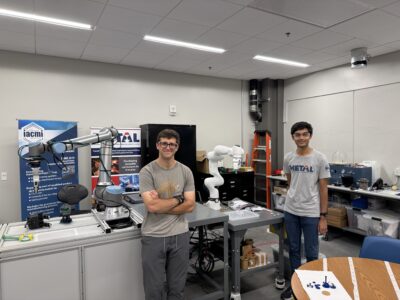
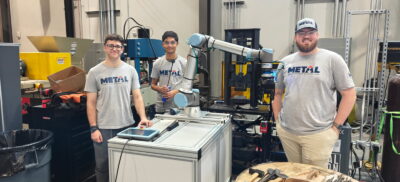
Students pose with a robotic arm in a university lab.

UTK is integrating new robotics tools into its METAL curriculum.

Stay tuned for an upcoming feature exploring how these robotic assistants are revolutionizing safety and precision on the foundry floor. 

Forging the Future: How Hands-On Experience is Shaping the Next Generation of Engineers

The manufacturing sector in the United States is at a critical inflection point, requiring brilliant young minds who are ready to tackle modern challenges with innovative, sustainable solutions.  

At just 21 years old, Mhakayla Johnson is already working to make the world a better place. Going into her senior year as a mechanical engineering student at Alabama A&M University, she is conducting research on composite materials that are more sustainable and easier to recycle. While interning this summer at the University of Alabama at Birmingham, Johnson was encouraged by her mentor, Dr. Haibin Ning, to attend a METAL bootcamp.  

Johnson poses with the skillet she made at the UAB Bootcamp

METAL, led by IACMI – The Composites Institute®, and funded by the Department of War’s Office of Industrial Base Policy, was built to revitalize American manufacturing through hands-on training in casting and forging. 

Through K-12 workshops and university bootcamps, METAL introduces students and career seekers to modern metalcasting and forging careers. Participants can complete METAL’s free online training before attending immersive, in-person bootcamps led by professional metallurgists and manufacturing experts across the country. 

For five days, UAB bootcamp participants gain hands-on experience in sand casting design and pouring processes. The trainees pound sand into molds, learn CAD software, pour molten metal, and machine-finish parts. Participants leave with their own metal creations, foundational metalcasting and forging skills, and a clearer picture of promising careers in aerospace, automotive and defense manufacturing.    

At bootcamp, Johnson gained critical, hands-on experience necessary to transition from classroom theory to real-world application.  

“I’m just a hands-on kind of person, you know. I like to work with my hands, I like to build and create stuff and improve things,” she says. Her journey highlights the vital importance of experiential learning in science, technology, engineering, and mathematics (STEM). 

Engineering a Sustainable Tomorrow 

Johnson’s current research, conducted under the mentorship of Dr. Ning through the REU research program, is deeply focused on manufacturing sustainability. She is actively exploring the creation of composites using cellulose and hemp fibers.  

“Dr. Ning told me I should step into the metal bootcamp so I can get my hands dirty and add more knowledge to what I already have,” she said of expanding her materials understanding.  

Currently, industries ranging from automotive to aerospace rely heavily on materials like carbon fiber. While highly effective, these materials are notoriously difficult to recycle. By researching viable, sustainable alternatives, Johnson is addressing a critical environmental challenge head-on. 

“Recyclability and just making our planet a better place [is important],” Johnson explains. “With carbon fibers… it’s very hard to recycle. And that’s why I’m glad I’m doing the research with Dr. Ning so that we can do research on composites and find different materials, better materials than the ones that are already being used.” 

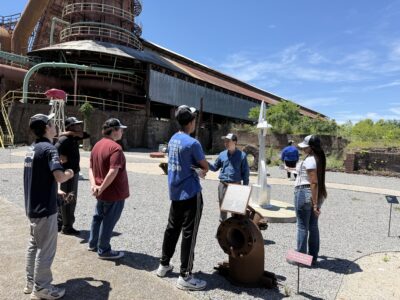
A group of student takes in the view of a retired historic foundry.

Johnson toured the historic Sloss Furnace site with her UAB Bootcamp classmates.

Nurturing a Lifelong Passion for STEM 

Johnson’s journey into science was no accident. Her mother, an Alabama A&M physical science professor, nurtured her passion for building and creating from an early age through robotics and STEM camps. “She didn’t just push me into it; she realized what my interests were as a kid and put me on that path,” Johnson stated.  

“I was a really hands-on creative type of kid,” she recalls. “I loved to draw, and I was very artistic… I want to be an engineer, I want to build stuff, I want to make stuff.”  

In high school, Johnson began welding and looking into different types of engineering, landing ultimately on mechanical. 

Despite identifying as a hands-on creator rather than a natural mathematician, her determination allowed her to excel.  

“This might sound crazy,” she said, but I was never the best at math…I understood it, but it took me more to get there. I had to study a little bit harder and just apply myself a little bit more.”  

Her story is a powerful testament to the fact that success in engineering requires immense creativity and perseverance just as much as raw calculation. 

Strengthening Foundations 

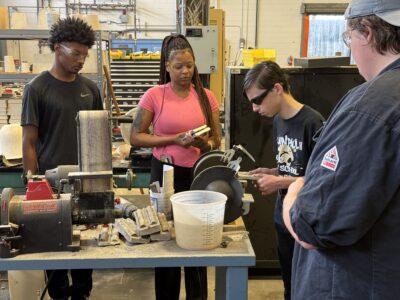
A student polishing a cast piece of metal on a grinder while others wait their turn.

Bootcamp participants take turns processing recently cast pieces.

While Johnson’s research focuses on sustainable composites and natural fibers, a foundational understanding of metallurgy is vital for innovations in material science. By participating in the METAL bootcamp, students like Johnson gain a comprehensive view of how traditional metalcasting interacts with modern materials.  

One example of this at UAB involved a project to produce composite screws that could be used on offshore oil rigs while maintaining strength similar to steel. Understanding the science behind both metal and non-metal materials proved vital in this pursuit.  

Johnson noted the lab at UAB was a great place to “actually see the real-world applications of what I’m learning.” 

METAL Bootcamps also dive into sustainability, teaching students about cleaner melting techniques and demonstrating them, as demonstrated by the use of the induction furnaces at the UAB lab.  

Inspiring the Next Generation 

As she looks toward her senior year and contemplates furthering her education, Johnson offers advice to aspiring young engineers. 

“Keep going and pushing towards your dreams,” she advises. “There’s nothing that you want to do that you can’t do… Take heed to your resources and believe in yourself. Stick to the course, your dreams can come true if you put in the work to achieve them.” 


Navigating NDAA Section 805 Compliance and the Role of METAL

The compliance landscape for United States defense contractors underwent a major shift on June 30. With Section 805 of the Fiscal Year 2024 National Defense Authorization Act (NDAA) now officially in effect, the Department of War has instituted a strict prohibition on the procurement of goods or services from entities identified on the Section 1260H list of Chinese military companies, as well as any entities under their control. 

For industry partners, this direct ban represents a fundamental restructuring of defense supply chain compliance. Maintaining operational continuity now requires aggressive due diligence, strategic auditing, and a proactive pivot toward domestic manufacturing capabilities. 

The ultimate goal of these new regulations is to decouple the defense industrial base from adversarial supply chains and anchor production firmly in the U.S. 

METAL, led by IACMI – The Composites Institute®, and funded by the Department of War’s

Office of Industrial Base Policy, was built to revitalize American domestic manufacturing through hands-on training in casting and forging.  

A worker in protective gear pours molten metal.

A foundry worker pours molten metal from a crucible.

The Role of the METAL Program 

Replacing foreign components in complex defense systems is easier said than done, particularly in sectors suffering from severe domestic labor shortages. Making matters more difficult, decades of offshoring has hollowed out American capabilities in foundational industries. Since the early 1990s, the U.S. has lost immense capacity in casting, forging, and advanced metallurgy.  

Lana Smith, a strategic consultant, owner of The Oakley Office and METAL bootcamp graduate, guides small- and mid-sized manufacturers through the complexities of the defense market. She notes that in some cases, domestic machine shops will be forced to reverse-engineer parts they can no longer legally procure from overseas. 

This is precisely where METAL (Metallurgical Engineering Trades Apprenticeships & Learning) becomes vital. METAL is designed to address the supply bottlenecks that Section 805 exposes. The program accelerates the training of a highly skilled workforce capable of scaling up domestic production, allowing companies to buy American and comply with these new requirements. 

Through K-12 workshops and university bootcamps, METAL introduces students and career seekers to modern metalcasting and forging careers. Participants can complete METAL’s free online training before attending immersive, in-person bootcamps led by professional metallurgists and manufacturing experts across the country.  

Smith views programs like METAL as an essential partner for companies looking to shorten lead times and stay competitive. “It’s a very impressive, proactive move for the Department [of War] to give funding to this,” she notes, describing the initiative as a “catalyst” for rebuilding the industrial base. “Manufacturers can immediately lean into the METAL network to recruit trained professionals eager to enter the sector.” 

For up to five days, bootcamp participants gain hands-on experience in sand-casting design and pouring processes. The trainees pound sand into molds, learn CAD software, pour molten metal, and machine-finish parts. Participants leave with their own metal creations, foundational metalcasting and forging skills, and a clearer picture of promising careers in aerospace, automotive, and defense manufacturing.     

The Compliance Challenge 

Navigating Section 805 requires understanding its phased implementation. The immediate “direct ban” prevents the Department from purchasing directly from 1260H-listed firms. However, the more complex hurdle arrives on June 30, 2027. This secondary “indirect ban” extends the prohibition to any contracts that incorporate components, goods, or services produced or developed by listed entities. 

For prime contractors and subcontractors alike, this creates an urgent need to map supply chains down to the raw material level. Identifying and phasing out restricted entities is critical to avoiding compliance issues. The sheer depth of modern defense manufacturing makes this a monumental task. To Smith, the true implications of the ban won’t be fully understood until audits and waiver requests begin. 

“Because the supply chain has so many tiers… I think a lot of companies don’t realize what is in their supply chain to know if this is going to impact them or not,” Smith explains. She points to the M1 Abrams tank as a prime example. “There are at least 30,000 parts you need just to build it. When you look at the full list of materials on that, it’s like 60,000 items…you don’t always know where it’s [materials] coming from.” 

The DOW has established a waiver process that businesses may submit in the name of national interest. The waiver requires a “compelling justification narrative,” comprehensive market analyses, and detailed corporate phase-out plans. 

Building a Resilient Industrial Base 

When defense regulations restrict foreign supply chains, programs like METAL provide the industrial capacity to fill the void. A recent expansion aims to double the program’s national footprint by 2030, establishing new bootcamps and deploying mobile training units to serve more communities and K-12 classrooms. This scaling up ensures that when a defense contractor needs to source American-made castings or forged components to comply with the 2027 indirect ban, a trained domestic workforce is ready to deliver. 

By bridging the gap between federal compliance and industrial capacity, the initiative ensures that supply chain security does not come at the expense of mission readiness. 

The Path Forward for Industry Partners 

Compliance with Section 805 is mandatory, but achieving it requires a dual approach. Defense partners may use the DOW’s new compliance hub to align with current timelines and, when necessary, navigate the waiver process. Simultaneously, organizations should actively engage with domestic workforce programs like METAL to support, hire, and scale domestic manufacturing and sustain American defense infrastructure for decades to come.