Nothing could have prepared me for my first time in a foundry.
Yet there I was at Erie Bronze and Aluminum Co., mesmerized by the sound of grinding machines, the sharp smell of metallic dust, and the giddy energy of everyone around me — all waiting in line to pour their first casting.
One metal worker, both hands wrapped around the heavy castings he cleaned, smiled warmly at the line of newcomers. “I’ve been there,” his eyes, filled with knowing anticipation, seemed to say.
Staring inside the massive ceramic crucible glowing red like a dragon’s mouth, I tried not to think about what I was about to do.
“I’m nervous,” I said to Russell Winter, a third-generation tool and die maker still dressed in his silver protective gear, raising my voice over the foundry’s symphonic churn.
“My arms shook the whole time,” he admitted, “mostly from nerves.” Great, I thought, staring up at the well-over-six-foot-tall man. I flexed my biceps — reminding myself they existed — attached to my spindly 5-foot-6 frame. Would I even be able to hold the ladle? Let alone manage a ladle filled with molten aluminum?
I heard the voice of Crystal Bentley from IACMI – The Composites Institute, in the back of my mind. On the flight to Pennsylvania she said, “In every class I’ve been to, someone has spilled the metal.”
Not me, not today, I prayed. Before fear held me back, someone piled a fire-resistant coat, gloves, leg and foot covers, and a massive face shield into my arms. “Your turn.”
I stood there like a toddler as student teachers from Penn State Behrend quickly and efficiently strapped everything onto me, tucking the protective gear over exposed clothing and tugging to make sure it all fit right. The oversized stuffed gloves turned my hands into teddy bear paws.
“How do you grip anything in these?” I said. A voice beyond my face shield responded, “Tightly.”
My Journey to the Foundry
Getting to Erie Bronze and Aluminum Co. took two flights from Knoxville and Charlotte and a 15-minute car ride. Finding my way to metalcasting took more than a year, and that journey began with METAL.
My trade is writing. The most gratifying part of my job is listening to the stories people share with me. For a moment, I see the world through their eyes, gain an understanding of their experiences, and find the words to pass it on. Then, I find the next story.
But writing about the metal industry felt different — I haven’t been ready to move on. I’ve spent the past year writing blogs for METAL, a program funded by the Department of War’s IBAS Program to revitalize metalcasting and forging in America through hands-on K-12 workshops, metallurgical bootcamps and apprenticeships.
I’ve seen the enthusiastic glow of students learning the trade; been inspired by the earnest dedication of the metallurgists reviving it; and felt the passion of recruiters who’d do anything – even babysit – to make sure apprentices succeed.
Here’s what I’ve learned along the way: Metalcasting is doing more than offering people careers — it’s changing lives.
For example, Georgia Southern University student Robert Myers became a welder and machinist after high school. But when a car accident put his career on hold, he decided to return to school, where he discovered GSU’s metalcasting program and hands-on internships.
“I’m so glad I found metalcasting when I did,” Myers said. “This industry is one of the blocks the world is built on. We need people who are willing to keep it alive.”
Then there are service members like Airman Savana Ohlenburger, learning the skills needed to support U.S. aircraft and weapons production; and Barron Industries’ Michael Price, a quality coordinator who stepped into the metal industry for the first time during COVID in search of a better way to support his family.
Again and again, I’ve heard these stories – often holding back my own tears during interviews, moved and stunned by the opportunities manufacturing jobs are offering Americans once again.
Why didn’t anyone tell me? I’ve thought. People should know these jobs exist.
“Have you tried it before,” interviewees would ask, “pour metal?” Sheepishly, I’d shake my head no.
“You should,” they’d say. Maybe.
America’s Blue Collar Comeback
There’s no denying the future of American manufacturing is strong. By 2033, the country could need nearly 4 million manufacturing workers to support its defense and supply chains. However, half of those jobs could go unfilled if manufacturers can’t train new employees fast, Deloitte reported.
At the same time, “white collar” office jobs across tech, government and other industries continue to get slashed. In 2025, the information sector lost 5,000 jobs on average per month, according to the U.S. Bureau of Labor Statistics. These included jobs at software, publishing, broadcasting, telecommunications, data processing and web companies. Tech giants like Amazon and Meta laid off thousands in 2025 and early 2026, with more cuts likely to come. Federal employment continues to slide, down 11% since October 2024.
Some days, scrolling on LinkedIn is downright depressing. Layoff victims are now competing with artificial intelligence, corporate offshoring and a ruthlessly competitive job pool. Professionals across marketing, human resources, administrative roles and sales are begging for interviews. But the jobs just aren’t there.
As someone in the “information” industry, diversifying my skills started to seem like a wise idea.
Breaking Metal – And Barriers
More than 20 blogs and dozens of interviews later, I decided it was my turn to experience the foundry. Doubts I’ve carried my entire life lingered: I’m not good at math. I couldn’t make more than a C in chemistry class. I have no hand-eye coordination, and I’m clumsy. When I told my family I planned to attend a casting and forging bootcamp, my sister laughed. “Can I come watch?” she said.
I share that to say, if you feel like an unlikely candidate for metal manufacturing, you’re not alone.
Thankfully, the encouragement from everyone I’d met in the industry overpowered preconceptions about myself and today’s manufacturing environments. Sure, people said it was dirty and the hours could be long. But they also said it was innovative, fulfilling and often thrilling – watching electric arcs illuminate the inside of a furnace, or flames flash up from sand molds during a pour.
More than anything, the sparks – and camaraderie – around metalcasting and forging sounded fun. So, I took METAL’s free online training, laced up my leather boots and prepared for the experience of a lifetime.
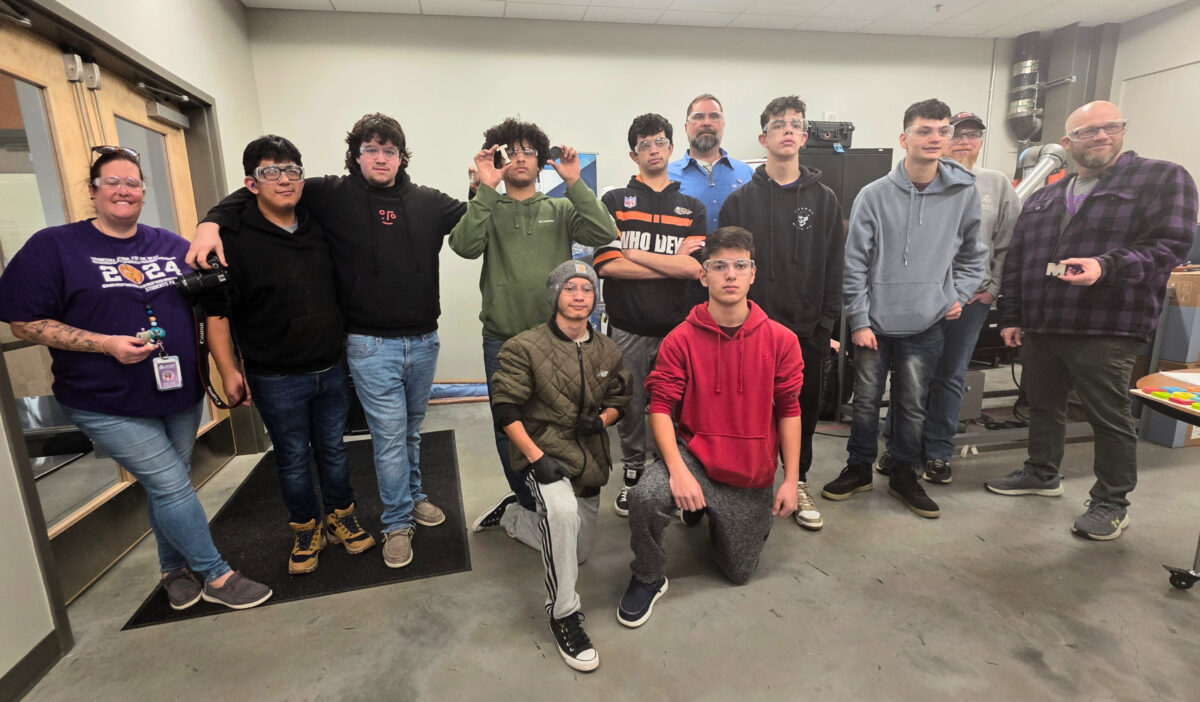
For two days, I joined real metal workers, manufacturing owners and industry leaders in Erie, Pennsylvania to learn new skills for the nation’s most urgent jobs. We learned how to use SolidCast and FlowCast software to simulate the time, metal quantities, and cooling patterns of pouring a casting.
We tested the strength of iron, aluminum and other metal materials using tensile and hardness testing machines. All metals and metal manufactured-parts undergo rigorous quality testing. After all, lives depend on it.
“Would this be the type of test they’d use on steel beams before building a bridge?” I asked, watching the Tensile machine stretch a thin strip of metal to its breaking point. A quiet anticipation filled the room.
“Absolutely,” a student teacher responded. A minute later, the metal split with a loud “pop,” like uncorking a champagne bottle. Everyone jumped, some exclaimed, and we all laughed at ourselves.
The group also dabbled in mold design. We used Autodesk Fusion, a software for 2D and 3D CAD modeling, to turn simple lines and dots into drawings of real machined parts. Man, I thought, customizing my creations on the screen, I could have enjoyed this. If only I had known it was an option.
Then on a March morning, dressed in my shiny, silver suit, it was finally time to pour molten metal.
The Final Pour
“This one is going to be more complicated,” said Dr. Paul C. Lynch, an associate professor of industrial engineering, as I stepped up, death-gripping my empty ladle. I’d watched in patient awe as everyone in my group meticulously poured the lava-like aluminum into stein molds. No one had spilled a drop, and I was the last one up.
Dr. Lynch leaned in and shouted over the machines, “We are going to need the metal to cool in your ladle before it is poured. After your ladle is filled, we’re going to put a metal cooling block in it to try to bring the temperature down before you pour.”
I nodded, wordlessly, and turned to the metal worker who manned the crucible in protective wear that reminded me of the X-Files. He scooped molten aluminum into his ladle and gently transferred it into mine. I turned back to Dr. Lynch, slicing the air with the ladle’s heat.
“Swish it!” He said, and my arms attempted small, careful circles. His student came over with the cold stone and I went stock-still. He dunked it in the metal once, read the thermometer and shook his head. Again. Dunk, still not cool enough. I pinched my elbows into my abdomen and activated my core. I could not let go.
As I began to wonder how much longer I could hold, Dr. Lynch released me, “It’s cool enough! We can pour!”
I found the molds on the floor behind me. I was pouring spiral castings instead of steins, which explained the temperature difference. Cautiously, I overturned the liquid metal into the mold’s teacup-size hole. Dr. Lynch guided me. “Faster,” he encouraged. Seconds later, I finished pouring metal into three molds and returned my leftover aluminum to the crucible.
It was over – and the metal didn’t spill! My fears of tripping and setting the foundry on fire slipped away.
I returned to my group like a champion. Exhilaration and a sense of accomplishment clung to the warm air. We had all faced our fears. We overcame stigmas, passed down from parents and grandparents, about manufacturing work. We looked beyond gender, age and education to learn something new. We got our hands dirty. We took part in a process that civilizations are built on
And, much like any rat pack, we were sorry to see the moment end.
Nothing could have prepared me for my first time in a foundry — or for my next question:
When can I do that again?
Ready to explore a future in metal? Start METAL’s free online training and visit our events page to attend the next METAL bootcamp or workshop near you.
By: Amanda Freuler