
The revitalization of American manufacturing relies heavily on bridging the gap between traditional metal trades and cutting-edge engineering.
At the forefront of this movement is a concerted effort to build a highly skilled, tech-savvy industrial workforce.
One of the chief guides of this effort at the University of Tennessee Knoxville is research coordinator and METAL workshop and bootcamp instructor Amy Wheelock. After pausing her engineering career to care for her family, she has become one of UTK METAL’s top trainers and a key part of the university’s efforts to train the next generation.
METAL, led by IACMI – The Composites Institute®, and funded by the Department of War’s Office of Industrial Base Policy, was built to revitalize American manufacturing through hands-on training in casting and forging.
Through K-12 workshops and university bootcamps, METAL introduces students and career seekers to modern metalcasting and forging careers. Participants can complete METAL’s free online training before attending immersive, in-person bootcamps led by professional metallurgists and manufacturing experts like Amy across the country.
For nearly a week, bootcamp participants gain hands-on experience in casting design and pouring processes. The trainees pound sand into molds, learn CAD software, pour molten metal, and machine-finish parts. Participants leave with their own metal creations, foundational metalcasting and forging skills, and a clearer picture of promising careers in aerospace, automotive and defense manufacturing.
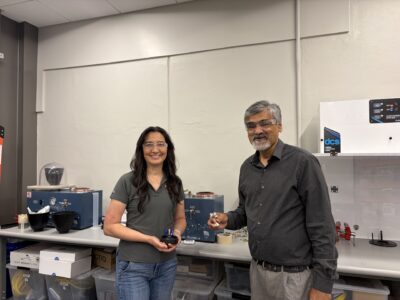
Wheelock works closely with IACMI Chief Technology Officer Dr. Uday Vaidya.
Building an Innovative Curriculum
UTK’s investment casting program hasn’t been around long.
“For us, this is the beginning of investment casting…we started this program about a year and a half ago,” said Wheelock.
The program’s origins began when university faculty, specifically IACMI Chief Technology Officer Dr. Uday Vaidya, identified the need for a specialized casting program that previously did not exist. Wheelock, a mechanical engineer who was auditing a class, was invited to help get the project off the ground.
“By the end of the semester, he’s [Vaidya] like, ‘You know, we’ve got some projects, I need to start up an investment casting program, would you like to come work for us?'”
Stepping into the role of research coordinator, Wheelock became a key part of the team. The program strategically grew from its initial, small-scale concepts, like jewelry, to processing high-temperature industrial metals. Today, the curriculum involves working with Nordic Gold at 2,000°F and castable 356 aluminum alloys to produce precision-engineering components such as miniature turbine blades. “
“Investment casting is everywhere. It’s in aerospace. It’s in automotive. It’s in defense,” Wheelock said of the prominence of cast parts.
METAL is a key aspect of the UTK investment casting program.
“METAL [the program] is a fundamental part of the investment casting program. We teach both sand and investment casting and machining,” said Wheelock. “Teaching the importance of casting is part of developing the next generation of people that can go into the workforce. We’re having diminishing numbers of people that have any knowledge of metalwork.”
The Technical Precision of Investment Casting
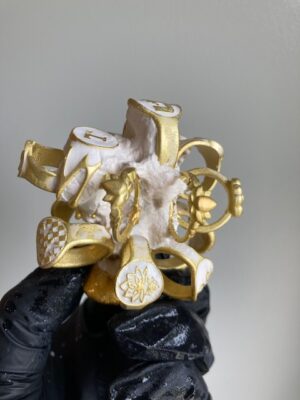
A major focal point of the curriculum is mastering the investment casting process itself. Historically referred to as “lost-wax casting,” this method has evolved significantly in modern foundries. Instead of carving beeswax by hand, students and technicians in the program frequently utilize 3D-printed PLA filaments or wax-based resins to create highly detailed patterns.
These patterns are assembled onto a central sprue, encased in a ceramic slurry, and baked in a burnout oven at extreme temperatures, often for up to 14 hours, to vaporize the original pattern and harden the ceramic. Finally, molten metal is drawn into the mold using advanced vacuum-casting machines. This method eliminates parting lines and achieves exceptional geometric tolerances, producing precision components that require minimal post-process machining. By mastering this technique, students are directly prepared for high-level manufacturing roles in aerospace, automotive, and beyond.
Mentoring the Next Generation
The core mission of the investment casting program is educational outreach. The foundry serves as a dynamic classroom for immersive METAL Bootcamps and workshops. Participants as young as high school age gain hands-on experience with metalcasting and the science behind it.”It’s a great thing when young people are trying to figure out what they want to do, to expose them to a lot of different things,” Wheelock notes. “A lot of people don’t really get exposure to metal casting or metal working, and it may be something that they could find really interesting and make a career out of that they otherwise would have never known existed.”
By teaching the intricate, one-piece mold process of investment casting, the program demonstrates exactly how engineering and materials science intersect. Students learn firsthand how selecting a specific material dictates the manufacturing technique, and how that technique, in turn, alters material properties.
Coming Soon: The Robotic Foundry
The innovation at UT doesn’t stop with traditional casting. Drawing on advanced machine design principles, the university is bringing advanced automation directly into the foundry and its METAL Bootcamps and workshops.
Some of these machines are already active in the foundry, with the full system expected to be online later this summer.
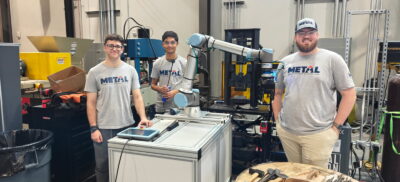
UTK is integrating new robotics tools into its METAL curriculum.
Stay tuned for an upcoming feature exploring how these robotic assistants are revolutionizing safety and precision on the foundry floor.