
The compliance landscape for United States defense contractors underwent a major shift on June 30. With Section 805 of the Fiscal Year 2024 National Defense Authorization Act (NDAA) now officially in effect, the Department of War has instituted a strict prohibition on the procurement of goods or services from entities identified on the Section 1260H list of Chinese military companies, as well as any entities under their control.
For industry partners, this direct ban represents a fundamental restructuring of defense supply chain compliance. Maintaining operational continuity now requires aggressive due diligence, strategic auditing, and a proactive pivot toward domestic manufacturing capabilities.
The ultimate goal of these new regulations is to decouple the defense industrial base from adversarial supply chains and anchor production firmly in the U.S.
METAL, led by IACMI – The Composites Institute®, and funded by the Department of War’s
Office of Industrial Base Policy, was built to revitalize American domestic manufacturing through hands-on training in casting and forging.
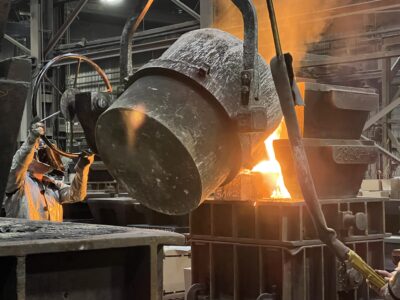
A foundry worker pours molten metal from a crucible.
The Role of the METAL Program
Replacing foreign components in complex defense systems is easier said than done, particularly in sectors suffering from severe domestic labor shortages. Making matters more difficult, decades of offshoring has hollowed out American capabilities in foundational industries. Since the early 1990s, the U.S. has lost immense capacity in casting, forging, and advanced metallurgy.
Lana Smith, a strategic consultant, owner of The Oakley Office and METAL bootcamp graduate, guides small- and mid-sized manufacturers through the complexities of the defense market. She notes that in some cases, domestic machine shops will be forced to reverse-engineer parts they can no longer legally procure from overseas.
This is precisely where METAL (Metallurgical Engineering Trades Apprenticeships & Learning) becomes vital. METAL is designed to address the supply bottlenecks that Section 805 exposes. The program accelerates the training of a highly skilled workforce capable of scaling up domestic production, allowing companies to buy American and comply with these new requirements.
Through K-12 workshops and university bootcamps, METAL introduces students and career seekers to modern metalcasting and forging careers. Participants can complete METAL’s free online training before attending immersive, in-person bootcamps led by professional metallurgists and manufacturing experts across the country.
Smith views programs like METAL as an essential partner for companies looking to shorten lead times and stay competitive. “It’s a very impressive, proactive move for the Department [of War] to give funding to this,” she notes, describing the initiative as a “catalyst” for rebuilding the industrial base. “Manufacturers can immediately lean into the METAL network to recruit trained professionals eager to enter the sector.”
For up to five days, bootcamp participants gain hands-on experience in sand-casting design and pouring processes. The trainees pound sand into molds, learn CAD software, pour molten metal, and machine-finish parts. Participants leave with their own metal creations, foundational metalcasting and forging skills, and a clearer picture of promising careers in aerospace, automotive, and defense manufacturing.
The Compliance Challenge
Navigating Section 805 requires understanding its phased implementation. The immediate “direct ban” prevents the Department from purchasing directly from 1260H-listed firms. However, the more complex hurdle arrives on June 30, 2027. This secondary “indirect ban” extends the prohibition to any contracts that incorporate components, goods, or services produced or developed by listed entities.
For prime contractors and subcontractors alike, this creates an urgent need to map supply chains down to the raw material level. Identifying and phasing out restricted entities is critical to avoiding compliance issues. The sheer depth of modern defense manufacturing makes this a monumental task. To Smith, the true implications of the ban won’t be fully understood until audits and waiver requests begin.
“Because the supply chain has so many tiers… I think a lot of companies don’t realize what is in their supply chain to know if this is going to impact them or not,” Smith explains. She points to the M1 Abrams tank as a prime example. “There are at least 30,000 parts you need just to build it. When you look at the full list of materials on that, it’s like 60,000 items…you don’t always know where it’s [materials] coming from.”
The DOW has established a waiver process that businesses may submit in the name of national interest. The waiver requires a “compelling justification narrative,” comprehensive market analyses, and detailed corporate phase-out plans.
Building a Resilient Industrial Base
When defense regulations restrict foreign supply chains, programs like METAL provide the industrial capacity to fill the void. A recent expansion aims to double the program’s national footprint by 2030, establishing new bootcamps and deploying mobile training units to serve more communities and K-12 classrooms. This scaling up ensures that when a defense contractor needs to source American-made castings or forged components to comply with the 2027 indirect ban, a trained domestic workforce is ready to deliver.
By bridging the gap between federal compliance and industrial capacity, the initiative ensures that supply chain security does not come at the expense of mission readiness.
The Path Forward for Industry Partners
Compliance with Section 805 is mandatory, but achieving it requires a dual approach. Defense partners may use the DOW’s new compliance hub to align with current timelines and, when necessary, navigate the waiver process. Simultaneously, organizations should actively engage with domestic workforce programs like METAL to support, hire, and scale domestic manufacturing and sustain American defense infrastructure for decades to come.