
David Muzzy still remembers his first time visiting a foundry. While his dad, Glenn Muzzy Sr., gave him a tour of Walker Machine and Foundry Corp. where he worked, Muzzy felt the heat radiating from massive induction furnaces and watched as fire-hot metal lost its form—turning into liquid, ready to become something new.
That was the moment Muzzy imagined his future in metal.
Muzzy, 22, followed his father’s footsteps into college, attending Glenn’s alma mater Penn State and majoring in industrial engineering. But it wasn’t until Muzzy held a ladle and poured ductile iron during his first internship that he felt his passion for metalcasting ignite.
“I remember being able to see it all up close—looking at the molten metal flowing, the way you move it around, pouring it. It looks like you are looking into the sun,” Muzzy explained. “You get that really bright light, the flare that comes out of the ladle, and the whole reaction is really cool.”
Every summer after his freshman year, Muzzy interned at Buck Company, a leading manufacturer of ferrous and non-ferrous castings in Lancaster, Pennsylvania. From making sand cores for molds to melting and pouring iron and aluminum to processing finished parts, Muzzy touched every phase of the casting process—or so he thought.
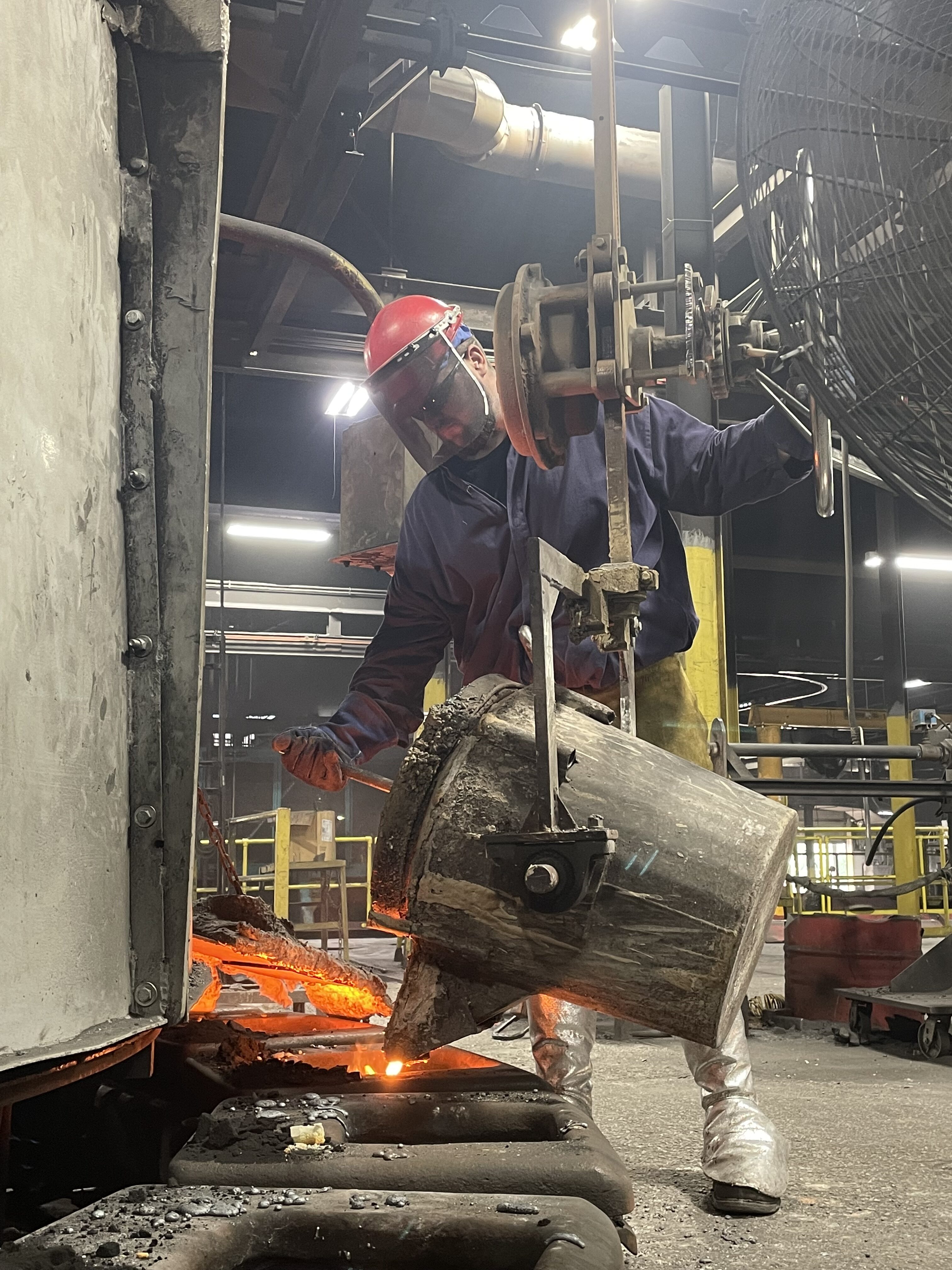
“I went through the entire foundry,” Muzzy said. “I did all the hard manual labor, and that experience is really rewarding. You have long days, but you finish and you feel accomplished.”
College only sparked Muzzy’s curiosity about metallurgy more. He served as vice president and president of Penn State’s American Foundry Society student chapter and received scholarships from the Non-Ferrous Founders’ Society and the Foundry Educational Foundation.
By his senior year, the undergrad went from learning in the foundry to leading innovation. Muzzy knew how demanding the job could be—especially the task of manually lifting and pouring 30 pounds of metal hundreds of times a day. He could see the strain on workers and the risks that came with it. So he set out to build a safer, smarter way.
The solution? Muzzy designed a six-foot robotic arm that reaches into the furnace, retrieves the exact amount of metal for each cast, and pours it in the same spot every time. It reads project-specific codes and automates a job that once required intense physical effort.
“It has increased our production, but the real benefit is we’ve seen a massive increase in employee retention in that department,” Muzzy said. “It’s a hot, brutal environment to work in for 10 hours.”
After seeing the impact he could make, Muzzy returned to Penn State his senior year ready for a new challenge—and he found it at METAL’s metallurgy bootcamp.
Preparing Tomorrow’s Workforce
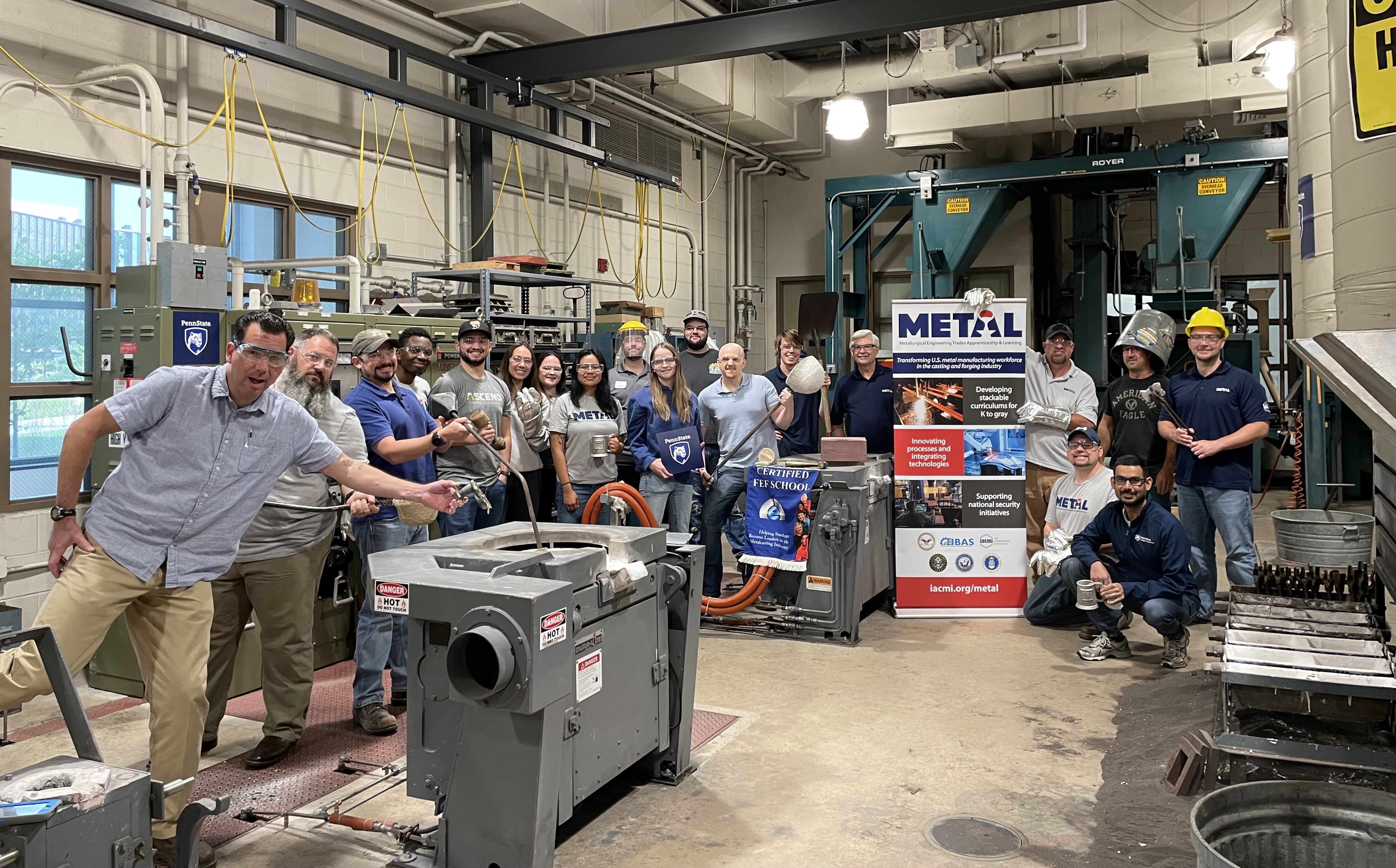
At universities across the country, students, industry professionals and career seekers get a rare chance to fully immerse themselves in metalcasting. Through METAL—led by IACMI – The Composites Institute®, with funding from the Department of War’s IBAS Program—industry professionals deliver a hands-on casting and forging experience for anyone eager to explore metal manufacturing.
The free bootcamps start with a self-paced online training that introduces participants to the metal industry and its career possibilities. Advanced bootcamps for industry professionals cover topics such as the science of green sand and virtual reality, helping manufacturers optimize production.
Dr. Robert Voigt, a professor of industrial and manufacturing engineering who leads Penn State’s bootcamps, has spent more than 35 years teaching metallurgy—and witnessing generations of innovation. Automation, he said, has changed everything.
Robots are now doing manufacturing jobs—cutting molds, pouring metal and sanding casts—that at one time required teams of people in dangerous or harsh conditions. As the industry’s capabilities have evolved, so have customer expectations. Metal workers and engineers must sharpen their skills to keep up, Voigt said.
“Behind all that automation is strong scientific and engineering knowledge. It’ll always be a process with people, but we have to improve our practices and refine our knowledge to be able to deliver the quality that the industry needs,” he added.
For Muzzy, METAL’s bootcamp was an opportunity to learn metallurgical skills that would mold his career. He’d poured metal, but now he had a chance to finish a cast to completion. Using a CNC machine, Muzzy shaved down and perfected a small medallion he made entirely on his own.
Muzzy also learned how to run solidification simulations, which are critical for a foundry’s quality control. Software like MAGMASOFT® help manufacturers predict how molten metal will cool, solidify and form inside a mold. Foundries use it to prevent defects, optimize designs, reduce scrap and accelerate production before they ever pour real metal.
Both machining and simulations were concepts Muzzy never encountered in his college courses or internships. Thanks to METAL’s bootcamp, Muzzy discovered new skills and pathways in metallurgical engineering he’d never considered—or knew existed.
“Before the bootcamp, my head was just at, ‘I’m going to work in the foundry in production, molding and pouring and that’s it,’” Muzzy said. “But being able to see the other side of things and experience different aspects of the foundry made me want to go into a role where I help in different departments, offer input and have influence. It helped me see the bigger picture.”
The Next Generation of Metal
Today, Muzzy is a full-time manufacturing engineer in Buck Company’s iron foundry. He supports machine automation, ensures the right tools and heat codes are in place for production, trains colleagues across departments—and occasionally returns to the robotic pouring arm he built.
“I don’t have a boring day at work,” Muzzy said. “Every day is exciting, every day is interesting, and I really love what I do.”
His father, who’s now Buck Company’s executive vice president, couldn’t be prouder.
“David is part of a great young team we have at Buck, who all have an opportunity to be the next generation of leaders in metalcasting,” said Glenn Muzzy Sr. “I have spent my entire career in the foundry, and it’s rewarding to be a mentor for him and the team.”
Voigt, who taught both father and son, called David Muzzy an industry success story.
“When David hit the ground after he graduated, he was ready to go—he understands the science, he understands the new technology and he understands the people,” Voigt said.
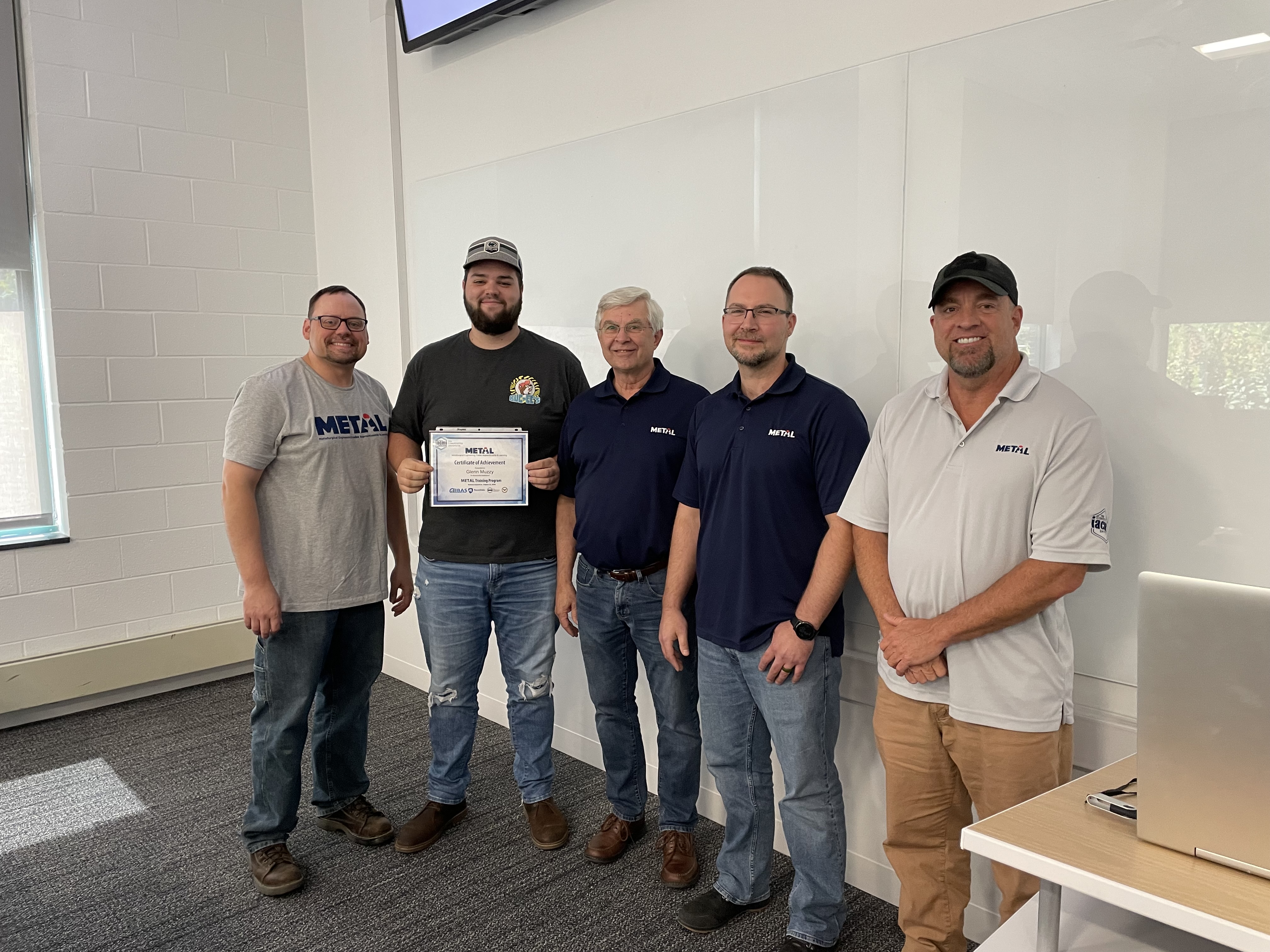
METAL’s Penn State bootcamp reinforced Muzzy’s passion for the foundry, revealing career opportunities he never knew were there. He recommends the experience to anyone open to trying something new—and who wants to make a difference.
“Take the opportunity to hold the metal in your hands and pour it yourself,” and, he added, “don’t place yourself above anything. There are a lot of opportunities to grow if you’re willing to learn.”
Ready to shape the future of American manufacturing? Register for our free online training then visit our events page to attend the next METAL bootcamp near you.