
“Companies need to know their destination before choosing their tech. If you don’t know where you’re going, any road will get you there,” said Jim Wetzel, co-founder of NxGen, quoting Alice in Wonderland.
Wetzel has been a leader in manufacturing for decades, and was a keynote speaker at the most recent AFS Industry 4.0 conference.
This strategic communication principle is the bedrock of successful Industry 4.0 adoption. Companies can’t simply plug in a new system and expect optimization without a clear blueprint of their desired business outcomes.
Wetzel cited a report from MIT that 95% of generative AI pilots at companies are failing.
The leading reason for these failures?
Lack of alignment to business outcomes.
“Know the value first,” Wetzel said, reiterating that understanding the business’ needs before making big spends on technology was key to successful implementation.
The 2026 American Foundry Society (AFS) Foundry Industry 4.0 Conference was held in Minneapolis on July 28-30. The METAL team was there to see firsthand the future of the foundry floor.
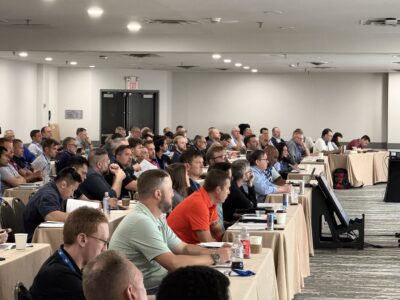
From AI integration to advanced robotics, the future of foundries is both high-tech and dependent on a skilled workforce.
METAL, led by IACMI – The Composites Institute®, and funded by the Department of War’s Office of Industrial Base Policy, was created to revitalize American manufacturing through hands-on training in metalcasting and forging. Finding workers was a recurring point of discussion amongst attendees and during the tour of the 3M CAM facility in Saint Paul, MN.
Through K-12 workshops and university bootcamps, METAL introduces students and career seekers to modern metalcasting and forging careers. Participants can complete METAL’s free online training course before attending immersive, in-person bootcamps led by professional metallurgists and manufacturing experts.
1. The Stakes Are Higher Than Ever
Todd Hutcheson, Director of Advance Iowa and the Center for Business Growth and Innovation at the University of Northern Iowa, provided a sobering look at the industrial landscape.
American metalcasting is at a crossroads.
Ninety percent of all manufactured goods contain castings, yet the number of U.S. casting plants has declined by 72 percent since 1991.
The path forward? Embracing technologies that bring smart manufacturing back to the U.S. while improving resiliency.
“Value comes from change when it enables new or improved capability and from stability when it preserves or better controls existing capability,” Hutcheson said. “Industry 4.0 implementation accomplishes both.”
Despite the decrease in facilities, Hutcherson noted the importance of casting and foundries to the economy. The industry supports nearly 800,000 jobs across the supply chain and is valued at over $50 billion.
Hutcheson also touched on how University of Northern Iowa (UNI), a METAL partner university, is tackling industry challenges. The school’s Metal Casting Center, Foundry 4.0 Center, and Center for Business Growth and Innovation work together to “engage students and staff in research and education.” UNI will soon begin offering METAL Bootcamps as part of this mission.
2. The (AI) Elephant in the Room
Artificial intelligence was a hot topic among speakers and exhibitors. Mike Lakas, Senior VP for IT at the American Foundry Society touched on everything from Large Language Models (LLMs) and transformers to the influx of Chat GPT-generated content. The core takeaway was separating practical utility from marketing buzz. The highlight of Lakas’ presentation was a comparison of outputs asking generative AI to produce an image. The difference between the initial image generated years ago and the video made this year was staggering and demonstrated a point he had made earlier: “We tend to overestimate progress in the short-term and underestimate it in the long run.”
Conor Keenan of Sinto America, who played a role in developing the new SMART Foundry at Purdue University, detailed how intelligent data tools are already making an impact. He explained that these tools are more than data collectors; they use advanced pattern recognition to drive real-time decision-making.
“When you get your data is just as important as getting the data itself,” he stated.
3. Who Let the Dogs Out?
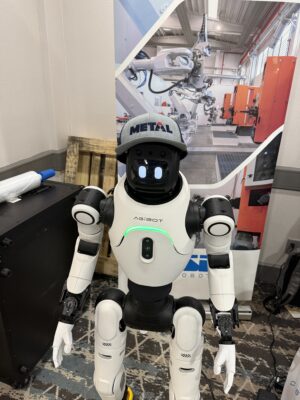
SIR Robotics, an Italian company with offices in California, showed off their robot Luciano.
Attendees were treated to case studies showing how digital tools are already yielding massive ROI on the floor:
Spot the Robot Dog: Jacob Moreau showcased how a Boston Dynamics robot is performing over 120 autonomous inspections for a Toyota NA camshaft supplier.
“The bot paid for itself in ROI within 10 months,” he said.
Spot uses thermal imaging, LiDAR, and acoustic leak detection to monitor equipment across the 200,000 sq ft facility.
Precision Pouring: Operations Data Analytics Engineer Ellyn Neubauer described how optimizing furnace controls using pyrometer data has impacted Mercury Marine, which manages an incredible 1.6 million pounds of poured steel per year. The use of the two-color pyrometer system has enabled continuous indirect temperature feedback, leading to more controlled furnace melts.
4. At the Forefront of Cyber Security Compliance
The conversations around smart energy and cybersecurity are urgent. ECK Industries recently became the first foundry and one of the first 50 companies to achieve CMMC (Cybersecurity Maturity Model Certification) Level 2. This framework requires defense contractors to protect Controlled Unclassified Information (CUI) and applies to any company handling CUI in the DoW supply chain. This information can include drawings, specs and technical data, etc.
Aaron Hayon, Director of Technology and Security at Eck Industries, and Jeremy Mares, who manages federal accounts at Redspin, provided an overview of the CMMC guidelines and Eck’s journey to certification.
“Trying to be the first to do something within an industry is always challenging. It seems that every day we learn something new about how requirements should be interpreted, how the CMMC program continues to evolve, and how available tools can be leveraged more effectively,” noted Hayon of the process.
The Takeaway
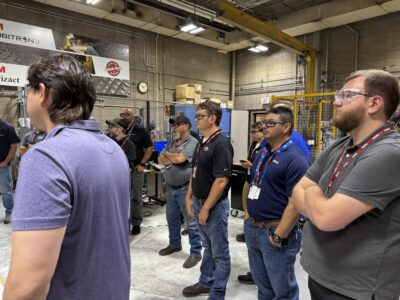
AFS Attendees were able to tour the 3M CAM Lab in Saint Paul, MN.
For us at METAL, the AFS Foundry Industry 4.0 Conference is a clear signal that our mission has never been more vital.
The technological advancements showcased in Minneapolis, from autonomous robotic inspections to AI-driven process optimization, offer a definitive path forward for reversing the decline of U.S. casting and forging facilities.
However, this digital transformation cannot succeed without a workforce capable of executing it. By continuing to offer expert-designed online and hands-on training, as well as stackable credentials, METAL is actively equipping the next generation of metalcasting pros with the digital know-how and problem-solving skills required to bring the Industry 4.0 vision to life on the foundry floor.