
Heavy hammers. High heat. Glowing metal. These are all images that come to mind when one pictures a foundry. While the heat and the molten materials remain central, the modern foundry floor is undergoing a massive technological transformation, and METAL is staying on top of the game. Our partners, including the University of Tennessee Knoxville, are bringing advanced robotics directly into the educational space. Bootcamp and workshop participants are getting a firsthand look at how smart manufacturing is reshaping the trades. It is no longer just about melting and pouring; it is about precision, safety, and efficiency.
Heavy Industry and High Tech
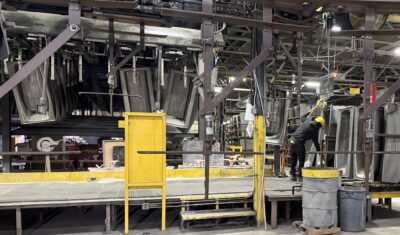
At the Kohler Foundry in Kohler, WI, high tech machines allow workers to move heavy cast iron tubs safely and with ease.
When participants step into a modern metal workshop, they see advanced robotic arms operating just feet away from traditional sand casting tables and investment casting stations. This pairing of the old and the new demonstrates the real-world applications of automation in manufacturing. Today’s industry relies heavily on automation to handle repetitive, dangerous, or highly precise tasks. By integrating these dynamic machines into the learning environment, bootcamps provide a comprehensive, 360-degree view of modern production pipelines.
Precision and Durability on the Foundry Floor
Industrial-strength heavy lifters, utilized in large-scale factory settings, are built to withstand the intense rigors of heavy industry. During induction forging demonstrations, these robust robotic arms handle the high-stress, high-heat tasks.
Paul, a UTK computer science student working on the foundry robots, explained the specific advantages of their UR12e model: “The UR12e on the other hand is actually used in industry as a factory robot, so that’s what we use for the induction furnace. It’s a little more durable, it can take more stress and stuff, and it’s also a lot easier to program.”
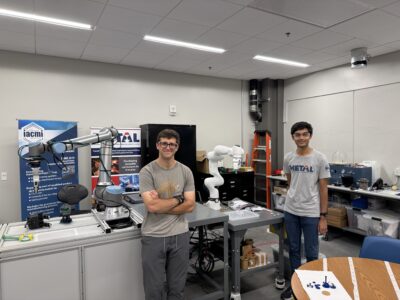
Tennessee students Paul and Vishnu work with the robotics used for METAL workshops and bootcamps.
These industrial machines are programmed to grip cylindrical metal pucks and precisely manage their thermal cycles. Describing the automation of this intense environment, Paul says they will “heat them up till they’re like orange, almost white-hot, and then we put them in a hydraulic press and we stamp the METAL logo into them.”
After the stamping process, the robotic arms smoothly transition metal into a cooling water bath. “We also have it dunk the puck in water to cool it off afterward so you can control how long it swirls,” Paul notes, ensuring the metallurgical properties of the token or tool are properly set without ever risking human burns.
In contrast to heavy-duty factory arms, smaller precision robots are deployed for tasks requiring delicate, highly accurate movements. Utilizing advanced camera systems and artificial intelligence, these robots perform dynamic location and sorting functions.
Vishnu, another researcher working on robotics, explains that the system uses a “machine learning algorithm to take a picture of it, identify the shapes within the picture, and then set those as positions for it to come pick up and do stuff with.”
This level of precision requires meticulous calibration to ensure the robots function correctly. Because some colors naturally lack contrast in a factory setting, the team has to adapt the materials for the robot’s optical sensors. “We cover them with white so it has higher contrast; it’s easier for the robot to see,” Paul explains, highlighting the real-world troubleshooting required to make automation seamless.
Enhancing Safety Without Replacing the Artisan
A common misconception surrounding industrial automation is the fear of human obsolescence. However, the core philosophy demonstrated in these technical workshops is that robotics are implemented to enhance human capability, not replace it. Introducing a robotic arm to a blistering induction furnace has an incredibly straightforward benefit: operator safety.
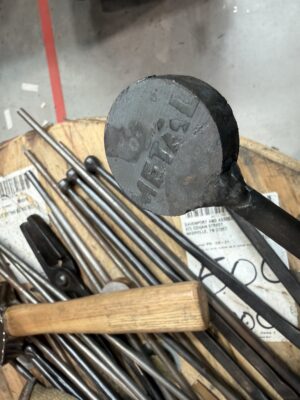
A metal cylinder handled by a robotic arm and stamped with the METAL logo.
By delegating the most dangerous and physically demanding steps to machines, human workers are shielded from extreme temperatures, hazardous fumes, and repetitive motion injuries.
Paul perfectly summarized this ethos when discussing the robotic programming: “The idea is not to take the job from a human but to give a human greater control and safety over the process.” Consequently, the human element shifts from brute force to high-level process management. An operator working alongside a robotic arm is making critical decisions, controlling parameters via a tablet, and ensuring stringent quality control. The artisan’s deep knowledge of metallurgy is more critical than ever; the robot simply serves as a highly advanced tool that executes the artisan’s commands with unwavering consistency.
Training the Next Generation of Innovators
Ultimately, the inclusion of robotics in metal bootcamps serves as a critical bridge for the future workforce. Engaging with these technologies early on demystifies the programming, calibration, and maintenance of industrial machines. When students and participants adjust a time parameter on a tablet and immediately watch a robotic arm adapt its workflow in real-time, the advanced concepts of smart manufacturing become highly accessible.
The skills honed in these workshops go far beyond basic metalworking or simple casting. Participants leave with a foundational understanding of integrated manufacturing systems, machine learning applications in quality control, and the strict safety protocols required in automated environments. By striking this balance between traditional craftsmanship and next-generation technology, the industry is forging a smarter, safer, and incredibly innovative future.