Forging the Future: How Hands-On Experience is Shaping the Next Generation of Engineers

The manufacturing sector in the United States is at a critical inflection point, requiring brilliant young minds who are ready to tackle modern challenges with innovative, sustainable solutions.  

At just 21 years old, Mhakayla Johnson is already working to make the world a better place. Going into her senior year as a mechanical engineering student at Alabama A&M University, she is conducting research on composite materials that are more sustainable and easier to recycle. While interning this summer at the University of Alabama at Birmingham, Johnson was encouraged by her mentor, Dr. Haibin Ning, to attend a METAL bootcamp.  

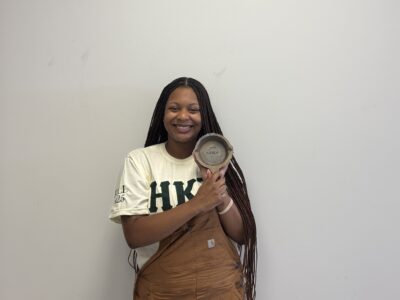
Johnson poses with the skillet she made at the UAB Bootcamp

METAL, led by IACMI – The Composites Institute®, and funded by the Department of War’s Office of Industrial Base Policy, was built to revitalize American manufacturing through hands-on training in casting and forging. 

Through K-12 workshops and university bootcamps, METAL introduces students and career seekers to modern metalcasting and forging careers. Participants can complete METAL’s free online training before attending immersive, in-person bootcamps led by professional metallurgists and manufacturing experts across the country. 

For five days, UAB bootcamp participants gain hands-on experience in sand casting design and pouring processes. The trainees pound sand into molds, learn CAD software, pour molten metal, and machine-finish parts. Participants leave with their own metal creations, foundational metalcasting and forging skills, and a clearer picture of promising careers in aerospace, automotive and defense manufacturing.    

At bootcamp, Johnson gained critical, hands-on experience necessary to transition from classroom theory to real-world application.  

“I’m just a hands-on kind of person, you know. I like to work with my hands, I like to build and create stuff and improve things,” she says. Her journey highlights the vital importance of experiential learning in science, technology, engineering, and mathematics (STEM). 

Engineering a Sustainable Tomorrow 

Johnson’s current research, conducted under the mentorship of Dr. Ning through the REU research program, is deeply focused on manufacturing sustainability. She is actively exploring the creation of composites using cellulose and hemp fibers.  

“Dr. Ning told me I should step into the metal bootcamp so I can get my hands dirty and add more knowledge to what I already have,” she said of expanding her materials understanding.  

Currently, industries ranging from automotive to aerospace rely heavily on materials like carbon fiber. While highly effective, these materials are notoriously difficult to recycle. By researching viable, sustainable alternatives, Johnson is addressing a critical environmental challenge head-on. 

“Recyclability and just making our planet a better place [is important],” Johnson explains. “With carbon fibers… it’s very hard to recycle. And that’s why I’m glad I’m doing the research with Dr. Ning so that we can do research on composites and find different materials, better materials than the ones that are already being used.” 

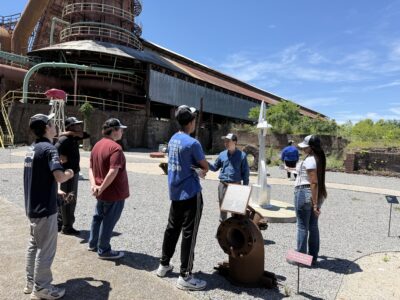
A group of student takes in the view of a retired historic foundry.

Johnson toured the historic Sloss Furnace site with her UAB Bootcamp classmates.

Nurturing a Lifelong Passion for STEM 

Johnson’s journey into science was no accident. Her mother, an Alabama A&M physical science professor, nurtured her passion for building and creating from an early age through robotics and STEM camps. “She didn’t just push me into it; she realized what my interests were as a kid and put me on that path,” Johnson stated.  

“I was a really hands-on creative type of kid,” she recalls. “I loved to draw, and I was very artistic… I want to be an engineer, I want to build stuff, I want to make stuff.”  

In high school, Johnson began welding and looking into different types of engineering, landing ultimately on mechanical. 

Despite identifying as a hands-on creator rather than a natural mathematician, her determination allowed her to excel.  

“This might sound crazy,” she said, but I was never the best at math…I understood it, but it took me more to get there. I had to study a little bit harder and just apply myself a little bit more.”  

Her story is a powerful testament to the fact that success in engineering requires immense creativity and perseverance just as much as raw calculation. 

Strengthening Foundations 

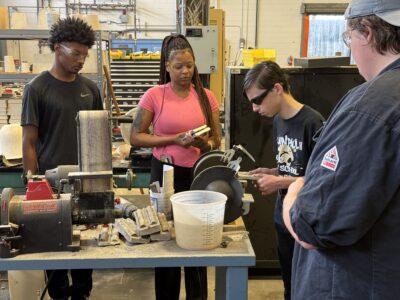
A student polishing a cast piece of metal on a grinder while others wait their turn.

Bootcamp participants take turns processing recently cast pieces.

While Johnson’s research focuses on sustainable composites and natural fibers, a foundational understanding of metallurgy is vital for innovations in material science. By participating in the METAL bootcamp, students like Johnson gain a comprehensive view of how traditional metalcasting interacts with modern materials.  

One example of this at UAB involved a project to produce composite screws that could be used on offshore oil rigs while maintaining strength similar to steel. Understanding the science behind both metal and non-metal materials proved vital in this pursuit.  

Johnson noted the lab at UAB was a great place to “actually see the real-world applications of what I’m learning.” 

METAL Bootcamps also dive into sustainability, teaching students about cleaner melting techniques and demonstrating them, as demonstrated by the use of the induction furnaces at the UAB lab.  

Inspiring the Next Generation 

As she looks toward her senior year and contemplates furthering her education, Johnson offers advice to aspiring young engineers. 

“Keep going and pushing towards your dreams,” she advises. “There’s nothing that you want to do that you can’t do… Take heed to your resources and believe in yourself. Stick to the course, your dreams can come true if you put in the work to achieve them.” 


Mark Rubeo with Penn State University – Behrend ACE Program

Check out this episode of Industrial Talk featuring Mark Rubeo with the Penn State – Behrend ACE program..

Industrial Talk is onsite at Penn State and talking to Dr. Mark Rubeo, Associate Professor of Mechanical Engineering with Penn State about “Educating the Future Industrial Leaders”.

Scott Mackenzie hosts the Industrial Talk podcast, celebrating industry professionals and their innovations. At Penn State University, the ACE (America’s Cutting Edge) program, led by Mark Rubeo, addresses the shortage of skilled workers in manufacturing. The program, designed pre-COVID by Tony Schmitz and his team, uses a hub and spoke model to provide training across the US. Rubeo, an assistant professor with a CNC machinist background, emphasizes the importance of manufacturing knowledge for mechanical designers. The ACE program aims to excite and educate future technicians and engineers, fostering a sense of accomplishment and high-tech skills in manufacturing.


Victor Okhuysen with Cal Poly Pomona

Check out this episode of Industrial Talk featuring Victor Okhuysen with Cal Poly Pomona.

Industrial Talk is onsite at Penn State and talking to Victor Okhuysen, Professor with Cal Poly Pomona about “Strengthening the future of manufacturing”.

Scott Mackenzie from Industrial Talk discusses the importance of training the next generation of industrial leaders with Victor Okhuysen from Cal Poly Pomona. The Penn State Erie campus hosts the METAL program, which aims to inspire and educate students in metallurgy and manufacturing. Victor, a principal investigator, highlights the program’s hands-on approach, including boot camps and workshops, to expose students to potential careers. The program has conducted four boot camps and ten workshops, using a system called Foundry in a Box. Victor emphasizes the need for skilled workers in an increasingly automated industry and the role of community colleges in providing relevant training.


Robert “Bob” Voigt with Penn State University – METAL Program

Check out this episode of Industrial Talk featuring Robert “Bob” Voigt with Penn State University

Industrial Talk is onsite at Penn State and talking to Robert “Bob” Voigt, Professor with Penn State University about “Educating the Future Manufacturing Leaders”.

The conversation highlights the importance of the Barcelona Cybersecurity Congress, scheduled for November 3-5, 2023. The Industrial Talk podcast, hosted by Scott Mackenzie, features an interview with Robert Voight, a professor at Penn State Behrend, discussing the Metallurgical Engineering Trade Apprenticeship and Learning (METAL) program. Voight emphasizes the hands-on experience provided to students, including foundry visits and practical metal casting. He also discusses the evolution of materials like austempered ductile iron and the integration of digital technologies to improve manufacturing efficiency and quality. Voight’s contact information is available for those interested in learning more.


Industrial Talk: Dr. Paul Lynch with Penn State METAL Program

Check out this episode of Industrial Talk featuring Penn State Associate Professor Dr. Paul Lynch.

Scott Mackenzie hosts the Industrial Talk podcast, celebrating industry professionals and their contributions. In this episode, he interviews Dr. Paul Lynch, who oversees the Metallurgical Engineering Trade Apprenticeship and Learning (METAL) program at Penn State Erie. Dr. Lynch discusses the importance of manufacturing in Erie, Pennsylvania, and the METAL program’s role in training the next generation of skilled workers. He emphasizes the need for hands-on training and collaboration between industry and academia to address the workforce shortage. The program aims to inspire interest in manufacturing careers and provide practical skills through boot camps and apprenticeships. Dr. Lynch also highlights the upcoming new center for manufacturing competitiveness at Penn State Erie.


Small But Mighty: TOSOH SMD Powers Semiconductor Innovation with METAL Bootcamp

Cyler McClure has spent his career studying the ins and outs of semiconductors—microscopic metal switches that power today’s world. Now, as product engineering manager at TOSOH SMD, McClure empowers the engineers and technicians driving America’s semiconductor industry forward.

When he learned about METAL’s metallurgy bootcamp at Ohio State University from his director, Eduardo del Rio, McClure knew this was a training opportunity the team couldn’t miss.

“We thought the bootcamp would help grow the knowledge of our workforce,” said del Rio, who serves as the director of research and development at TOSOH SMD, a leading supplier of semiconductor materials in Ohio.

Built from billions of transistors, minuscule stacks of silicon and metal, semiconductors operate everything from smartphones and laptops to robotics, medical devices and GPS systems. You’d never know semiconductors exist—except for their massive impact. Semiconductors underpin more than 300 industries, including automotive, manufacturing, healthcare and U.S. defense. The technology is so far-reaching that one semiconductor job generates more than five new jobs across America’s economy.  

“Semiconductors are used in everything,” del Rio explained. “You see it in your everyday life—smart factories, smart cities, facial recognition, voice recognition, artificial intelligence. As we get into a more electronically-automated life, semiconductors need to continue progressing.” 

But semiconductor production, much like other metal products, is at risk in the U.S. 

By 2033, almost 4 million manufacturing jobs could be available nationwide, without the skilled labor to fill them. The semiconductor industry alone faces a shortage of 67,000 technicians, computer scientists and engineers—a gap that threatens America’s supply chain resilience and security.

TOSOH SMD is working to meet this demand, relying on strong materials, an innovative team and industry-wide collaboration. “We truly believe in partnering with universities and other industries to foster collaboration and growth of materials science in the U.S., especially for the semiconductor industry where TOSOH SMD is a critical supplier,” del Rio said. 

Del Rio shared METAL’s bootcamp with TOSOH SMD’s casting technicians, PhD materials engineers and managers. For McClure, it felt like the perfect opportunity to refresh his team on metal manufacturing basics and learn cutting-edge techniques for incredibly fine metalcasting. 

“I’ve always had a strong interest in materials, especially metals, so I was excited for the opportunity to revisit core concepts,” McClure said. “My goal was to gain practical insights I could bring back to support smarter design choices.”

Plus, McClure admitted, he was eager for a week spent transforming metal in the foundry. 

Back to the Basics

Led by IACMI – The Composites Institute®, with funding from the Department of Defense’s IBAS Program, METAL introduces students, career seekers and industry professionals to the possibilities of metalcasting. Through free online training and hands-on casting and forging experiences at universities nationwide, participants explore the metal industry—and pour molten metal into creations of their own. 

METAL also upskills America’s manufacturing workforce through advanced bootcamps for metallurgists and metal workers. Industry professionals start with self-paced, online modules, building their foundation in materials science. Then, with the basics covered, they’re ready to spark their curiosity in the foundry with topics like the science of sand and digital technologies for casting.

Ohio State University researcher and bootcamp lead Dr. Jason Walker said he wants people to understand how complex and diverse the world of metal manufacturing is. 

“Metalcasting is not just pouring liquid metal in a foundry,” Walker explained. “Behind every pour is an entire industry: people engineering binders and coatings, developing next-gen refractories, building high-temperature furnaces and controls, running multiphysics simulations, integrating automation and robotics, advancing additive manufacturing, inspecting parts, handling post-processing—the list goes on. The foundry floor is just one node in a much larger ecosystem that has many different needs.”

When it comes to tech manufacturing, McClure knows exactly what it takes to build a powerful semiconductor. The Ohio State alum has developed new casting techniques for metals used in transistors and refined the chemistry of aluminum for enhanced semiconductor performance. Today, his team designs metal alloys to fuel tomorrow’s groundbreaking technology.

“I love working with people. I was really excited to get into a management position so I could better support others and help train everyone to be the best version of themselves,” McClure said. 

Together McClure’s team returned to the foundations of metallurgy at The Ohio State University. Technicians and engineers each cast an aluminum stein, a brass medallion and their own lost foam casting—McClure made a candle holder for his wife. But their work wasn’t over when the metal cooled. Then the team learned the art of finishing a casting with heat treatment, CNC machining, grinding and polishing. 

“I was surprised by how much hands-on experience was offered. My favorite activity was the opportunity to pour, by hand, molten aluminum and brass, not just once, but several times each day,” McClure said. “We got to take home some really cool trinkets, which was exciting and added a sense of ownership to the experience.”

The team also learned simulation software to prevent defects in semiconductors before production even begins. Using MAGMASOFT®, bootcamp participants studied the theoretical temperature of metal as it solidifies. If the metal doesn’t solidify correctly, the casting can end up with defects like air bubble holes, resembling the inside of baked bread.     

Avoiding defects in semiconductor production is essential, McClure said. Even the smallest imperfection can lead to excessive production delays, device failure and millions in lost revenue. High-quality is a fingerprint of TOSOH SMD’s semiconductor materials, imprinted in the team’s DNA.

McClure and his colleagues took quality testing beyond simulations, too. They performed fluidity spiral tests to determine how well molten metal flows through a mold, indicating its ideal pouring temperature, and tensile tests helped measure how much stress a casting can take before it breaks. In-person testing showed the team how to bring new quality control processes back to the lab—fine-tuning metal structures to meet the demands of advanced semiconductor development.     

“This experience helped all of us step back from our daily routines and see manufacturing challenges from a broader perspective,” McClure said. “It bridged gaps between roles and encouraged a shared understanding that will strengthen our teamwork and problem-solving going forward.” 

Powering a Smarter Tomorrow 

Thanks to METAL’s bootcamp, everyone from TOSOH SMD returned home with new and refreshed skills to sharpen the company’s competitive edge. Technicians gained engineering insight to strengthen product quality; material engineers bridged theory with hands-on practice; and managers deepened collaboration—molding a manufacturing team built for the future.

Would McClure recommend the bootcamp to other managers? Absolutely. 

“Investing in this kind of training benefits not just the company, but the industry as a whole—promoting smarter manufacturing, better process control and a more unified approach to solving casting and manufacturing challenges,” he said.

As McClure motivates his team in the lab, his director, del Rio, keeps his eyes on the future of semiconductor innovation—looking for opportunities to grow TOSOH SMD’s research and people. 

“The semiconductor industry has a great future,” Del Rio said. “We just need to continue building the workforce and ecosystem to push it to its full potential.”

Ready to power the future of American manufacturing? Register for our free online training, then visit our events page to attend the next METAL bootcamp near you.

A Family Trade: David Muzzy Joins Buck Company’s Next Generation of Metal Innovators

David Muzzy still remembers his first time visiting a foundry. While his dad, Glenn Muzzy Sr., gave him a tour of Walker Machine and Foundry Corp. where he worked, Muzzy felt the heat radiating from massive induction furnaces and watched as fire-hot metal lost its form—turning into liquid, ready to become something new. 

That was the moment Muzzy imagined his future in metal. 

Muzzy, 22, followed his father’s footsteps into college, attending Glenn’s alma mater Penn State and majoring in industrial engineering. But it wasn’t until Muzzy held a ladle and poured ductile iron during his first internship that he felt his passion for metalcasting ignite.  

“I remember being able to see it all up close—looking at the molten metal flowing, the way you move it around, pouring it. It looks like you are looking into the sun,” Muzzy explained. “You get that really bright light, the flare that comes out of the ladle, and the whole reaction is really cool.” 

Every summer after his freshman year, Muzzy interned at Buck Company, a leading manufacturer of ferrous and non-ferrous castings in Lancaster, Pennsylvania. From making sand cores for molds to melting and pouring iron and aluminum to processing finished parts, Muzzy touched every phase of the casting process—or so he thought.

“I went through the entire foundry,” Muzzy said. “I did all the hard manual labor, and that experience is really rewarding. You have long days, but you finish and you feel accomplished.”

College only sparked Muzzy’s curiosity about metallurgy more. He served as vice president and president of Penn State’s American Foundry Society student chapter and received scholarships from the Non-Ferrous Founders’ Society and the Foundry Educational Foundation

By his senior year, the undergrad went from learning in the foundry to leading innovation. Muzzy knew how demanding the job could be—especially the task of manually lifting and pouring 30 pounds of metal hundreds of times a day. He could see the strain on workers and the risks that came with it. So he set out to build a safer, smarter way.

The solution? Muzzy designed a six-foot robotic arm that reaches into the furnace, retrieves the exact amount of metal for each cast, and pours it in the same spot every time. It reads project-specific codes and automates a job that once required intense physical effort.

“It has increased our production, but the real benefit is we’ve seen a massive increase in employee retention in that department,” Muzzy said. “It’s a hot, brutal environment to work in for 10 hours.”

After seeing the impact he could make, Muzzy returned to Penn State his senior year ready for a new challenge—and he found it at METAL’s metallurgy bootcamp

Preparing Tomorrow’s Workforce

At universities across the country, students, industry professionals and career seekers get a rare chance to fully immerse themselves in metalcasting. Through METAL—led by IACMI – The Composites Institute®, with funding from the Department of War’s IBAS Program—industry professionals deliver a hands-on casting and forging experience for anyone eager to explore metal manufacturing.

The free bootcamps start with a self-paced online training that introduces participants to the metal industry and its career possibilities. Advanced bootcamps for industry professionals cover topics such as the science of green sand and virtual reality, helping manufacturers optimize production.

Dr. Robert Voigt, a professor of industrial and manufacturing engineering who leads Penn State’s bootcamps, has spent more than 35 years teaching metallurgy—and witnessing generations of innovation. Automation, he said, has changed everything.  

Robots are now doing manufacturing jobs—cutting molds, pouring metal and sanding casts—that at one time required teams of people in dangerous or harsh conditions. As the industry’s capabilities have evolved, so have customer expectations. Metal workers and engineers must sharpen their skills to keep up, Voigt said. 

“Behind all that automation is strong scientific and engineering knowledge. It’ll always be a process with people, but we have to improve our practices and refine our knowledge to be able to deliver the quality that the industry needs,” he added.

For Muzzy, METAL’s bootcamp was an opportunity to learn metallurgical skills that would mold his career. He’d poured metal, but now he had a chance to finish a cast to completion. Using a CNC machine, Muzzy shaved down and perfected a small medallion he made entirely on his own. 

Muzzy also learned how to run solidification simulations, which are critical for a foundry’s quality control. Software like MAGMASOFT® help manufacturers predict how molten metal will cool, solidify and form inside a mold. Foundries use it to prevent defects, optimize designs, reduce scrap and accelerate production before they ever pour real metal. 

Both machining and simulations were concepts Muzzy never encountered in his college courses or internships. Thanks to METAL’s bootcamp, Muzzy discovered new skills and pathways in metallurgical engineering he’d never considered—or knew existed.

“Before the bootcamp, my head was just at, ‘I’m going to work in the foundry in production, molding and pouring and that’s it,’” Muzzy said. “But being able to see the other side of things and experience different aspects of the foundry made me want to go into a role where I help in different departments, offer input and have influence. It helped me see the bigger picture.”

The Next Generation of Metal

Today, Muzzy is a full-time manufacturing engineer in Buck Company’s iron foundry. He supports machine automation, ensures the right tools and heat codes are in place for production, trains colleagues across departments—and occasionally returns to the robotic pouring arm he built.

“I don’t have a boring day at work,” Muzzy said. “Every day is exciting, every day is interesting, and I really love what I do.”

His father, who’s now Buck Company’s executive vice president, couldn’t be prouder.

“David is part of a great young team we have at Buck, who all have an opportunity to be the next generation of leaders in metalcasting,” said Glenn Muzzy Sr. “I have spent my entire career in the foundry, and it’s rewarding to be a mentor for him and the team.” 

Voigt, who taught both father and son, called David Muzzy an industry success story.

“When David hit the ground after he graduated, he was ready to go—he understands the science, he understands the new technology and he understands the people,” Voigt said. 

METAL’s Penn State bootcamp reinforced Muzzy’s passion for the foundry, revealing career opportunities he never knew were there. He recommends the experience to anyone open to trying something new—and who wants to make a difference.

“Take the opportunity to hold the metal in your hands and pour it yourself,” and, he added, “don’t place yourself above anything. There are a lot of opportunities to grow if you’re willing to learn.”

Ready to shape the future of American manufacturing? Register for our free online training then visit our events page to attend the next METAL bootcamp near you.


Great Question Podcast: Forming Metal Heads: How To Address the Metals Casting and Forging Skills Gap

Check out this episode of Great Question: A Manufacturing Podcast featuring METAL Program Manager Mike Kubacki.

Manufacturers understand the skills gap: every day they recognize that do not have enough people or enough of the right people to execute the difficult and sometimes dirty, often dangerous tasks like pouring and forming molten materials, grinding or machining parts, treating and handling those parts, welding and finishing components and systems, etc. It’s more than a practical problem. It’s an economic and institutional crisis.

The Metallurgical Engineering Trades Apprenticeship and Learning program (METAL) established by the Dept. of Defense in 2024 is moving fast to resolve it, setting up and coordinating practical training in critical disciplines for metal casting and metal forging processes at seven universities, and drawing in fresh minds who ensure that knowledge and practical understanding continue to be available to engineers and investors in the decades ahead of us.

Mike Kubacki, program manager for METAL describes the program and its progress.


Anderson County Students Experience Forging Firsthand at UT Knoxville

Original source: WBIR

Students from Anderson County, Tennessee, recently visited our partners at the University of Tennessee, Knoxville (UTK) for an immersive, hands-on forging workshop. During the session, students explored the properties of metal through a series of interactive activities that connected classroom concepts with real-world applications in metallurgy and materials science.

Their first activity was clay forging, which introduced them to the behavior of metal under heat by using modeling clay to simulate how metal behaves during the forging process. Students practiced drawing out and upsetting the clay, then pressed images into their finished pieces before setting them to cure.

Next came sand casting, where students used their 3D-printed designs from school to create molds and pour molten tin, transforming their digital models into tangible cast shapes. Meanwhile, small groups took turns participating in induction forging, heating metal “lollipops” until they were red hot, then hammering their initials into them. 

Watch the full coverage here

Pouring Metal and Powering National Defense: DoD Contractors Join METAL Bootcamp

Melissa Walston and Rachel Reed have spent their careers traveling the world, learning languages and guiding U.S. diplomats across foreign nations and cultures. But when it came to navigating a foundry for the first time, they felt lost. 

In their new roles as Department of Defense contractors with Vision Point Systems, Walston and Reed support metal manufacturing projects for the Navy’s Carderock Naval Surface Warfare Center. Carderock is the Navy’s premier center for engineering, modeling and testing ships and ship systems. Its mission spans ship design, naval architecture and the strength of the structures that keep sailors safe at sea. At its core, both Carderock’s success and the future of U.S. defense rely on one critical capability: consistent, high-quality metal production.

“Metal is in everything,” said Reed, who’s a program analyst. “The Naval Service Warfare Center and other government agencies require a strong base of manufacturers who can provide the materials we need at the scale and to the specification we need—and that’s not easy.” 

Reed joined Vision Point Systems in February after 15 years managing international exchange programs and delegation visits. Her superpower? Connecting the right people and organizations, no matter where they’re from. Now Reed coordinates contracts between metal manufacturers and the Navy. But to lead this collaboration, she needed to understand the world of metallurgy.  

“When I first did an audit visit at a foundry, it was awesome, but it was also confusing,” said Reed. “The terminology was so unfamiliar to me, it was like a different language.”

Reed, who is fluent in Japanese, knew she had to approach her new job like she was preparing for a trip—immersing herself in casting, forging and manufacturing culture. Her colleague, Walston, recommended METAL’s week-long metallurgy bootcamp at Penn State University to Reed.

“I immediately started telling my coworkers, ‘you guys have to take this course.’ It will help so much because none of us came from this world,” Walston said, referring to manufacturing.  

Walston, who’s a program coordinator at Vision Point Systems, has led American ambassadors around the world, tracked missions in the U.S. Air Force, and served as an executive assistant at the White House. Her career, nothing short of a Disney World ride (she worked there, too), is now focused on reigniting the nation’s defense manufacturing capabilities.  

“I’ve spent most of my life, in one way or another, supporting my country,” Walston said. “It means a lot to me to be doing something that is directly helping our military. I know what it feels like to be one of them, waiting for a part to be fixed or made.”

Off to Bootcamp

Walston decided to try Penn State’s METAL bootcamp after her Vision Point Systems orientation, when she realized she had no idea what a Charpy was. 

“I sat in this meeting and almost every briefer brought up the term ‘Charpy.’ I kept laughing to myself saying, ‘I know they’re not talking about the pen in my purse,’” she said—they weren’t. In metalcasting, a Charpy, pronounced like “Sharpie,” is a type of test used to measure the material’s toughness when struck with sudden impact. 

Walston quickly learned “Charpy” wasn’t the only term she’d need under her belt to support the defense industry’s metal pipeline. “I thought my head was going to explode. I didn’t understand most of what I heard,” she admitted. 

An introduction to metallurgy terminology and science—from casting and heat treatment to nonferrous metals and alloys—is exactly where METAL’s online training starts. Led by IACMI – The Composites Institute®, with funding from the Department of Defense’s IBAS Program, METAL is building a highly-skilled, adaptable manufacturing workforce with K-12 workshops and hands-on bootcamps for career seekers.

As more metal workers retire, the U.S. faces a critical knowledge gap. By 2033, manufacturers could need more than 2 million additional workers to keep up with supply chain and national security needs. 

“Right this moment, we cannot entirely build a U.S. naval ship in the United States,” Walston said. “You don’t know what the future’s going to hold, and we need to be self-sufficient. If there’s a surge, we need to be able to meet that demand.” 

Through partnerships with Penn State and universities across the country, METAL bootcamps are forging the next generation of industry leaders and innovators. Walston signed up without hesitation when she learned she could support her country by melting, casting and forging metal.

For one week, Walston and Reed suited up in safety glasses and fire-resistant gear to bring the science of metalcasting to life. From designing 3D molds to melting aluminum and bronze to machining a finished part, they experienced exactly what it takes to create a casting with their own hands.

Reed said the highlight of the bootcamp was firing up the foundry furnace for her first pour. After aluminum is heated to about 1,300 degrees Fahrenheit and liquifies, participants get the rare chance to carry the ladle and pour metal into the mold themselves.

“It was so cool. I’m never going to have that opportunity again,” Reed said. “It gave me a real respect for the work that our manufacturing partners do and how complicated it can be.” 

Walston said she might have had a different career if she’d known what was possible in metal manufacturing sooner. 

“If I had been introduced to the foundry when I was in high school, that would’ve been where I wanted to be—working with my hands, getting dirty, playing with fire, and getting paid for it,” Walston said. “I was on cloud nine.” 

Both Walston and Reed returned home with their own creations—a bronze medallion and an aluminum stein—and a deeper understanding of what the Navy needs from metal manufacturers.   

The Secret Weapon to Career Success

Since graduating from METAL’s bootcamp, the contractors feel like they’re finally speaking the same language as their metallurgy and manufacturing partners. Reed said she’s not only better equipped to have technical conversations, but she knows what a foundry needs to be successful. 

“Every place is a culture, and METAL was my cultural introduction to working with manufacturers,” Reed said. “There’s a lot of time dedicated to keep a foundry running. I learned more about how they operate and the costs associated with producing a part.”

She strongly encourages anyone who supports the metal industry—or is curious about a fulfilling, well-paid career—to experience the bootcamp for themselves. 

“We need more people interested in manufacturing,” Reed said. “Programs like METAL are essential because a lot of people are afraid of what they don’t understand. If you can get hands-on experience and realize the opportunities that exist, that is the real strength of this program.”

What Walston found in the foundry was confidence. Now she asks the right questions, keeps pace in meetings, and uses her growing expertise to help safeguard America’s metal production—and its future.

“I owe so much of my progress to this course,” she said.  

Ready to cast a stronger career and a stronger America? Register for our free online training then visit our events page to attend the next METAL bootcamp near you.

Penn State Industrial and Manufacturing Engineering Professor Robert Voigt, Melissa Walston, Professor Paul Lynch and Ralph Workman celebrate Walston’s graduation from Penn State’s METAL bootcamp.

Rachel Reed graduates from METAL’s week-long, hands-on bootcamp experience with students and fellow industry professionals who expanded their skills in metallurgy.

Changing Lives: Manufacturing Works Fuels Ohio’s Metal Industry with Registered Apprenticeships

Manufacturing Works has been the right hand of Northeast Ohio’s manufacturing community for nearly 40 years. Through life-changing apprenticeships and strategic funding, the organization helps manufacturers grow their talent and produce high-quality parts faster. Now, at a pivotal time for our nation, Manufacturing Works is forging a skilled workforce for the metal industry.

Foundries today need one thing: people. More than 65% of manufacturers said attracting and retaining talent is their top business challenge, according to a 2024 National Association of Manufacturers survey. By 2033, almost 4 million manufacturing jobs will be available in the U.S., but half could go unfilled due to an unprecedented skills gap in the workforce. 

Beth Dawson, director of apprenticeship programs at Manufacturing Works, explained that the COVID-19 pandemic catalyzed the nation’s labor shortage. Before the end of 2020, almost 29 million Baby Boomers in the U.S. retired—200% more than in 2019.

“When you look at the skilled workforce in manufacturing, most of them are planning to retire,” Dawson said. “The need for new talent and knowledge transfer is critical.”

Casting Solutions to the Talent Crisis

When metal workers are in short supply, America’s strength is, too. Metalcasting, forging and rolling are vital for producing fighter jets, naval ships, weapons, and components in transportation, medical and agricultural industries.

In April, the White House issued an executive order to ensure national security and economic resilience related to critical minerals like metal and its manufactured products. 

“A strong national defense depends on a robust economy and price stability, a resilient manufacturing and defense industrial base, and secure domestic supply chains,” President Trump wrote.

Together with METAL and Jobs for the Future (JFF), group sponsors like Manufacturing Works are part of the solution. Manufacturers, who are often short on time and budget, can partner with group sponsors to manage apprenticeships and workforce development programs for them, JFF’s Director of Solutions Design and Delivery Mark Genua explained.    

“It’s an easy lift for small to mid-sized employers. They could have an apprentice the next day,” Genua said. “Instead of taking the time to develop a program, employers can do what they do best—train.”

METAL, led by IACMI – the Composites Institute and supported by the Department of Defense’s IBAS program, and JFF work with community colleges and nonprofit organizations across the country to administer apprenticeship programs for metal manufacturers. Through this partnership, casting, forging, and plate rolling companies can access up to $24,000 per year for in-person or online learning programs. The funding can cover training equipment and trainer costs, curriculum development, program design and implementation, and support services for apprentices. Manufacturing Works was awarded incentive funding from JFF through METAL earlier this year.

So far, JFF and Manufacturing Works have sponsored and supported seven forging apprentices. But this is only the beginning. Since Dawson joined Manufacturing Works in 2020, the organization’s apprenticeship programs have grown 400%—making it clear, manufacturers need help.

“I met a company with machines that can produce 30,000 parts a day,” Dawson said. “But because they don’t have the talent to run the machines, they’re only producing 14,000 parts. Think about what that does to their production.” 

Dawson works closely with her teammates Angilique Cole, workforce program and data coordinator, and Tiffany Rashada, director of strategic marketing, to connect manufacturers with apprentices—and transform metal workers’ lives.

Training Metal Workers—And Changing Lives

In Northeast Ohio, the road to a manufacturing career can feel out of reach. Many residents face hurdles that extend far beyond the foundry—from reading and transportation to the high cost of childcare. In East Cleveland, where household incomes are around $37,500—less than half the national average—families must overcome steep economic challenges.

Most apprenticeship programs take about four years to complete. But when metal workers graduate, they have the skills to support a fulfilling, in-demand career, with salaries starting at $57,500 a year, according to Manufacturing Works’ data.

That’s exactly what Manufacturing Works’ apprentice Alexandra Wagoner was looking for.

“I wanted to go into a career path that wouldn’t require a long academic education,” Wagoner said. “This is the only option for me that provides a stable career without needing a bunch of college.”


When Manufacturing Works visits high schools, Dawson said their goal is to help students and parents see the potential and career opportunities the metal industry offers.

“Their earning potential coming out of college is likely going to be lower than a journey-level person completing their apprenticeship, and with an apprenticeship, they won’t have college debt,” Dawson said. 

Cleveland is also one of the most diverse cities in Ohio. To help apprentices and metal workers find success, manufacturers need to build welcoming environments with a strong learning culture, Rashada said. 

“Most manufacturers care about employee engagement and retention,” Rashada explained. “But to even engage people that are non-traditional in manufacturing, your culture matters.”

With a deep passion for their communities, the Manufacturing Works team is dedicated to helping Ohio’s manufacturers overcome workforce challenges. Through mentorship, supervisor training, high school outreach and math- and literacy-focused pre-apprenticeships, Manufacturing Works is forging an industry where metal workers thrive.

Thanks to Cole, manufacturers can trust that their apprentices are on the track to success.

“I have to fuss at them sometimes, but it is all for the good,” she joked. “I just want them to let me know if they encounter and stumble across anything, professionally and personally. We can get over this hump together.”

Cole said the most rewarding part of her job is seeing people’s humble beginnings before finding a career in manufacturing. 

“When they get to the finish line, I’m probably more emotional than they are,” she said. “They don’t realize the difference they’ve made in their lives.”  

Ready to forge a stronger workforce? Apply for JFF’s apprenticeship incentive program here. 

Cast a new career: Register for our free online training, then visit our events page to attend the next METAL bootcamp near you. 

Penn State’s Sand Science Bootcamp Sparks New Thinking Across the Foundry Industry

In October, Penn State hosted its first METAL Sand Science Bootcamp, a hands-on course exploring the chemical and physical principles behind green sand and chemically bonded sand. These are two essential materials used to create molds for casting metal parts. From engine blocks and pipe fittings to aerospace and defense components, these molds form the foundation of American manufacturing.

Led by IACMI – The Composites Institute®, with funding from the Department of Defense’s IBAS Program, METAL is closing critical labor gaps in U.S. metal manufacturing. By 2030, almost 4 million manufacturing jobs will need to be filled, from entry level positions to trained production workers and specialized engineers. However, half of those positions might be left empty—putting the supply chain and our national defense at risk.

The free course encouraged participants to connect theory with practice and return home ready to improve their operations. A large contingent of industry professionals attended this bootcamp and came away with many new insights. 

“I appreciated the collaborative conversation about broad topics and how it relates to what we’re doing in the real world,” said Olin Covington from Benton Foundry.. “Hearing from foundries, coremakers, sand guys—brainstorming and sharing. Mold energy was the best topic. The industry does drag its feet on certain things, but metalcasting has been around for thousands of years and there’s a reason it’s still here.”

For Justin Kinslow of Victaulic, the session on advanced oxidation stood out. “I hadn’t been exposed to that before. It ties into other projects we’re working on. I liked the setup—enough guidelines for it to be effective but informal enough for good conversations. I learned about other foundries and people.”

Penn State Professor Dr. Paul Lynch, Justin Kinslow with Victaulic, Penn State Professor Bob Voigt, and METAL Workforce Manager Greg Harrell.

His colleague Ian Erb, a plant manager at Victaulic, agreed that the course offered clarity: “I had some misconceptions about the theory behind mulling to energy. Glad I was here to crystallize exactly what we need to do. Pretty clear actions we’ll take when I get back.”

Joe Kramer from CWC Textron, where his team produces about 40,000 crankshafts a year, found the content directly applicable to ongoing projects. “We got some info on specific stuff we’re looking at: bond reclamation, a subset of advanced oxidant. CWC is the odd one out in scope and process, but it was nice to get a glimpse at what different shops look like. We also discussed 3D printing core molds, which is a new technology for us.”

For Bryan Rash of Spring City Electrical, the best part was realizing how much others share the same challenges. “Spring City is insular with our production, so it was nice to hear and see what other people have. Even though we’re low volume, we deal with some of the same struggles—not just technical, but hiring too. 3D sand printing on the design end, the basics of science—I’m not necessarily exposed to the difficulty of sand, and this helped me be aware of that on the front end.”

On the supplier side, Jim Kundratic of Badger Mining Corporation saw a broader opportunity for the industry. “I like where the program is going. I see a lot of foundries that need this program. We need more people to come in and learn the basics. The next piece is to promote it internally to my customers. Leadership is strained because they’re the only ones who know these things, and mid- to high-level management gets burned out.”

The Sand Science Bootcamp is part of a growing effort to equip metalworkers with the knowledge to optimize their systems and push new technology forward. As course leader Paul Lynch summarized, “The goal is for people to take these ideas back to improve their systems. What are the challenges? What are the opportunities?”

Want to get involved? Register for our free online training then visit our events page to attend the next METAL bootcamp near you.